Fish Guide
Beluga Sturgeon
What Is a Beluga Sturgeon? The beluga sturgeon (Huso huso) is a giant, slow-growing fish native to the Caspian and Black Sea regions of Eurasia. It is one of the largest freshwater-associated fish in the world and is …
At a glance
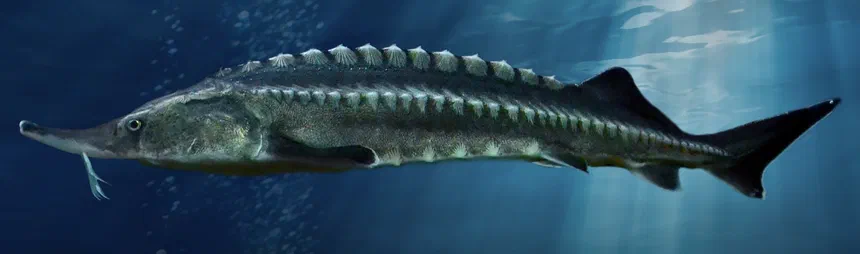
Image: Максим Яковлєв — CC BY-SA 4.0 · source
What Is a Beluga Sturgeon?
The beluga sturgeon (Huso huso) is a giant, slow-growing fish native to the Caspian and Black Sea regions of Eurasia. It is one of the largest freshwater-associated fish in the world and is famous as the source of the prized “beluga” caviar. Despite its name, it is unrelated to the beluga whale.
Appearance and Identification
The beluga sturgeon has a long, torpedo-shaped body with a distinctly upturned snout that is shorter and broader than in many other sturgeons. Instead of true scales, it bears five rows of bony plates called scutes running along its body, which are relatively small and less pronounced than in some relatives. Coloration ranges from slate-gray or greenish on the back to a pale, whitish underside. A large crescent-shaped mouth sits beneath the snout, preceded by four sensory barbels that help it locate food along the bottom. Mature individuals typically reach 2 to 4 meters, though historical records describe extraordinary fish exceeding 5 meters and weights well over 1,000 kilograms.
Habitat and Range
This species is anadromous, meaning it spends much of its adult life in the brackish and marine waters of the Caspian and Black Seas (and formerly the Adriatic and Azov Seas) before migrating up large rivers to spawn. Key spawning rivers historically included the Volga, Ural, Danube, and Don. Adults favor deep river channels and open coastal waters, while juveniles use lower river stretches and estuaries. Dam construction has blocked many traditional migration routes, drastically reducing available spawning habitat.
Diet
The beluga sturgeon is a powerful carnivore, and unlike most sturgeons that feed mainly on bottom invertebrates, adults are largely piscivorous. They prey on fish such as herring, carp, gobies, and other sturgeons, and will also consume mollusks, crustaceans, and occasionally waterfowl. Young fish begin by feeding on invertebrates and small prey before transitioning to a fish-dominated diet as they grow.
Behavior
These sturgeons are generally solitary, roaming wide areas of sea and river in search of prey. They are strong, long-distance swimmers and undertake seasonal migrations tied to spawning. Like other sturgeons, they rely heavily on their barbels and electroreceptive senses to detect prey in murky or deep water rather than on sharp eyesight. Adults spend most of the year in open water, congregating only during breeding runs.
Life Cycle and Reproduction
The beluga sturgeon is exceptionally long-lived and slow to mature, with females often not breeding until they are around 15 to 20 years old or older. Spawning occurs in spring when adults migrate upriver to fast-flowing stretches with gravel or rocky bottoms. Females release enormous numbers of eggs, potentially hundreds of thousands to millions in a single season, which are fertilized externally. After spawning, adults return to the sea, and the hatched larvae drift and grow before making their own way downstream. Individuals can live for many decades, with some estimated at over a century old.
Conservation Status
The beluga sturgeon is listed as Critically Endangered by the IUCN. Intense overfishing, driven largely by demand for its caviar, combined with dam construction that blocks spawning migrations, water pollution, and habitat loss, has caused catastrophic population declines. International trade is tightly regulated under CITES, and hatchery restocking programs and fishing bans have been implemented in several range countries, but wild reproduction remains severely limited and recovery is slow.
Frequently Asked Questions
Why is beluga sturgeon so valuable? Its roe is processed into beluga caviar, one of the most expensive foods in the world, which historically fueled heavy and often illegal fishing.
How big can a beluga sturgeon get? Most mature fish are 2 to 4 meters, but historical accounts describe rare giants over 5 meters and more than 1,000 kilograms, making it among the largest bony fishes.
Is the beluga sturgeon related to the beluga whale? No. Despite sharing a name, the beluga sturgeon is a fish, while the beluga whale is a marine mammal; the shared name is a coincidence of language.
References
The conservation status and key facts in this profile are supported by these sources:
- Animal Diversity Web — Huso huso (Beluga) (accessed 2026-07-29)
- GBIF — Huso huso (Linnaeus, 1758) (accessed 2026-07-29)
Found an error, source problem, or image concern? Report this page.