Fish Guide
Basking Shark
What Is a Basking Shark? The basking shark (Cetorhinus maximus) is the second-largest living fish, surpassed in size only by the whale shark. Despite its enormous mouth and imposing bulk, it is a gentle filter feeder …
At a glance
What Is a Basking Shark?
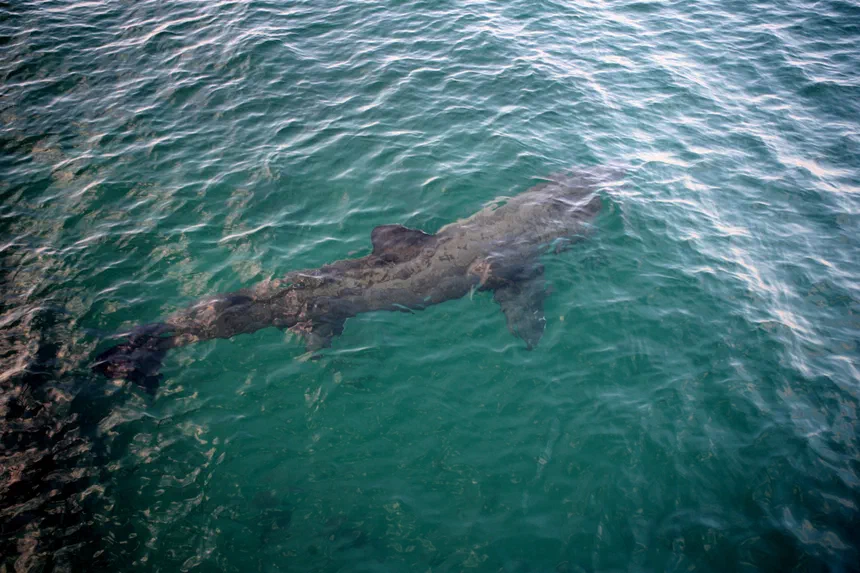
The basking shark (Cetorhinus maximus) is the second-largest living fish, surpassed in size only by the whale shark. Despite its enormous mouth and imposing bulk, it is a gentle filter feeder that strains tiny plankton from the water rather than hunting prey. Its common name comes from its habit of swimming slowly near the surface, appearing to bask in the sun.
Appearance and Identification
Basking sharks have a stout, torpedo-shaped body colored grayish-brown to slate gray on top, fading to a lighter shade underneath, often with mottled patches. The most striking feature is the huge, cavernous mouth, which can gape more than a meter wide when feeding. Long gill slits nearly encircle the head, and the gill arches carry bristle-like rakers used to trap plankton. The species has a prominent, sometimes floppy dorsal fin, a strongly forked crescent-shaped tail, and a pointed, conical snout that is especially pronounced in young animals. Adults commonly reach 6 to 8 meters in length, with exceptional individuals approaching 10 meters and weighing several tons.
Habitat and Range
This shark lives in temperate waters across both hemispheres, occurring in the North Atlantic, North Pacific, and cooler seas of the Southern Hemisphere. It frequents continental shelves and coastal zones, especially where currents and fronts concentrate plankton, but it also ranges into open ocean. Basking sharks are seasonal visitors to many coastlines, appearing near the surface in spring and summer when plankton blooms peak. In colder months they often move to deeper water, and satellite tracking has shown that some individuals undertake long migrations spanning thousands of kilometers.
Diet
The basking shark is a passive filter feeder that consumes zooplankton, including small crustaceans such as copepods, along with fish eggs and larvae. Rather than actively pumping water, it simply swims forward with its mouth open, letting seawater flow across its gill rakers, which sieve out food particles. A large individual can filter enormous volumes of water each hour. The rakers are periodically shed and regrown, and during seasons of low plankton the sharks may retreat to deeper waters where feeding conditions differ.
Behavior
Basking sharks are slow-moving and generally solitary, though they sometimes gather in loose groups where food is abundant, occasionally forming aggregations of dozens of animals. They are not aggressive toward people and pose no threat, feeding only on plankton. Observers have documented curious behaviors including breaching, in which these massive fish launch clear of the water, possibly to dislodge parasites or as part of social interaction. Their unhurried surface cruising, with dorsal fin and snout exposed, makes them a memorable sight for coastal watchers.
Life Cycle and Reproduction
Much about basking shark reproduction remains poorly understood because mating and birth are rarely observed. The species is ovoviviparous, meaning embryos develop inside the mother and are nourished by yolk before live young are born. Developing pups are thought to practice oophagy, feeding on unfertilized eggs within the uterus. Gestation is believed to last a long time, possibly a year or more, and litters are small. Basking sharks grow slowly and mature late, likely not reproducing until they are well over a decade old, traits that make populations slow to recover from decline.
Conservation Status
The basking shark is listed as Endangered on the IUCN Red List. Historically it was hunted heavily for its large, oil-rich liver, as well as for meat and fins, and its slow reproduction left populations unable to rebound quickly. Today it faces threats from accidental capture in fishing gear, collisions with vessels, and disturbance in busy coastal waters. The species is now protected in many countries and listed under international agreements that restrict trade, though continued monitoring is needed to safeguard its recovery.
Frequently Asked Questions
Is the basking shark dangerous to humans? No. Despite its size and gaping mouth, it feeds only on plankton and is harmless to people.
How big can a basking shark get? Most adults are 6 to 8 meters long, but the largest reliably recorded individuals approach 10 meters.
Why is it called a basking shark? The name refers to its habit of swimming slowly at the surface, where it appears to be basking in the sun while filter feeding.
References
The conservation status and key facts in this profile are supported by these sources:
- Animal Diversity Web — Cetorhinus maximus (basking shark) (accessed 2026-07-29)
- GBIF — Cetorhinus maximus (Gunnerus, 1765) (accessed 2026-07-29)
Found an error, source problem, or image concern? Report this page.