Fish Guide
Great Barracuda
What Is a Great Barracuda? The great barracuda (Sphyraena barracuda) is a large, fast-swimming predatory fish found in warm coastal waters around much of the world. It belongs to the family Sphyraenidae and is known for …
At a glance
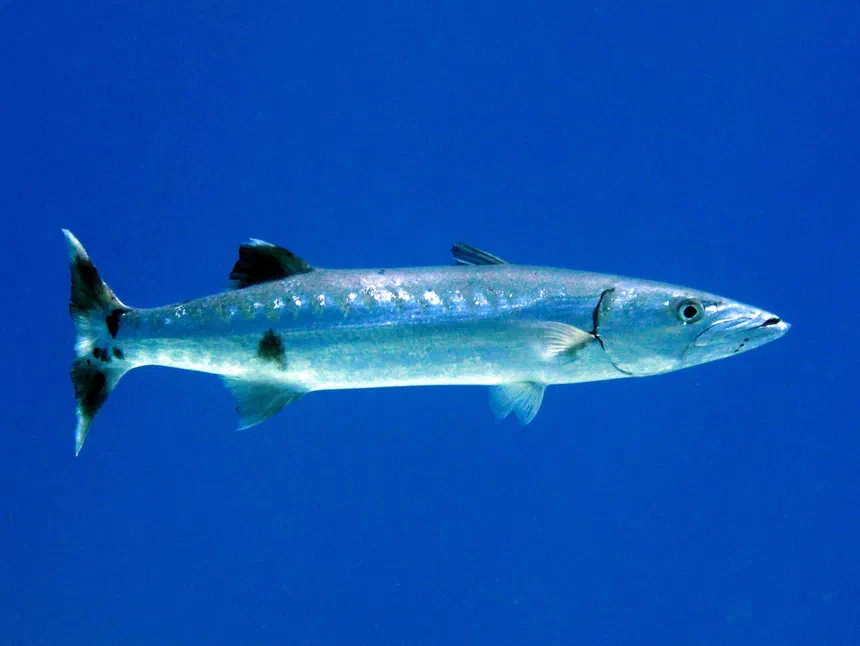
Image: Hectonichus — CC BY-SA 4.0 · source
What Is a Great Barracuda?
The great barracuda (Sphyraena barracuda) is a large, fast-swimming predatory fish found in warm coastal waters around much of the world. It belongs to the family Sphyraenidae and is known for its slender, torpedo-shaped body and fearsome set of teeth. Among the roughly two dozen barracuda species, it is the largest and most widely recognized.
Appearance and Identification
The great barracuda has an elongated, streamlined body built for bursts of speed. Its back is dark blue-gray to greenish, fading to silvery sides and a white belly, and scattered dark blotches often mark the lower flanks toward the tail. The head is long and pointed, with a protruding lower jaw that houses two rows of razor-sharp, unevenly sized teeth. Two well-separated dorsal fins, large eyes, and a deeply forked tail complete its distinctive profile. Adults commonly reach 60 to 100 centimeters, though exceptional individuals approach 1.5 meters.
Habitat and Range
This species occupies tropical and subtropical seas across the Atlantic, Indian, and western Pacific Oceans, and is notably absent only from the eastern Pacific. Juveniles shelter among mangroves, estuaries, and seagrass beds, where cover is plentiful, while adults range more widely across coral reefs, sandy flats, and the open water above and beyond the reef edge. Great barracuda are usually found from the surface down to depths of around 30 meters, but they may venture deeper.
Diet
The great barracuda is a carnivore and an ambush predator. It feeds primarily on smaller fishes, including jacks, groupers, snappers, mullets, and grunts, and will also take squid and shrimp. Relying on excellent eyesight, it hangs nearly motionless in the water before accelerating in a short, explosive rush to seize prey. Powerful jaws and shearing teeth allow it to slice larger victims in half, then return to consume the pieces.
Behavior
Adults are largely solitary hunters, though juveniles and subadults often gather in loose schools for protection. Great barracuda are curious and are frequently drawn to shiny, flashing objects, which occasionally leads them to follow divers or strike at glinting lures and jewelry. Despite a reputation for aggression, unprovoked attacks on humans are rare and usually the result of mistaken identity in murky water. The fish tends to hold a fixed position in the current, watching its surroundings with a characteristic open-mouthed, toothy stare.
Life Cycle and Reproduction
Great barracuda spawn in open water, generally during spring and summer in warmer regions. Females release large numbers of eggs that are fertilized externally and drift as plankton near the surface. After hatching, the tiny larvae settle into sheltered seagrass and estuarine habitats, where the young grow quickly before moving out to the reefs as they mature. Individuals typically reach sexual maturity within a few years and may live around 10 to 14 years in the wild.
Conservation Status
The great barracuda is listed as Least Concern by the IUCN, reflecting its broad distribution and generally stable populations. It is not a major target of commercial fisheries but is caught by recreational and subsistence anglers throughout its range. One notable concern for people is ciguatera: because large barracuda accumulate toxins from the reef fish they eat, eating big individuals carries a risk of ciguatera poisoning, and many regions advise against consuming them.
Frequently Asked Questions
Are great barracuda dangerous to humans? They look intimidating but rarely bite people. The few recorded incidents usually involve murky water or a shiny object mistaken for prey, so divers are advised not to wear flashy jewelry.
How fast can a barracuda swim? Great barracuda are capable of short, explosive bursts estimated at roughly 40 kilometers per hour, which they use to ambush prey.
Can you eat great barracuda? Small ones are eaten in some areas, but large individuals can carry ciguatera toxins, so eating big barracuda is discouraged in many regions.
References
The conservation status and key facts in this profile are supported by these sources:
- Animal Diversity Web — Sphyraena barracuda (great barracuda) (accessed 2026-07-29)
- GBIF — Sphyraena barracuda (Edwards, 1771) (accessed 2026-07-29)
Found an error, source problem, or image concern? Report this page.