Fish Guide
Atlantic Salmon
What Is a Atlantic Salmon? The Atlantic salmon (Salmo salar) is a large, migratory ray-finned fish native to the cold waters of the North Atlantic. It is famous for its remarkable life cycle, in which adults leave the …
At a glance
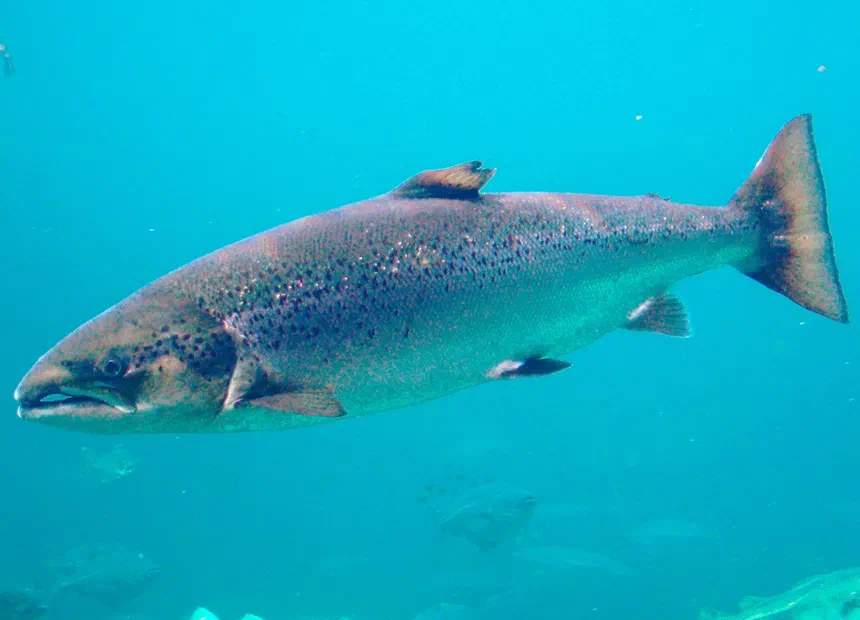
Image: Hans-Petter Fjeld — CC BY-SA 2.5 · source
What Is a Atlantic Salmon?
The Atlantic salmon (Salmo salar) is a large, migratory ray-finned fish native to the cold waters of the North Atlantic. It is famous for its remarkable life cycle, in which adults leave the ocean and travel far up rivers to spawn in the same freshwater streams where they hatched. The species is both an ecologically important predator and one of the world’s most economically valued fish.
Appearance and Identification
Adult Atlantic salmon have a streamlined, torpedo-shaped body built for powerful swimming. At sea they are bright silver along the sides with a dark blue-green back and a paler belly, and they carry scattered black spots above the lateral line, often shaped like small crosses or X marks. As they return to freshwater to breed, their coloring darkens, and mature males develop a hooked lower jaw called a kype. Most adults measure roughly 28 to 30 inches (70 to 76 cm), though exceptional individuals approach 5 feet (1.5 m) and can weigh well over 30 pounds (13.6 kg).
Habitat and Range
Atlantic salmon occupy two very different worlds during their lives. They spawn and spend their early years in clean, cool, well-oxygenated rivers and streams, then migrate to the open North Atlantic Ocean to feed and grow. Their range spans both sides of the Atlantic, from the rivers of eastern North America to those of Iceland, the British Isles, Scandinavia, and continental Europe, with important ocean feeding grounds near Greenland and the Norwegian Sea. Healthy spawning habitat requires clean gravel beds and unobstructed river flow.
Diet
Atlantic salmon are carnivores whose diet shifts with age and habitat. Young fish in rivers feed mainly on aquatic insect larvae, small crustaceans, and other invertebrates. Once at sea, they become active predators, hunting small schooling fish such as herring, capelin, and sand lance, along with shrimp and other crustaceans. This rich marine diet fuels the rapid growth that allows them to reach large sizes before returning to spawn. Notably, adults generally stop feeding once they enter freshwater to breed.
Behavior
These fish are strong, agile swimmers capable of covering vast distances during their ocean migrations. They are best known for their leaping ability, launching themselves up waterfalls and rapids as they push upstream toward spawning grounds. Atlantic salmon use a combination of ocean currents, the Earth’s magnetic field, and their acute sense of smell to navigate home to their natal rivers. Outside of the breeding migration, they tend to be solitary while feeding at sea rather than forming tight schools as adults.
Life Cycle and Reproduction
The Atlantic salmon life cycle passes through several distinct stages. Females excavate a nest in river gravel called a redd, where they deposit thousands of eggs that males fertilize. The eggs hatch into alevins that live off their yolk sacs, then develop into fry and later parr, which remain in the river for one to several years. When ready for the sea, they transform into silvery smolts and migrate downstream to the ocean. After feeding and growing for one to several years at sea, mature adults return to freshwater to spawn. Unlike Pacific salmon, Atlantic salmon do not always die after spawning; some survive, return to the ocean, and breed again.
Conservation Status
The IUCN lists the Atlantic salmon overall as Least Concern, but this label hides serious regional declines. Many wild populations, especially in parts of North America and southern Europe, have fallen sharply or disappeared due to dam construction that blocks migration, habitat degradation, pollution, overfishing, and climate-driven changes in ocean conditions. Concerns about interbreeding and disease from escaped farmed salmon add further pressure. Conservation efforts include dam removal, habitat restoration, fishing regulation, and careful management of aquaculture.
Frequently Asked Questions
Do Atlantic salmon die after spawning? Not always. Unlike Pacific salmon species, a portion of Atlantic salmon survive spawning and may return to the sea to breed again in a later year.
Where do Atlantic salmon live? They divide their lives between cold rivers, where they hatch and spawn, and the open North Atlantic Ocean, where they feed and grow to adult size.
What do Atlantic salmon eat? Young fish eat insects and small invertebrates in rivers, while adults at sea prey on small fish like herring and capelin along with crustaceans.
References
The conservation status and key facts in this profile are supported by these sources:
- Animal Diversity Web — Salmo salar (Atlantic salmon) (accessed 2026-07-29)
- GBIF — Salmo salar Linnaeus, 1758 (accessed 2026-07-29)
Found an error, source problem, or image concern? Report this page.