Fish Guide
Atlantic Cod
What Is a Atlantic Cod? The Atlantic cod (Gadus morhua) is a large, bottom-dwelling fish of the cold and temperate waters of the North Atlantic. It belongs to the family Gadidae and has long been one of the most …
At a glance
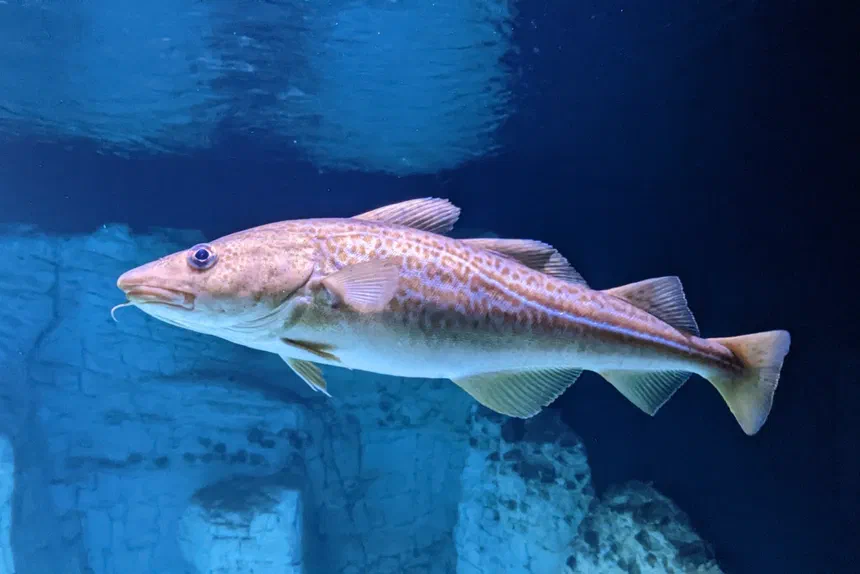
Image: Wilhelm Thomas Fiege — CC BY-SA 4.0 · source
What Is a Atlantic Cod?
The Atlantic cod (Gadus morhua) is a large, bottom-dwelling fish of the cold and temperate waters of the North Atlantic. It belongs to the family Gadidae and has long been one of the most economically important food fishes in the world. Prized for its mild white flesh, the species has shaped the history of fishing communities on both sides of the ocean.
Appearance and Identification
Atlantic cod have a heavy, elongated body that tapers toward a broad, squared tail. Their coloration is variable, ranging from olive-brown to greenish-gray, often with dense darker speckles across the back and sides, fading to a pale or whitish belly. A prominent pale lateral line curves along each flank, and a single fleshy barbel hangs from the lower jaw, an adaptation for sensing prey. The species carries three rounded dorsal fins and two anal fins, a hallmark of the cod family. Individuals living over different backgrounds, such as kelp beds versus open sand, can appear noticeably lighter or darker.
Habitat and Range
The Atlantic cod occupies both the western and eastern North Atlantic. In the west it ranges from around Greenland and the Labrador coast south to Cape Hatteras, while in the east it is found from the Barents Sea and around Iceland down to the Bay of Biscay, including the Baltic and North seas. Cod generally favor cool water and are most abundant over continental shelves and banks, frequently near the seabed at depths from the shallows to several hundred meters. Many populations undertake seasonal migrations between feeding and spawning grounds.
Diet
Atlantic cod are opportunistic carnivores with a broad appetite. Younger fish feed heavily on small crustaceans such as copepods, amphipods, and shrimp, while larger adults take a wide variety of prey including herring, capelin, sand eels, and other smaller fish, as well as crabs, mollusks, and marine worms. Cod are known to be somewhat cannibalistic, occasionally eating smaller members of their own species. Their barbel and keen senses help them locate food along the bottom.
Behavior
Cod are typically found in loose aggregations or schools, particularly during feeding and spawning seasons. They are relatively active swimmers that move between depths and locations in response to temperature, light, and the distribution of prey. Feeding often intensifies at dawn and dusk. Sound also plays a role in cod life; males can produce drumming or grunting noises using muscles associated with the swim bladder, which appear to be important during courtship.
Life Cycle and Reproduction
Atlantic cod are highly prolific spawners. During the spawning season, which varies by region but often peaks in late winter and spring, females release enormous numbers of eggs into the water column, with large individuals capable of producing several million eggs in a single season. The eggs are fertilized externally and drift as plankton near the surface. After hatching, the tiny larvae feed on plankton and gradually develop, eventually settling toward the bottom as juveniles. Growth is steady, and cod may take several years to reach maturity, with the exact age depending on population and environmental conditions.
Conservation Status
The Atlantic cod is listed by the IUCN as Vulnerable. Decades of intensive commercial fishing, most famously the collapse of stocks off Newfoundland in the early 1990s, sharply reduced many populations and in some cases they have been slow to recover. Management measures such as catch quotas, gear restrictions, and protected spawning periods have been introduced across its range, and some stocks have rebuilt while others remain depleted. The species remains a focus of ongoing fisheries science and conservation effort.
Frequently Asked Questions
How big can an Atlantic cod get? Most fish caught today are well under a meter, but the species can historically reach lengths beyond 1.8 meters and weights of several tens of kilograms.
Why did Atlantic cod populations collapse? Overfishing, aided by increasingly efficient fishing technology, drove several major stocks to very low levels, most dramatically off eastern Canada in 1992.
What do Atlantic cod eat? They are carnivores that feed on smaller fish, crustaceans, mollusks, and worms, with their diet shifting toward larger prey as they grow.
References
The conservation status and key facts in this profile are supported by these sources:
- Animal Diversity Web — Gadus morhua (Atlantic cod) (accessed 2026-07-29)
- GBIF — Gadus morhua Linnaeus, 1758 (accessed 2026-07-29)
Found an error, source problem, or image concern? Report this page.