Fish Guide
Atlantic Bluefin Tuna
What Is a Atlantic Bluefin Tuna? The Atlantic bluefin tuna (Thunnus thynnus) is one of the largest and fastest bony fishes in the ocean, a powerful predator built for long-distance migration. Prized by anglers and …
At a glance
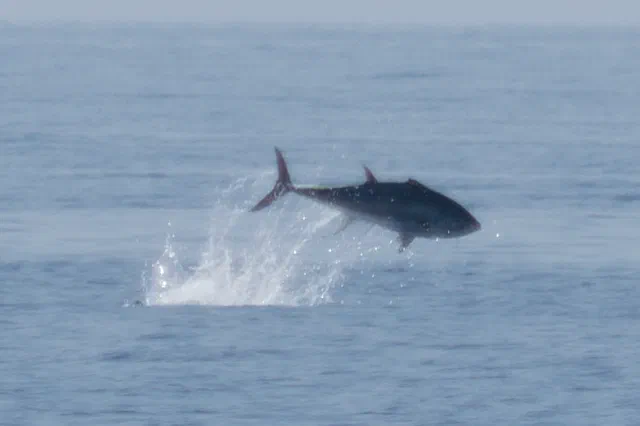
What Is a Atlantic Bluefin Tuna?
The Atlantic bluefin tuna (Thunnus thynnus) is one of the largest and fastest bony fishes in the ocean, a powerful predator built for long-distance migration. Prized by anglers and commercial fisheries alike, it is a warm-blooded relative of mackerels that ranges across the North Atlantic and into the Mediterranean Sea.
Appearance and Identification
Atlantic bluefin tuna have a robust, torpedo-shaped body designed to reduce drag at high speed. The back is a deep metallic blue to blackish, fading to silvery-white on the belly, often with faint spots or bands on the lower flanks. A series of small yellow finlets runs along the top and bottom of the body toward the tail, and the crescent-shaped caudal fin provides tremendous propulsion. Adults commonly reach 6.5 to 8 feet (2 to 2.5 meters) in length, though exceptional individuals surpass 10 feet (3 meters) and weigh well over 1,000 pounds (450 kilograms), making this the largest of the tuna species.
Habitat and Range
This species inhabits the open ocean of the North Atlantic, from subtropical to cool temperate waters, and enters the Mediterranean Sea to spawn. Bluefin tuna are highly migratory, crossing entire ocean basins between feeding grounds and breeding areas. They tolerate a wide range of water temperatures thanks to a specialized circulatory system, allowing them to forage in cold, productive northern waters and still function efficiently.
Diet
Atlantic bluefin tuna are opportunistic carnivores. Younger fish feed heavily on small schooling fish such as anchovies, sardines, and herring, along with crustaceans and squid. Larger adults take bigger prey, including mackerel and other mid-water fishes. Their speed and endurance let them run down fast-swimming schools, and they often hunt cooperatively, driving prey toward the surface.
Behavior
Bluefin tuna are among the most athletic of all fishes. They possess a form of warm-bloodedness called regional endothermy, retaining muscle-generated heat to keep their bodies warmer than the surrounding water. This adaptation boosts swimming power, digestion, and vision, and lets them exploit a broad range of ocean temperatures. They swim continuously to force oxygen-rich water over their gills and can reach bursts of speed exceeding 40 miles per hour (65 kilometers per hour). Schools often travel and feed together, especially when younger.
Life Cycle and Reproduction
Atlantic bluefin tuna are slow to mature, generally not reaching breeding age until around 4 to 8 years or older, depending on the population. Spawning takes place in warm waters, chiefly the Mediterranean Sea and the Gulf of Mexico, where females release enormous numbers of eggs, sometimes millions per season. The eggs float near the surface and hatch within a couple of days. Larvae and juveniles grow rapidly, but survival is low, and only a tiny fraction reach adulthood. Long lifespans, in some cases approaching 40 years, help offset high early mortality.
Conservation Status
Atlantic bluefin tuna have historically faced intense fishing pressure, driven in large part by demand for high-grade sushi and sashimi. Decades of overfishing sharply reduced some populations, prompting strict international quotas and management measures. Following these efforts, stocks have shown signs of recovery, and the IUCN reassessed the species as Least Concern, an improvement from earlier, more threatened classifications. Continued careful management remains important, as the species grows slowly and matures late, making it vulnerable to renewed overharvest.
Frequently Asked Questions
How fast can an Atlantic bluefin tuna swim? In short bursts they can exceed 40 miles per hour (about 65 kilometers per hour), aided by their streamlined shape and powerful crescent-shaped tail.
Are Atlantic bluefin tuna warm-blooded? Partly. They use regional endothermy to keep certain muscles and organs warmer than the surrounding water, which improves their strength and lets them hunt in cold seas.
Why are they so valuable? Their rich, fatty flesh is highly prized in the sushi and sashimi market, where single large fish have sold for extraordinary prices, driving heavy fishing pressure.
References
The conservation status and key facts in this profile are supported by these sources:
- Animal Diversity Web — Thunnus thynnus (Atlantic bluefin tuna) (accessed 2026-07-29)
- GBIF — Thunnus thynnus (Linnaeus, 1758) (accessed 2026-07-29)
Found an error, source problem, or image concern? Report this page.