Fish Guide
Silver Arowana
What Is a Silver Arowana? The silver arowana (Osteoglossum bicirrhosum) is a large, elongated freshwater fish native to the river systems of tropical South America. A member of the “bonytongue” family Osteoglossidae, it …
At a glance
What Is a Silver Arowana?
The silver arowana (Osteoglossum bicirrhosum) is a large, elongated freshwater fish native to the river systems of tropical South America. A member of the “bonytongue” family Osteoglossidae, it is an ancient lineage of ray-finned fishes and is prized by aquarists for its sleek, ribbon-like body and dramatic surface-hunting behavior.
Appearance and Identification
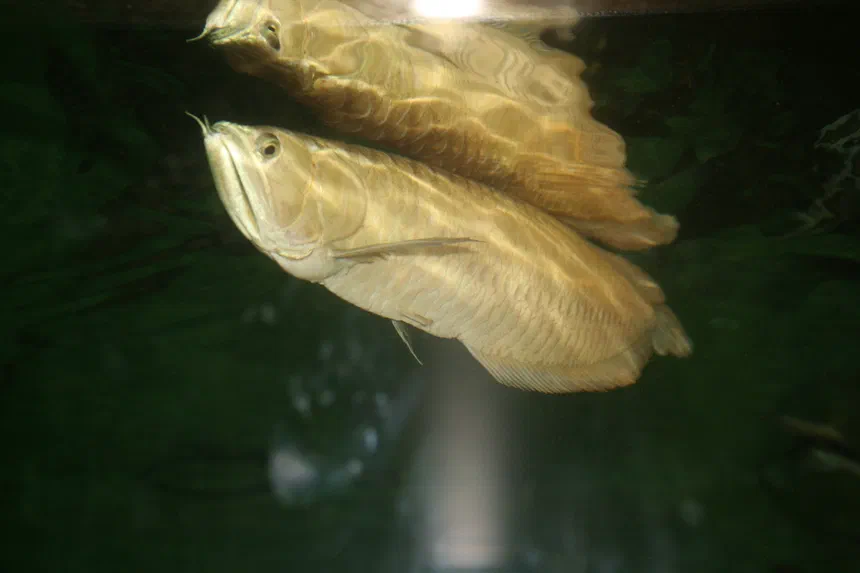
The silver arowana has a long, laterally compressed body covered in large, metallic silver scales that can flash pink, blue, or gold under changing light. Its most distinctive features are the sweeping dorsal and anal fins that run far back toward the tail, giving the fish an almost eel-like profile as it glides. The mouth is large and steeply upturned, set at the very front of a tapered head, and a pair of short barbels projects from the tip of the lower jaw. These barbels help the fish sense prey and disturbances at the water’s surface. Adults typically reach about 2.5 to 3 feet (75 to 90 cm) in length, with some individuals growing larger under ideal conditions.
Habitat and Range
This species inhabits the warm, slow-moving freshwaters of the Amazon Basin and the Rupununi and Oyapock drainages of northern South America. It favors quiet backwaters, oxbow lakes, and the seasonally flooded forests known as várzea and igapó. During the wet season, arowanas move into inundated woodland to feed among submerged branches and vegetation, retreating to deeper river channels and lagoons as the waters recede. They tolerate the soft, often oxygen-poor waters typical of these habitats.
Diet
The silver arowana is a highly effective surface predator, and its upturned mouth is perfectly suited to seizing prey from the water’s surface or just above it. Its diet is dominated by insects, spiders, small fish, and crustaceans, but it will readily take almost any animal it can overpower. The fish is famous for its ability to leap clear of the water to snatch beetles, insects, and even small perched creatures from overhanging branches, a behavior that has earned it the nickname “water monkey” in parts of its range.
Behavior
Arowanas are strong, deliberate swimmers that patrol the upper layers of the water column, where their keen eyesight and sensitive barbels help them detect movement. They are generally solitary and can be territorial toward other fish of their kind. Their signature leaping ability allows them to capture aerial prey and, at times, to escape enclosures or predators. Despite their size and predatory nature, they can be wary and easily startled, retreating quickly when threatened.
Life Cycle and Reproduction
Silver arowanas are mouthbrooders, an unusual and devoted form of parental care. Spawning tends to coincide with the flood season, when food is abundant. After the eggs are fertilized, the male gathers them into his mouth and carries them there through incubation. The young remain sheltered in the parent’s mouth even after hatching, nourished at first by their large yolk sacs, and continue to seek refuge there until they are large enough to venture out and feed on their own. This strategy produces relatively few but well-protected offspring.
Conservation Status
The silver arowana has not been formally assessed on the IUCN Red List, and it remains widespread across much of its native range. It is important to local subsistence and commercial fisheries, and juveniles are collected in large numbers for the international aquarium trade. While the species is not currently considered threatened, heavy harvesting of young fish and ongoing habitat changes in the Amazon are worth watching. Sustainable collection and habitat protection help ensure healthy wild populations.
Frequently Asked Questions
Why is the silver arowana called the “water monkey”? The nickname comes from its remarkable ability to leap out of the water to catch insects and other small prey from overhanging branches, a feat that looks strikingly agile for a fish.
How large do silver arowanas get? Adults commonly reach about 2.5 to 3 feet (75 to 90 cm) in length, making them one of the larger freshwater fish kept by hobbyists and a demanding species to house properly.
How do silver arowanas care for their young? They are mouthbrooders: the male carries the fertilized eggs and newly hatched fry inside his mouth, protecting them until the young are developed enough to swim and feed independently.
References
The conservation status and key facts in this profile are supported by these sources:
- Animal Diversity Web — Osteoglossum bicirrhosum (accessed 2026-07-29)
- GBIF — Osteoglossum bicirrhosum (Cuvier, 1829) (accessed 2026-07-29)
Found an error, source problem, or image concern? Report this page.