Fish Guide
Archerfish
What Is a Archerfish? The archerfish is a small, sharp-eyed predator famous for shooting jets of water at prey perched above the surface. The banded archerfish, Toxotes jaculatrix, is the best known member of the family …
At a glance
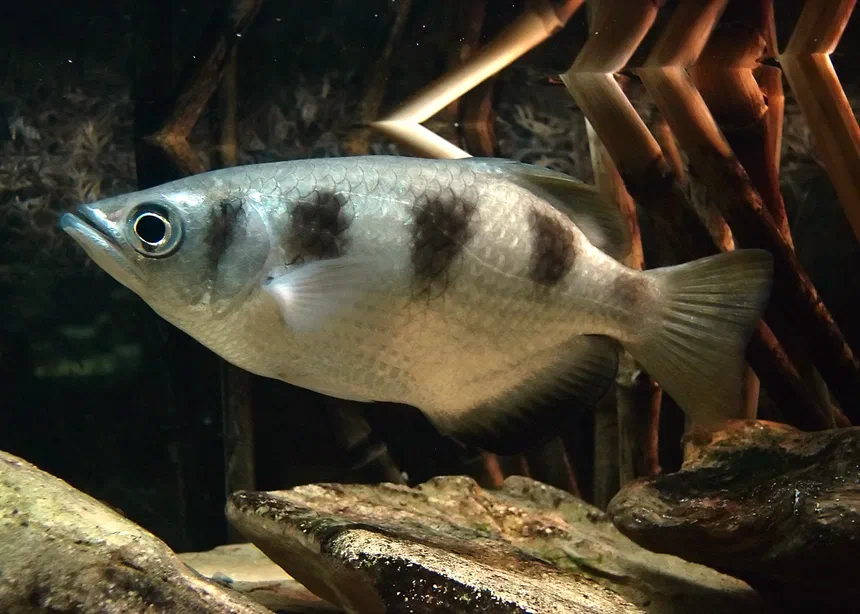
Image: Chrumps — CC BY-SA 3.0 · source
What Is a Archerfish?
The archerfish is a small, sharp-eyed predator famous for shooting jets of water at prey perched above the surface. The banded archerfish, Toxotes jaculatrix, is the best known member of the family Toxotidae and lives in the brackish waters of the Indo-Pacific. Its unusual hunting method has made it a favorite subject of scientific study.
Appearance and Identification
Archerfish have a deep, laterally compressed body that tapers to a pointed snout with a large, upward-tilted mouth. The banded archerfish is silvery to pale gold with four to six dark vertical bars or wedge-shaped blotches along its upper flanks, and its eyes are notably large, set well forward on the head. The dorsal fin is positioned far back near the tail, giving the fish a wedge-like profile that lets it hang just beneath the surface. Most adults reach about 15 to 20 centimeters, though exceptional individuals approach 30 centimeters.
Habitat and Range
This species occupies a wide swath of the tropical Indo-Pacific, from coastal India eastward through Southeast Asia to the Philippines, Indonesia, and northern Australia. It favors mangrove forests, river mouths, estuaries, and brackish lagoons where overhanging vegetation supplies a steady rain of insects. Archerfish tolerate a range of salinities and move between fresh, brackish, and marine water, but they are most abundant in the tangled root zones of mangroves.
Diet
Archerfish are primarily insectivores that take beetles, flies, ants, spiders, and other small invertebrates, along with the occasional small fish or floating scrap. Their signature technique is spitting: by pressing the tongue against a groove in the roof of the mouth and snapping the gill covers shut, the fish fires a focused stream of water that knocks land-based prey into the water. They compensate for the way light bends at the surface, aiming accurately at targets that appear displaced from their true position. Effective shots typically reach one to two meters, and the fish will also leap clear of the water to grab prey within range.
Behavior
These fish are alert, social, and often found in loose groups near the surface. Hunting in a group has advantages and drawbacks: a downed insect is up for grabs, so archerfish jockey for position and race to reach fallen prey first. Young fish appear to learn and refine their aim through practice and by observing others, and experienced individuals become strikingly accurate. When not hunting, they patrol shaded margins and shelter among submerged roots and branches.
Life Cycle and Reproduction
Details of wild breeding are not fully documented, but archerfish are egg scatterers that spawn in open or brackish water, often near the surface. A female can release hundreds to thousands of buoyant eggs in a single event, and the parents provide no care afterward. The tiny larvae drift and feed on plankton before developing the body form and the spitting ability of adults. Growth is relatively quick in warm water, and fish reach breeding size within a couple of years.
Conservation Status
The banded archerfish has not been formally assessed by the IUCN, and it remains widespread and reasonably common across its large range. It is collected for the aquarium trade and taken locally for food, but no major population decline has been reported. The chief long-term concern is the loss and degradation of mangrove and estuarine habitats, which are vital nurseries for this and many other coastal species.
Frequently Asked Questions
How does an archerfish shoot water? It forms a narrow channel with its tongue and mouth roof, then squeezes water through it by closing the gill covers, producing a jet powerful enough to dislodge insects from leaves and stems above the water.
Can archerfish really account for light bending? Yes. They adjust their aim to correct for the refraction that makes above-water prey appear shifted from its real location, striking with impressive accuracy.
Are archerfish kept in aquariums? They are popular but demanding aquarium fish, needing brackish water, open space, and live or floating food to thrive.
References
The conservation status and key facts in this profile are supported by these sources:
- Animal Diversity Web — Toxotes jaculatrix (accessed 2026-07-29)
- GBIF — Toxotes jaculatrix (Pallas, 1767) (accessed 2026-07-29)
Found an error, source problem, or image concern? Report this page.