Fish Guide
Arapaima
What Is a Arapaima? The arapaima (Arapaima gigas) is one of the largest freshwater fish in the world, a torpedo-shaped giant native to the warm rivers and floodplains of tropical South America. It belongs to an ancient …
At a glance
What Is a Arapaima?
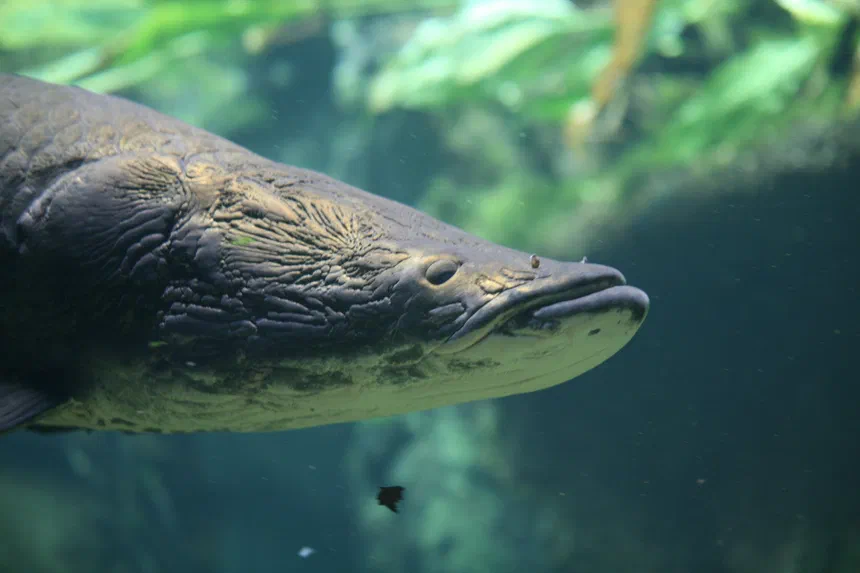
The arapaima (Arapaima gigas) is one of the largest freshwater fish in the world, a torpedo-shaped giant native to the warm rivers and floodplains of tropical South America. It belongs to an ancient lineage of air-breathing fish and is famous both for its size and for the way it must surface to gulp air.
Appearance and Identification
The arapaima has a long, streamlined body covered in large, hard scales that overlap like armor. The back is typically a dark olive-green that fades to silver along the flanks, while the rear third of the body and the fins often carry a striking reddish or coppery flush. The head is broad, bony, and somewhat flattened, with an upturned mouth suited to feeding near the surface. The dorsal and anal fins are set far back near the tail, giving the fish a powerful, paddle-like shape for short bursts of speed. Adults commonly reach 6 to 9 feet in length, with exceptional individuals approaching 10 feet, and can weigh well over 200 pounds.
Habitat and Range
Arapaima live in the Amazon River basin and adjacent drainages such as the Essequibo, across parts of Brazil, Peru, Guyana, and neighboring countries. They favor slow-moving, oxygen-poor waters: backwaters, floodplain lakes, and forests that flood seasonally when rivers rise. Because these habitats often become warm and low in dissolved oxygen, the arapaima’s ability to breathe air is a major advantage. The species has also been introduced, sometimes for aquaculture or sport fishing, to waters outside its native range in Southeast Asia.
Diet
The arapaima is a carnivore and an ambush-style predator. Its diet is dominated by fish, but it also takes crustaceans, insects, and other small aquatic animals, and larger individuals may seize prey at or near the water’s surface. It feeds by opening its large mouth rapidly to create suction, drawing prey inward. Even the tongue is specialized: it is bony and rough, and Indigenous peoples have long used the dried tongue as a natural rasp or scraping tool.
Behavior
One of the arapaima’s most distinctive traits is obligate air breathing. It has a modified, lung-like swim bladder lined with tissue that absorbs oxygen, so the fish must rise to the surface every 10 to 20 minutes to take a breath. This surfacing produces a characteristic gulping sound and a visible roll, which unfortunately also makes the fish easy for hunters to locate. Arapaima are generally solitary or loosely social and tend to move slowly, conserving energy in still, warm water until a burst of speed is needed to strike at prey.
Life Cycle and Reproduction
Arapaima reproduction is tied closely to the seasonal flood cycle. As waters begin to rise, adults build nests by clearing shallow depressions in sandy or muddy bottoms. After spawning, the parents guard the eggs and young with unusual devotion. The male in particular shelters the developing fry, and the young may cluster near his head; a specialized gland on the head is thought to release a substance that helps keep the school together. This parental care gives the offspring a better chance of surviving their vulnerable early weeks. Arapaima grow quickly, which is part of why they are valued in aquaculture.
Conservation Status
The arapaima is listed by the IUCN as Data Deficient, reflecting uncertainty about the number of species in the genus and a shortage of reliable population data. Even so, the fish’s habit of surfacing to breathe makes it highly vulnerable to overfishing, and many local populations have been depleted by harpoon and net fishing. In several regions, community-based management programs that set quotas and protect breeding fish have helped some populations recover, showing that careful regulation can allow both people and the species to benefit.
Frequently Asked Questions
How big can an arapaima get? Arapaima commonly reach 6 to 9 feet and can weigh more than 200 pounds, with rare individuals approaching 10 feet in length.
Why does the arapaima come to the surface so often? It is an obligate air breather. Its swim bladder works like a primitive lung, so the fish must surface every 10 to 20 minutes to gulp air, especially in warm, low-oxygen water.
Are arapaima endangered? The IUCN lists the species as Data Deficient, but many wild populations have declined from overfishing, and it is protected or managed in parts of its range.
References
The conservation status and key facts in this profile are supported by these sources:
- Animal Diversity Web — Arapaima gigas (accessed 2026-07-29)
- GBIF — Arapaima gigas (accessed 2026-07-29)
Found an error, source problem, or image concern? Report this page.