Fish Guide
Anglerfish
What Is a Anglerfish? The anglerfish Melanocetus johnsonii, often called the humpback anglerfish or black seadevil, is a deep-sea fish famous for the glowing lure that dangles above its enormous mouth. It belongs to the …
At a glance
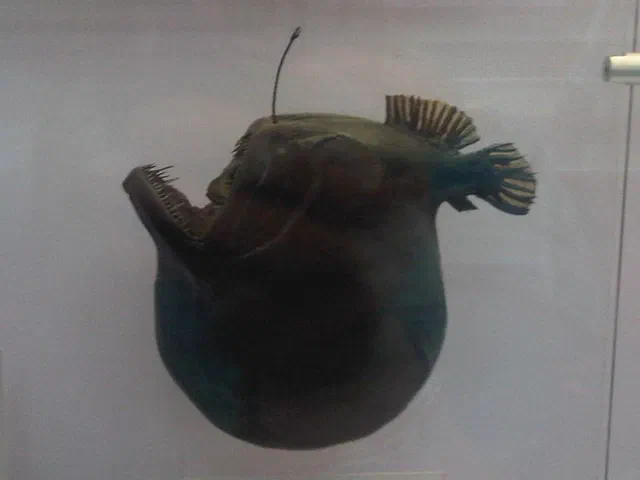
Image: Emőke Dénes — CC BY-SA 4.0 · source
What Is a Anglerfish?
The anglerfish Melanocetus johnsonii, often called the humpback anglerfish or black seadevil, is a deep-sea fish famous for the glowing lure that dangles above its enormous mouth. It belongs to the anglerfish order Lophiiformes, a group of predators named for the way they “fish” for prey. This species lives in the perpetual darkness of the open ocean far below the reach of sunlight.
Appearance and Identification
The female is the animal most people picture: a rounded, almost balloon-shaped body covered in soft, dark brown to black skin, a huge upturned mouth, and long, needle-like teeth that curve inward. Females typically reach around 15 to 18 centimeters, which is small for such a fearsome reputation. Rising from the forehead is a modified fin ray called the illicium, tipped with a light-producing organ, the esca. The glow comes from symbiotic bacteria housed inside this bulb. Males are astonishingly different, only a few centimeters long, with large eyes and no lure, built for one purpose: finding a mate.
Habitat and Range
This anglerfish inhabits the bathypelagic zone, the vast midwater layer roughly 1,000 to 4,000 meters deep where no sunlight penetrates. It drifts through the open water column rather than resting on the seafloor. The species is widely distributed, occurring in tropical and temperate waters of the Atlantic, Pacific, and Indian Oceans. Because this environment is cold, dark, and food-poor, the fish are thinly spread and rarely encountered.
Diet
Melanocetus is an ambush predator with a carnivorous diet of whatever it can catch, including small fish, shrimp and other crustaceans, and various soft-bodied deep-sea animals. Its expandable stomach and jaws allow it to swallow prey nearly as large as itself, an important advantage where meals are scarce and unpredictable. The glowing esca acts as a bait, drawing curious animals close enough to be engulfed in a single rapid gulp.
Behavior
Life in the deep sea rewards patience and energy conservation. The anglerfish hangs nearly motionless in the water, letting its luminous lure do the work of attracting prey. When something approaches, the fish opens its cavernous mouth and creates a sudden inrush of water that pulls the victim inside. Its dark, non-reflective skin helps it stay hidden even to eyes that can sense the faintest light. Rather than actively hunting over long distances, it relies on stealth and the trap of its glowing bait.
Life Cycle and Reproduction
Reproduction reflects the challenge of finding a partner in an enormous, empty ocean. The tiny male does not feed as an adult in the usual way; instead he searches for a female using well-developed eyes and a keen sense of smell tuned to her chemical cues. In this genus the male does not permanently fuse to the female as some other anglerfishes do, but he attaches temporarily to spawn. Females release eggs into the water, and the larvae develop near the surface before descending into the depths as they mature. Many details of the life cycle remain unknown because the animals are so difficult to study.
Conservation Status
The IUCN lists Melanocetus johnsonii as Least Concern. It has a broad global range and lives at depths largely beyond the reach of fisheries, so it faces few direct human pressures. Scientists caution, however, that deep-sea ecosystems are poorly understood and may be sensitive to long-term changes such as warming waters and shifts in food supply sinking from above.
Frequently Asked Questions
Why does the anglerfish glow? The glow is produced by bioluminescent bacteria living inside the lure on its head. The fish uses this light to attract prey in an environment where no sunlight reaches.
Are male and female anglerfish really so different? Yes. Females can be many times larger than males. The dwarf males lack a lure and are adapted mainly for locating a female to reproduce.
Is the anglerfish dangerous to people? No. It is a small deep-sea fish that lives far below where humans go, and it poses no threat to swimmers or divers.
References
The conservation status and key facts in this profile are supported by these sources:
- Animal Diversity Web — Melanocetus johnsonii (accessed 2026-08-06)
- GBIF — Melanocetus johnsonii (accessed 2026-08-06)
Found an error, source problem, or image concern? Report this page.