Fish Guide
Angelshark
What Is a Angelshark? The angelshark (Squatina squatina) is a large, flattened bottom-dwelling shark that looks more like a ray than a typical shark. It belongs to the family Squatinidae and spends most of its life …
At a glance
What Is a Angelshark?
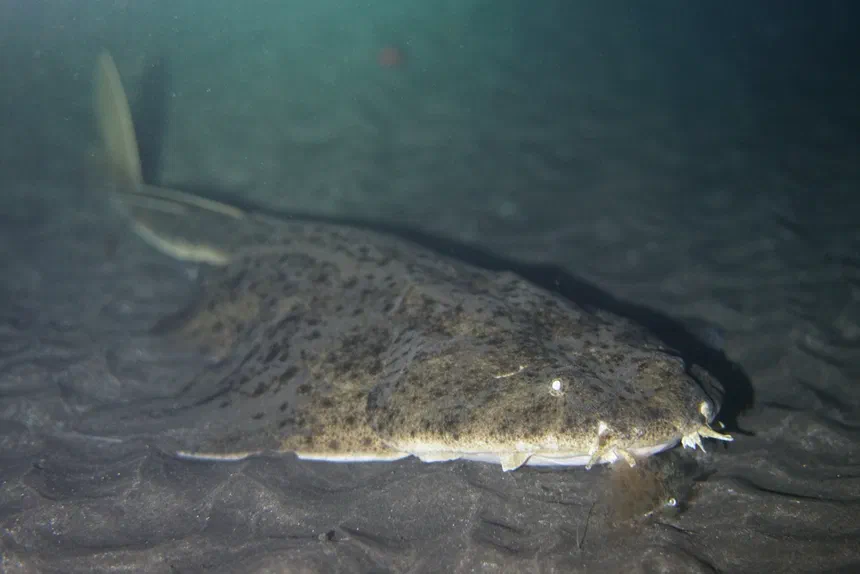
The angelshark (Squatina squatina) is a large, flattened bottom-dwelling shark that looks more like a ray than a typical shark. It belongs to the family Squatinidae and spends most of its life partly buried on the seafloor, ambushing prey that swims within reach.
Appearance and Identification
The angelshark has a broad, dorsoventrally flattened body with wide, wing-like pectoral fins that give it its angelic name. Its coloration is typically sandy brown to grayish, often marbled with darker blotches and scattered pale spots, which provides excellent camouflage against sandy or muddy bottoms. Unlike rays, its pectoral fins are not fused to the head, and it retains a shark-like tail with the lower lobe larger than the upper. The eyes sit on top of the head, and prominent spiracles just behind them draw in water for breathing while the animal lies buried. Large adults can reach lengths of about 1.8 to 2.4 meters, with females generally growing larger than males.
Habitat and Range
Angelsharks favor soft seabeds of sand, mud, or gravel where they can bury themselves and wait for prey. They occur mostly on the continental shelf, from shallow coastal waters down to depths of around 150 meters, though they are most common in relatively shallow zones. Historically the species ranged widely across the eastern Atlantic, from Scandinavia and the British Isles south to northwest Africa, and throughout the Mediterranean and Black Sea. Today its range has contracted sharply, and healthy populations persist mainly around the Canary Islands and a few scattered locations.
Diet
The angelshark is a patient ambush predator. It lies half-buried in the sediment, often flicking sand over its back for concealment, and waits for prey to pass overhead. When a target comes close, it lunges upward with a rapid strike, snapping its mouth open to engulf the victim. Its diet consists largely of bony fish such as flatfish, along with crustaceans, mollusks, cephalopods like squid and cuttlefish, and occasionally skates. Sharp, needle-like teeth help it grip slippery prey.
Behavior
Angelsharks are largely nocturnal and solitary, spending daylight hours motionless and buried in the seabed. They become more active at night, sometimes cruising short distances in search of feeding grounds. Because they rely on camouflage and ambush rather than pursuit, they are generally sluggish swimmers. They are not aggressive toward people, but a buried individual may bite defensively if stepped on or disturbed. Some populations undertake seasonal movements, shifting between deeper and shallower waters as temperatures change.
Life Cycle and Reproduction
Angelsharks are ovoviviparous, meaning the eggs develop and hatch inside the mother’s body, and she gives birth to live young. Litters typically number from around 7 to 25 pups, born after a gestation of roughly 8 to 10 months. Newborns measure about 24 to 30 centimeters long and are miniature versions of the adults, independent from birth. The species grows slowly and matures late, and females may reproduce only every other year. These traits, combined with a lifespan estimated at 25 to 35 years, make the angelshark especially slow to recover from population declines.
Conservation Status
The angelshark is listed as Critically Endangered on the IUCN Red List. Once common across European waters, it has suffered dramatic declines driven mainly by bottom trawling, which frequently captures the species as bycatch, and by habitat degradation in coastal zones. Its bottom-dwelling lifestyle makes it highly vulnerable to nets that sweep the seabed. The species is now regionally extinct or extremely rare across much of its former range. Conservation efforts, including protected areas around the Canary Islands and fishing restrictions in parts of Europe, aim to safeguard the remaining strongholds.
Frequently Asked Questions
Is the angelshark dangerous to humans? It is not considered dangerous and does not seek out people, but a buried individual can deliver a defensive bite if accidentally touched or stepped on.
Is an angelshark a shark or a ray? It is a true shark, despite its flattened, ray-like shape. Its gills open on the sides and its pectoral fins are not fused to its head, both features that distinguish it from rays.
Why is the angelshark endangered? Slow reproduction, late maturity, and heavy losses to bottom-trawl bycatch have caused steep population declines across most of its historic range.
References
The conservation status and key facts in this profile are supported by these sources:
- Animal Diversity Web — Squatina squatina (accessed 2026-08-06)
- GBIF — Squatina squatina (Linnaeus, 1758) (accessed 2026-08-06)
Found an error, source problem, or image concern? Report this page.