Fish Guide
Freshwater Angelfish
What Is a Freshwater Angelfish? The freshwater angelfish (Pterophyllum scalare) is a striking, disc-shaped cichlid native to the tropical rivers of South America. Despite its name, it is unrelated to the marine …
At a glance
What Is a Freshwater Angelfish?
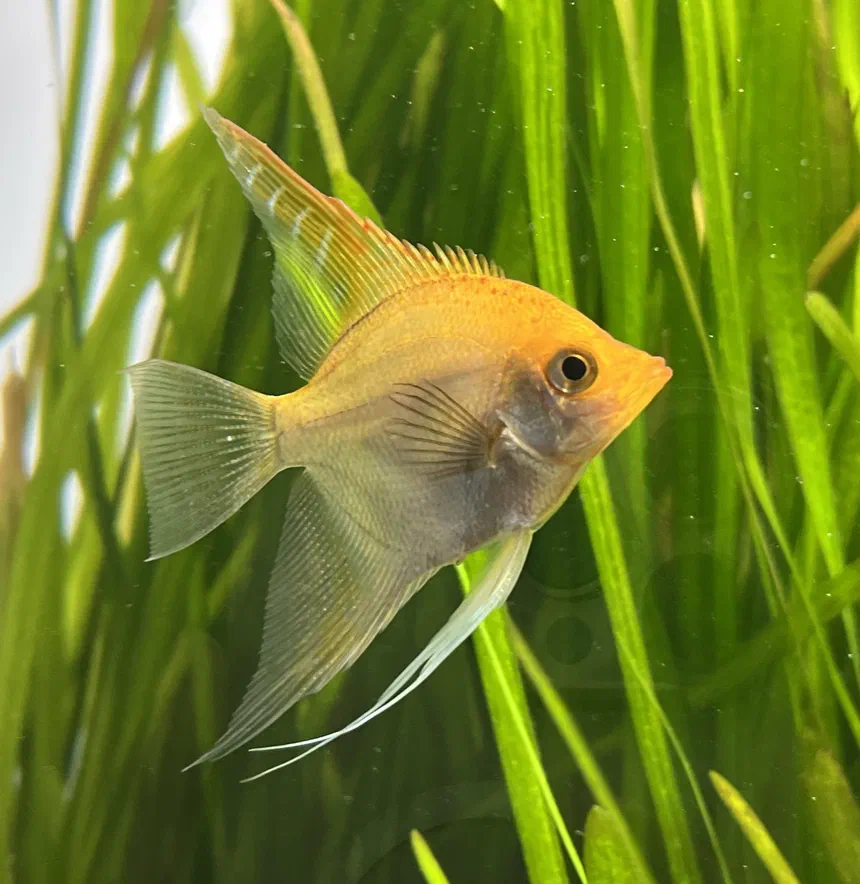
The freshwater angelfish (Pterophyllum scalare) is a striking, disc-shaped cichlid native to the tropical rivers of South America. Despite its name, it is unrelated to the marine angelfishes and belongs instead to the diverse family Cichlidae. Its distinctive body shape and graceful, trailing fins have made it one of the most popular and recognizable fish in the freshwater aquarium hobby.
Appearance and Identification
Angelfish have a laterally compressed, almost coin-shaped body that appears very tall and thin when viewed from the front. This flattened form is exaggerated by long, tapering dorsal and anal fins that give the fish a triangular silhouette, along with slender, whisker-like pelvic fins that trail beneath the body. Wild specimens are typically silver with several dark vertical bars that help break up their outline among aquatic plants. A wild adult usually reaches about 6 inches (15 cm) in length but can stand up to 8 inches (20 cm) tall from fin tip to fin tip. Generations of selective breeding have produced numerous captive color and fin varieties, including all-black, marble, gold, koi, and long-finned “veil” forms.
Habitat and Range
This species occurs across much of the Amazon River basin and its tributaries in countries such as Brazil, Peru, and Colombia. It favors slow-moving or still waters, including quiet backwaters, flooded forest margins, and densely vegetated stretches of river. The tall, narrow body and vertical striping are well suited to life among submerged roots, reeds, and plant stems, where the fish can slip between vegetation and remain camouflaged. Angelfish thrive in warm, soft, slightly acidic waters typical of these lowland tropical environments.
Diet
Freshwater angelfish are opportunistic omnivores that lean toward carnivory. In the wild they feed on small aquatic invertebrates, crustaceans, insect larvae, tiny fish, and some plant material and detritus. Their body shape allows slow, deliberate movement, and they tend to ambush or pick at prey rather than chase it over long distances. In aquariums they readily accept flake and pellet foods, along with live or frozen items such as brine shrimp, bloodworms, and daphnia.
Behavior
Angelfish are generally peaceful but can be territorial, particularly when breeding or competing for space. They often form loose groups when young and establish pairs as they mature. Communication and dominance are expressed through posturing, fin displays, and subtle changes in coloration. Although calm compared with many cichlids, adults may prey on very small tankmates and can squabble over favored resting or spawning sites. They are most active during daylight hours and tend to occupy the middle and upper levels of the water column.
Life Cycle and Reproduction
Angelfish are substrate-spawning cichlids that form monogamous pairs and show notable parental care. A breeding pair selects and meticulously cleans a flat vertical surface, such as a broad leaf, a stem, or a submerged branch, before the female deposits rows of adhesive eggs that the male then fertilizes. Both parents guard the clutch, fanning it with their fins to keep it oxygenated and free of debris, and they remove eggs that fail to develop. The eggs hatch within a few days, and the newly hatched larvae, called wrigglers, remain attached to the surface until they absorb their yolk sacs and become free-swimming fry. Parents may continue to shepherd and protect the young for some time afterward.
Conservation Status
The freshwater angelfish has not been formally assessed by the IUCN, and it is not considered globally threatened. It remains widespread across the Amazon basin, and the vast majority of angelfish in the aquarium trade are captive-bred rather than wild-caught, which reduces collection pressure on natural populations. As with many Amazonian species, however, habitat loss, deforestation, and water pollution pose potential long-term risks to local wild populations.
Frequently Asked Questions
Are freshwater angelfish related to marine angelfish? No. Despite the shared name and similar body shape, freshwater angelfish are cichlids from South America, while marine angelfish belong to an entirely separate family found in ocean reefs.
How big do freshwater angelfish get? A mature adult typically reaches around 6 inches (15 cm) in length and can measure up to about 8 inches (20 cm) tall when including the extended dorsal and anal fins.
Are angelfish good parents? Yes. Breeding pairs are attentive parents that clean the spawning site, guard and fan their eggs, and protect the newly hatched fry for a period after hatching.
References
The conservation status and key facts in this profile are supported by these sources:
- Animal Diversity Web — Pterophyllum scalare (accessed 2026-07-29)
- GBIF — Pterophyllum scalare (Schultze, 1823) (accessed 2026-07-29)
Found an error, source problem, or image concern? Report this page.