Cicada Life Cycle and Appearance Facts
Identification
What’s the big deal with cicadas?
In 2024, two different broods of periodical cicadas emerged at the same time for the first time in more than 220 years. Learn more about the double emergence with our Cicada Emergence Fact Sheet .
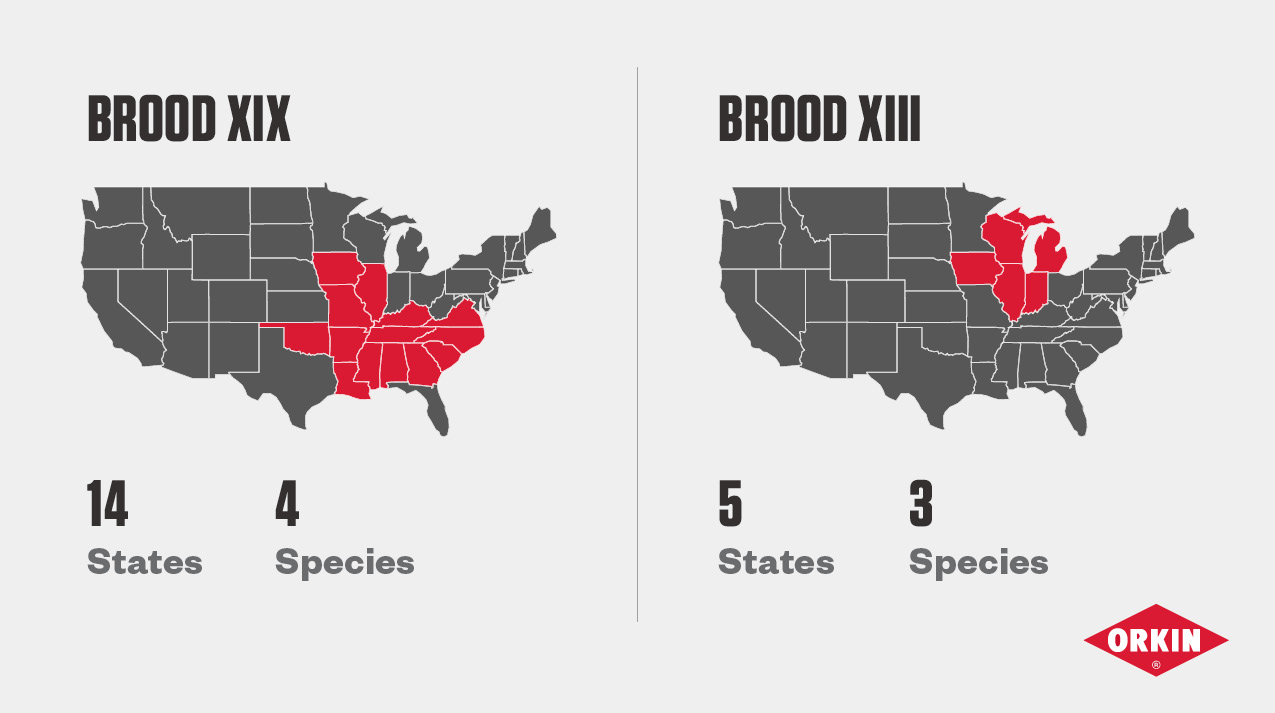
After 13 years underground, Brood XIX emerged across 14 states in the Southeast and Midwest and included four species of cicadas.
At the same time, the 17-year Brood XIII appeared in five Midwestern states, Michigan , Illinois , Wisconsin , Iowa , and Indiana , with three species making up this brood.
In 2025, another major emergence is underway as Brood XIV, a 17-year brood, begins to surface in parts of the eastern U.S. This brood is expected to be one of the largest of the year, with activity concentrated in states like Georgia , Kentucky , and Pennsylvania .
What does a cicada look like?
- Length : Adult cicadas vary in size depending upon the particular species but are generally about 2-3 inches long.
- Wings : They have large, clear wings with many easily seen wing veins. The cicada’s immature stage, called the nymph, is wingless.
- Eyes : Their eyes are large, reddish or black and set apart on each side of the head.
Cicada Life Cycle
- Eggs : The female adult cicada lays eggs on trees and shrubs by inserting the eggs into the small twigs at the outer end of branches. Eggs hatch in about 40-60 days and become nymphs.
- Nymphs : Nymphs drop to the ground, and burrow about 1-2 feet into the soil where they feed on the fluids in the small roots of the host plant. Mature nymphs emerge from the soil, climb onto surrounding trees or shrubs, and mature into adults.
- Adults : Adults live for about 14-50 days during which time they mate, lay eggs, and die. What is the difference between periodic and annual cicadas?
What is the difference between periodic and annual cicadas?
Periodic cicadas emerge from the ground in periodic cycles, often every 13 or 17 years depending on the species. These emergence events can occur in different regions.
Annual cicadas emerge on an annual basis, typically in May.
Double Cicada Brood 2024
In the spring of 2024, the United States experienced the rare emergence of Broods XIX (“Great Southern Brood”) and XIII (“Illinois Brood”), two distinct groups of periodical cicadas that surfaced after spending years underground. Brood XIX emerged after 13 years, while Brood XIII appeared after 17 years. Annual cicadas were also active during this time, emerging in waves lasting 4 to 6 weeks. More than a trillion cicadas filled the air with their signature buzzing, making for a loud spring and summer across much of the country. This double emergence happens only once every 221 years and isn’t expected again until 2245.
Brood XIV Cicadas
Brood XIV, a 17-year periodical cicada group, is expected to emerge in spring 2025 across parts of the eastern U.S. Their emergence begins in late April in southern regions like northern Georgia and progresses northward through May. States experiencing significant activity include Georgia , Tennessee , Kentucky , Ohio , Pennsylvania , and Massachusetts .
When do cicadas come out?
Cicadas typically emerge in late spring or early summer when the soil, about eight inches below the surface, reaches at least 64°F. A warm rain often triggers their emergence. Not all cicadas come out at once; some emerge later. This period will last for 4- 6 weeks continuously throughout the season .
Can cicadas harm humans or pets?
No, cicadas do not bite or sting. They are not aggressive towards humans or animals. Cicada killer wasps , however, can emerge to attack cicadas in the ground. When provoked, these wasps can sting humans.
Are there any watchouts with cicadas?
While cicadas are harmless to humans and pets, they have the potential to damage limbs of young trees, however, they typically recover quickly.
Additionally, when cicadas emerge, cicada killer wasps will prey on them. While not aggressive by nature, these wasps will sting if aggravated.
What should I do if I see them?
Cicadas may be loud and overwhelming, but they aren’t harmful to people, pets, or structures. Since they spend most of their lives underground and only emerge as adults for a brief 4 to 6 weeks, chemical treatments are not effective or necessary. If cicadas are becoming a nuisance around your home, focus on simple, non-chemical methods including:
- Remove them by hand – Picking adults and nymphs off plants by hand, if found in small enough numbers.
- Use a garden hose – Knocking cicadas off plants by spraying water with a garden hose.
- Wrap trees in foil and barrier tape – Wrapping tree trunks and large pushes with foil or sticky bands to catch cicadas trying to move up plants to feed or lay eggs.
- Contact a professional – Refer to a lawn and garden center for advice on protecting young or valuable plants.