Birds Guide
Sandhill Crane
What Is a Sandhill Crane? The sandhill crane (Antigone canadensis) is a tall, long-legged wading bird native to North America and parts of northeastern Siberia. Named for Nebraska’s Sandhills, where huge flocks gather …
At a glance
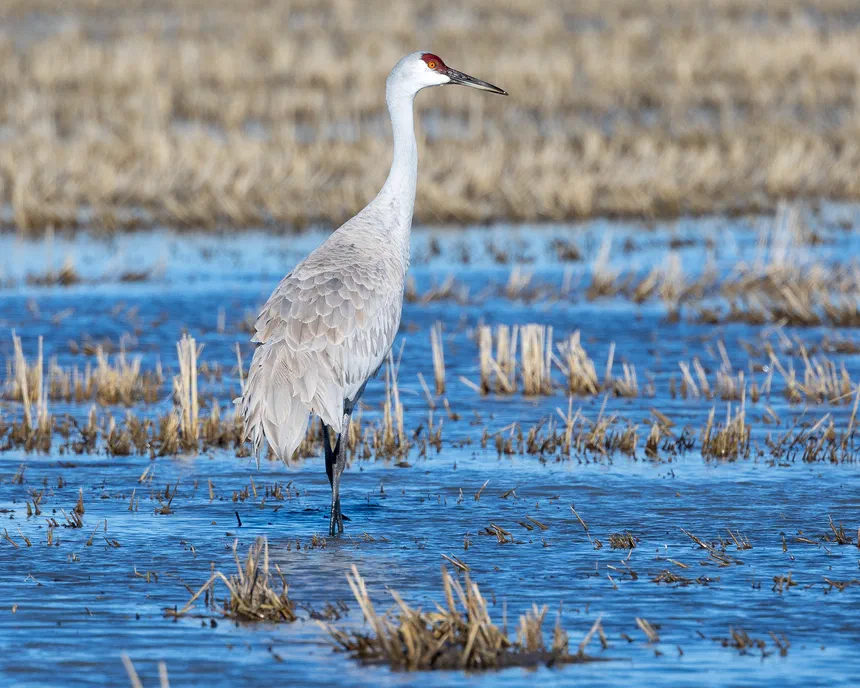
Image: Frank Schulenburg — CC BY-SA 4.0 · source
What Is a Sandhill Crane?
The sandhill crane (Antigone canadensis) is a tall, long-legged wading bird native to North America and parts of northeastern Siberia. Named for Nebraska’s Sandhills, where huge flocks gather each spring, it is one of the most abundant crane species in the world and is famous for its bugling calls and elaborate dancing displays.
Appearance and Identification
Sandhill cranes are large birds standing roughly 3 to 4 feet tall, with a wingspan that can reach 5 to 7 feet. Their plumage is predominantly slate gray, often stained rusty brown when birds preen with mud rich in iron oxides. A distinctive patch of bare red skin covers the crown and forehead, while the cheeks are pale white. They have a long straight bill, a slender neck, and long dark legs. In flight, cranes hold their necks fully extended, a useful feature that distinguishes them from herons, which fly with necks tucked. Males and females look alike, though males tend to be slightly larger.
Habitat and Range
These cranes favor open wetlands, freshwater marshes, wet meadows, and the edges of shallow ponds, but they also forage widely in grasslands and agricultural fields. Populations range from the Arctic tundra of Canada, Alaska, and Siberia south through the central and southern United States and into Mexico and Cuba. Some populations, such as those in Florida and Cuba, are non-migratory residents, while northern breeders undertake long seasonal migrations. Each spring, hundreds of thousands stage along Nebraska’s Platte River, one of North America’s great wildlife spectacles.
Diet
Sandhill cranes are opportunistic omnivores. Much of their diet consists of plant matter, including seeds, waste grain such as corn, tubers, roots, and berries. They also probe wet soil and shallow water for invertebrates like insects, earthworms, snails, and crayfish, and will take small vertebrates such as amphibians, reptiles, rodents, and the eggs or nestlings of other birds. Their varied diet allows them to thrive across a wide range of habitats.
Behavior
Sandhill cranes are highly social outside the breeding season, forming flocks that can number in the tens of thousands at migratory staging grounds. They are best known for their dancing: birds leap into the air with wings spread, bow, and toss vegetation, behaviors that strengthen pair bonds and can occur year-round. Their loud, rattling bugle calls carry for great distances and are produced by an unusually long, coiled windpipe. Cranes typically roost standing in shallow water, which offers protection from predators.
Life Cycle and Reproduction
Sandhill cranes form long-term monogamous pair bonds that may last for life. Breeding pairs build a large mound nest of grasses and plant material in or near shallow water. The female usually lays two eggs, and both parents share incubation over roughly a month. The young, called colts, can walk and swim within a day of hatching and follow their parents closely. Often only one chick survives to fledging. Juveniles remain with their parents through their first migration and into the following spring. Cranes are slow to mature, generally not breeding until two to seven years of age.
Conservation Status
The sandhill crane is listed as Least Concern by the IUCN, and overall populations are large and stable or increasing. This recovery followed severe declines in the early twentieth century caused by hunting and wetland loss. However, some regional populations, including those in Mississippi and Cuba, remain small and are considered endangered. Ongoing conservation depends on protecting wetland habitat and key migratory stopover sites.
Frequently Asked Questions
Why do sandhill cranes sometimes look brown? Their natural plumage is gray, but they often appear rusty because they preen with bills coated in iron-rich mud, which stains their feathers.
How long do sandhill cranes live? In the wild they commonly live around 20 years, and some individuals have reached well over 30 years.
Are sandhill cranes endangered? As a species they are not; the IUCN lists them as Least Concern. A few isolated regional populations, however, are considered endangered.