Birds Guide
Northern Cardinal
What Is a Northern Cardinal? The Northern Cardinal (Cardinalis cardinalis) is a mid-sized songbird native to eastern and central North America, instantly recognized by the male’s vivid red plumage and jaunty crest. A …
At a glance
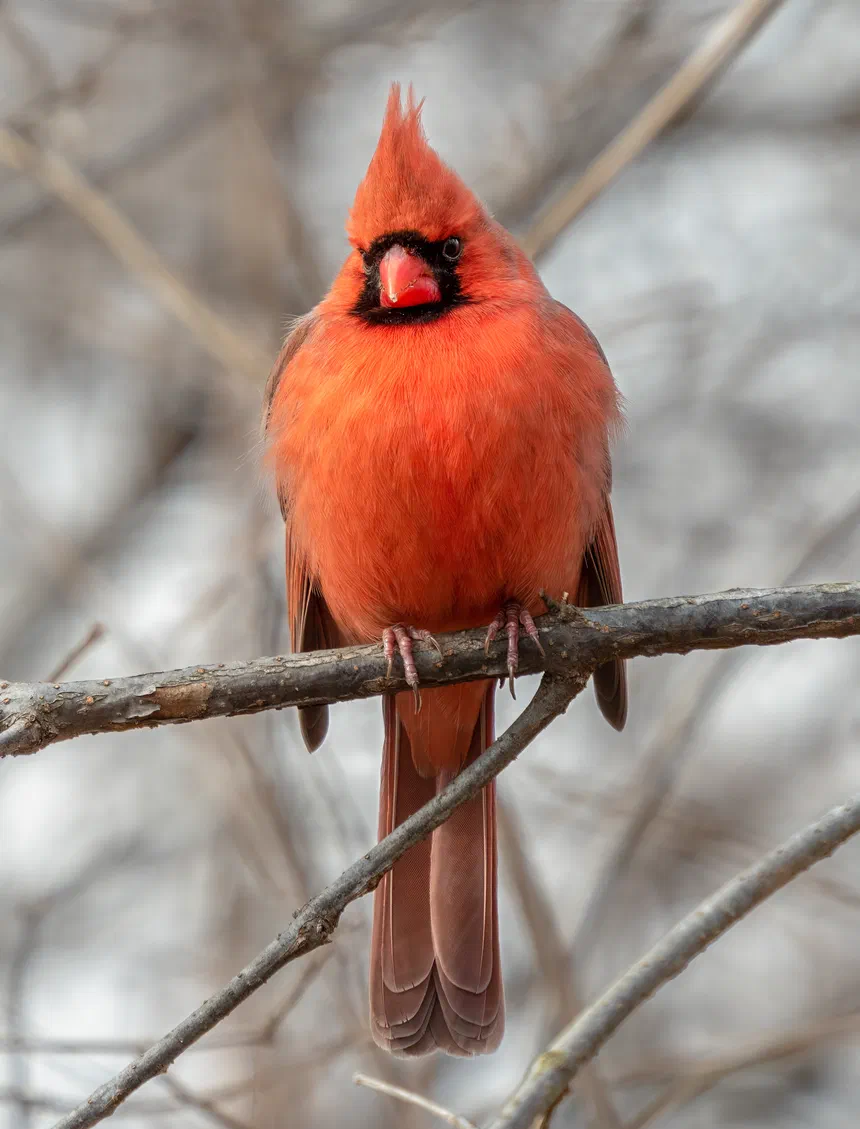
Image: Rhododendrites — CC BY-SA 4.0 · source
What Is a Northern Cardinal?
The Northern Cardinal (Cardinalis cardinalis) is a mid-sized songbird native to eastern and central North America, instantly recognized by the male’s vivid red plumage and jaunty crest. A member of the family Cardinalidae, it is one of the most beloved backyard birds on the continent and serves as the official state bird of seven U.S. states.
Appearance and Identification
Cardinals are stocky, medium-sized birds roughly 8 to 9 inches (21 to 23 cm) long, with a prominent pointed crest and a short, thick, cone-shaped bill built for cracking seeds. Adult males are an unmistakable brilliant red across the body, brightest on the crest and breast, with a black mask surrounding the reddish-orange bill. Females are subtler, wearing warm grayish-tan plumage washed with reddish tints on the wings, tail, and crest, and a grayer face mask. Both sexes share the same body shape and coral-colored bill, making the species easy to distinguish from other North American birds. Juveniles resemble females but have a dark bill until they mature.
Habitat and Range
The Northern Cardinal occupies a broad range across the eastern and central United States, extending south through Mexico into parts of Central America and reaching north into southern Canada. Its distribution has expanded northward over the past century, aided by backyard feeders and warming winters. Cardinals favor dense, brushy environments: woodland edges, overgrown fields, hedgerows, streamside thickets, and shrubby suburban gardens. They adapt readily to human-altered landscapes and are common in parks and residential neighborhoods, where they nest in tangled shrubs and small trees.
Diet
Cardinals are omnivores with a diet dominated by plant material. Seeds and grains make up the bulk of their food, and their heavy bill is well suited to husking sunflower seeds, safflower, and the seeds of grasses and weeds. They also eat wild fruits and berries, buds, and a variety of insects and other small invertebrates, especially during the breeding season when protein-rich prey is fed to nestlings. Their fondness for sunflower seed makes them frequent and welcome visitors at backyard feeders throughout the year.
Behavior
Northern Cardinals are non-migratory and typically remain on or near their territory year-round. They are known for their loud, clear, whistled songs, described with phrases like “cheer-cheer-cheer” and “birdie-birdie-birdie.” Unlike many songbirds, the female cardinal also sings, often exchanging phrases with her mate. During the breeding season males are strongly territorial and will vigorously chase off rivals, sometimes attacking their own reflection in windows or car mirrors. In colder months cardinals often gather in loose flocks and mix with other feeder birds, but pairs frequently stay together and defend a shared territory.
Life Cycle and Reproduction
Cardinals form socially monogamous pairs, and courtship includes the male feeding seeds to the female beak-to-beak. The female builds a cup-shaped nest of twigs, bark strips, and grasses hidden in dense shrubbery, usually laying 2 to 5 eggs. She incubates the eggs for about 11 to 13 days while the male brings her food. Nestlings fledge roughly 9 to 11 days after hatching, and the male often tends the newly fledged young while the female begins a second brood. A pair may raise two or more broods in a single season. Most cardinals live only a few years in the wild, though some individuals have survived well over a decade.
Conservation Status
The Northern Cardinal is listed as Least Concern by the IUCN. Its population is large, stable, and even increasing across much of its range, and it has benefited from the spread of suburban habitat and winter bird feeding. The species is protected in the United States under the Migratory Bird Treaty Act. There are no significant conservation concerns for the cardinal at present, making it one of North America’s true wildlife success stories.
Frequently Asked Questions
Why are male and female cardinals different colors? The male’s bright red plumage helps attract mates and advertise his fitness, while the female’s muted tones provide camouflage that keeps her concealed while incubating eggs on the nest.
Do Northern Cardinals migrate? No. Cardinals are year-round residents that stay in the same general area throughout the seasons, which is why they are a familiar sight against winter snow.
Do female cardinals sing? Yes. Female cardinals are among the relatively few female songbirds that sing regularly, often duetting with their mate to coordinate breeding and defend territory.