Birds Guide
Mallard
What Is a Mallard? The mallard (Anas platyrhynchos) is a medium-sized dabbling duck and one of the most familiar and widespread waterfowl in the world. Found on wetlands across the Northern Hemisphere and introduced to …
At a glance
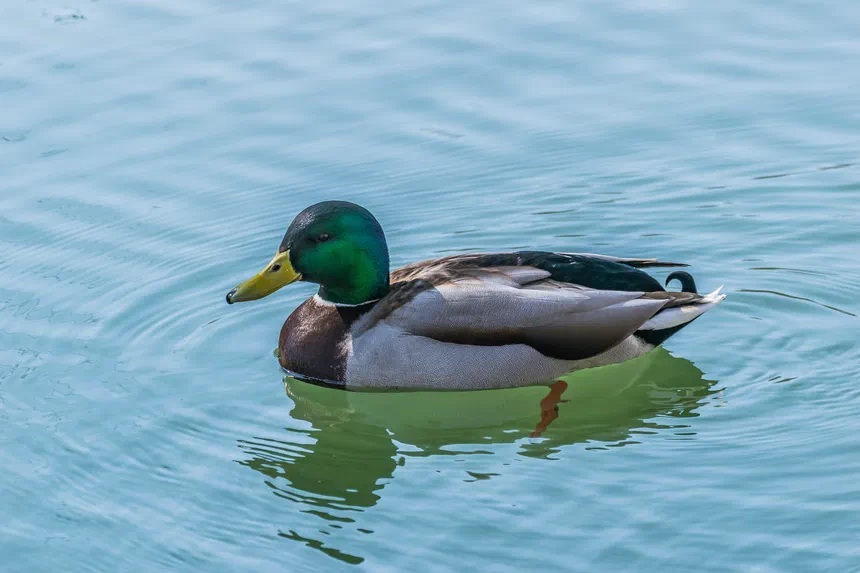
Image: Krzysztof Golik — CC BY-SA 4.0 · source
What Is a Mallard?
The mallard (Anas platyrhynchos) is a medium-sized dabbling duck and one of the most familiar and widespread waterfowl in the world. Found on wetlands across the Northern Hemisphere and introduced to many other regions, it is the ancestor of most domestic duck breeds. Its adaptability to both wild and human-altered habitats has made it a common sight from remote marshes to city park ponds.
Appearance and Identification
Mallards show strong sexual dimorphism, meaning males and females look quite different. The breeding male, or drake, is unmistakable with its iridescent green head, thin white neck ring, chestnut-brown breast, pale gray body, and a distinctive upward curl of black tail feathers. The female is mottled brown throughout, providing camouflage while nesting. Both sexes share a bright blue-purple wing patch, called a speculum, bordered by white bands that is especially visible in flight. Bill color differs too: drakes have a yellowish bill, while hens have an orange-and-brown one. Adults measure roughly 20 to 26 inches long with a wingspan near 32 to 39 inches.
Habitat and Range
Mallards occupy an enormous variety of wetland environments, including shallow lakes, ponds, slow rivers, marshes, flooded fields, and coastal estuaries. They thrive in urban and suburban settings, readily using park lakes, drainage basins, and even backyard ponds. Their native range spans North America, Europe, and Asia, and they have been introduced to places such as Australia, New Zealand, and parts of South America. Many northern populations migrate seasonally, moving south as waters freeze, while individuals in milder climates may remain year-round.
Diet
As omnivorous dabbling ducks, mallards feed by tipping forward in shallow water, tail up, to reach food below the surface rather than diving. Their diet shifts with the seasons and includes aquatic vegetation, seeds, grains, roots, insects, snails, worms, and small crustaceans. Breeding females and growing ducklings rely heavily on protein-rich invertebrates. In areas where people gather, mallards will also opportunistically eat human-provided food, though such handouts are far less nutritious than their natural fare.
Behavior
Mallards are social birds that often gather in flocks outside the breeding season. They are strong fliers, capable of sudden near-vertical takeoffs from water, and they communicate with a range of calls. The familiar loud “quack” comes almost exclusively from females; males produce quieter, raspier sounds. Mallards spend much of their time swimming, foraging, and preening, spreading waterproofing oils across their feathers. They are generally tolerant of human presence, which contributes to their success in developed areas.
Life Cycle and Reproduction
Pairs typically form in autumn and winter, well before nesting begins in spring. The female builds a shallow, down-lined nest on the ground, usually hidden in vegetation near water, and lays a clutch of roughly 8 to 13 eggs. She incubates them alone for about 27 to 28 days. Ducklings are precocial, meaning they hatch covered in down with eyes open and can walk, swim, and feed themselves within hours, following the hen to water. They fledge at around 50 to 60 days. Mallards readily interbreed with other duck species, which can complicate conservation efforts for some closely related ducks.
Conservation Status
The mallard is listed as Least Concern by the IUCN, reflecting its very large, stable, and widespread population. It is among the most abundant ducks on Earth and is not considered globally threatened. However, its tendency to hybridize with rarer native ducks, such as certain island and regional species, can pose a genetic threat to those populations. Habitat loss and wetland degradation remain broader concerns for waterfowl, but the mallard itself continues to flourish.
Frequently Asked Questions
How can you tell a male mallard from a female? The male has a glossy green head, white neck ring, and chestnut breast, while the female is uniformly mottled brown. Both share the blue wing patch bordered in white.
Are mallards migratory? Many northern mallards migrate south for winter, but populations in milder climates, including many urban birds, often stay in one place year-round.
What do mallards eat? They are omnivores, feeding on aquatic plants, seeds, grains, insects, snails, and other small invertebrates gathered mostly by dabbling at the water’s surface.