Birds Guide
Junglefowl
What Is a Junglefowl? The junglefowl (Gallus gallus), often called the red junglefowl, is a colorful, ground-dwelling bird native to the forests of southern and southeastern Asia. It belongs to the pheasant family …
At a glance
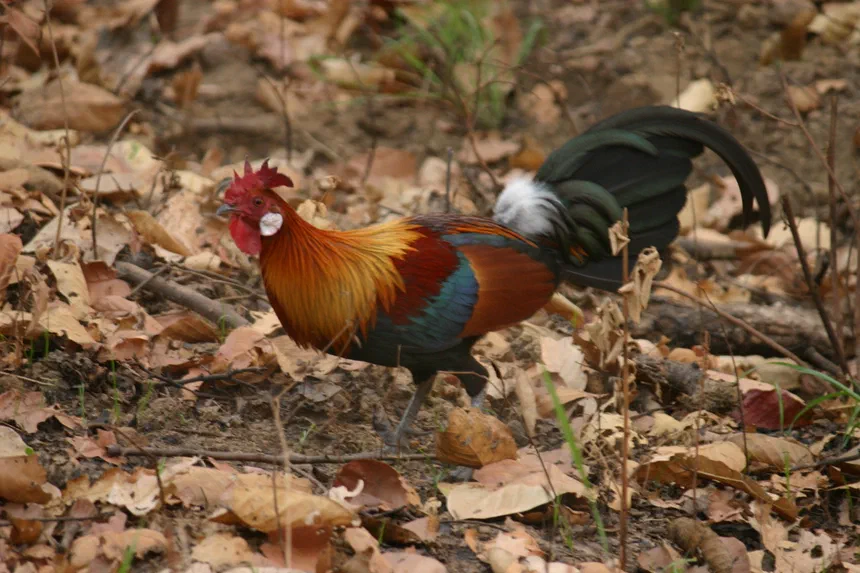
Image: Davidvraju — CC BY-SA 4.0 · source
What Is a Junglefowl?
The junglefowl (Gallus gallus), often called the red junglefowl, is a colorful, ground-dwelling bird native to the forests of southern and southeastern Asia. It belongs to the pheasant family (Phasianidae) and is best known as the wild ancestor of the domestic chicken, which was bred from it thousands of years ago.
Appearance and Identification
Red junglefowl show striking differences between the sexes. Adult males, or cocks, are vividly ornamented with glossy golden-orange neck and back feathers, a deep chestnut mantle, and long, arching tail feathers that gleam with dark green and black iridescence. They carry a bright red fleshy comb on the head and two wattles beneath the bill, both of which flush more intensely during courtship. Females, or hens, are far more subdued, with mottled brown feathering that provides excellent camouflage while nesting. Birds typically measure roughly 16 to 30 inches (40 to 75 cm) in length, with the male’s ornamental tail accounting for much of that. Adults generally weigh between about 1.5 and 3 pounds (0.7 to 1.4 kg), with males heavier than females.
Habitat and Range
Junglefowl occupy a broad swath of South and Southeast Asia, from the foothills of the Himalayas across India, Bangladesh, and Myanmar through Thailand, Indochina, and parts of southern China, and into the Malay Peninsula, Sumatra, and neighboring islands. They favor the transition zones between dense forest and open ground: forest edges, secondary growth, bamboo stands, scrubby thickets, and the margins of farmland. Such habitats offer both dense cover for hiding and open patches for foraging. They are most common in lowland and hill country up to moderate elevations.
Diet
The red junglefowl is an opportunistic omnivore. It spends much of the day scratching and pecking at the ground, using its feet to expose food hidden in leaf litter and soil. The diet includes seeds, grains, fresh shoots, fruits, and berries, supplemented by a wide range of small animals such as insects, larvae, spiders, worms, and the occasional small lizard. This flexible feeding strategy helps the species thrive along the edges of human cultivation, where it can find spilled grain and disturbed ground rich in invertebrates.
Behavior
Junglefowl are social birds that usually move in small groups, often a dominant male accompanied by several females and younger birds. They are wary and quick to flee into thick vegetation when disturbed, running rather than flying when possible, though they can burst into short, noisy flights to reach roost trees or escape danger. At dusk they fly up to roost in trees, safe from many ground predators. Males are highly vocal, giving the familiar crowing call at dawn and throughout the day to advertise their presence and territory. During the breeding season, males perform elaborate displays, spreading their wings and fanning their bright plumage to attract mates and warn off rivals.
Life Cycle and Reproduction
Breeding often peaks with the onset of favorable, wetter conditions. A hen builds a simple nest as a shallow scrape on the ground, usually well hidden in dense vegetation, and lays a clutch of roughly 4 to 8 eggs. She incubates them alone for about three weeks. The chicks are precocial, meaning they hatch covered in down with their eyes open and can leave the nest and feed themselves within hours, though they remain under the hen’s protection for several weeks. Young birds reach maturity within their first year. In the wild, junglefowl commonly live around 5 to 8 years, with predation and disease limiting the lifespan of most individuals.
Conservation Status
The red junglefowl is listed as Least Concern by the IUCN, reflecting its wide distribution and large overall population. The main long-term concern for the species is not outright scarcity but genetic dilution: because wild junglefowl readily interbreed with free-ranging domestic and feral chickens, pure wild populations are becoming harder to find in many areas. Habitat loss and hunting also affect local populations, but the species as a whole remains widespread and adaptable.
Frequently Asked Questions
Is the junglefowl the ancestor of the chicken? Yes. The red junglefowl is the principal wild ancestor of the domestic chicken, which was domesticated from it in Asia thousands of years ago, with some genetic contribution from related junglefowl species.
How can you tell a wild junglefowl from a domestic chicken? Wild junglefowl tend to be slimmer and more agile, with the male showing glossy golden hackles, a dark iridescent tail, and, in many populations, a white ear patch and grayish legs. They are also far more wary of people.
Can junglefowl fly? They are weak but capable fliers. They usually prefer to run from danger but can make short, powerful bursts of flight to reach tree roosts or escape predators.