Birds Guide
Java Sparrow
What Is a Java Sparrow? The Java sparrow (Padda oryzivora) is a small, sturdily built songbird in the estrildid finch family, Estrildidae. Despite its common name, it is not a true sparrow but a close relative of the …
At a glance
What Is a Java Sparrow?
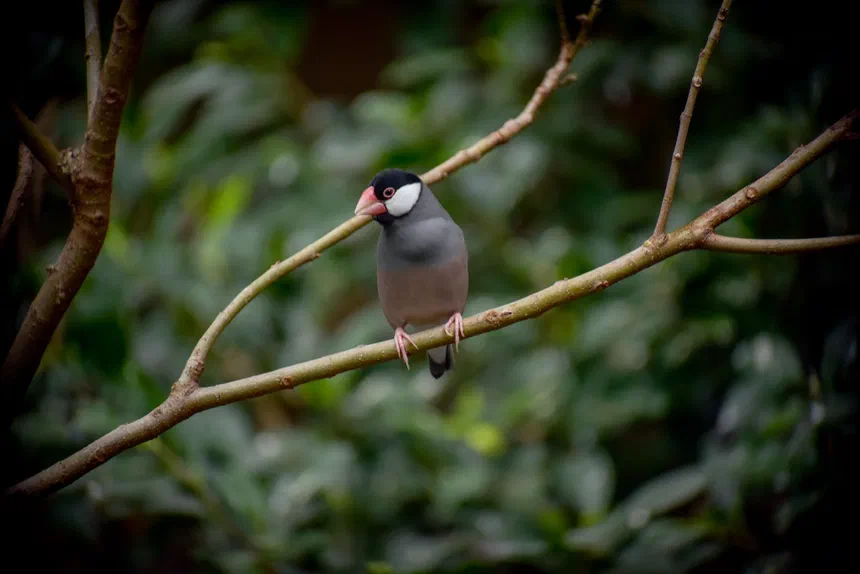
The Java sparrow (Padda oryzivora) is a small, sturdily built songbird in the estrildid finch family, Estrildidae. Despite its common name, it is not a true sparrow but a close relative of the mannikins and munias. Native to the Indonesian islands of Java and Bali, it has become one of the most widely kept and widely introduced cage birds in the world.
Appearance and Identification
The Java sparrow is a compact, plump finch measuring roughly 5.5 to 6.5 inches (14 to 17 cm) in length and weighing about 24 to 30 grams. Adults are unmistakable, with a pale bluish-gray body, a glossy black crown and throat, and bold white cheek patches. The tail and undertail are black, while the belly fades to a warm pinkish-buff. A thick, deep pink bill and a narrow ring of bare pink skin around the eye complete the look. Males and females are very similar, though males often show a slightly heavier bill and a bolder eye-ring. Juveniles are duller, with brownish-gray plumage, darker bills, and none of the crisp black-and-white head pattern that develops as they mature. Selective breeding in captivity has produced white, fawn, and pied color variants.
Habitat and Range
In its native range, the Java sparrow favors open lowland habitats, including grasslands, rice paddies, cultivated fields, savanna edges, and the gardens and parks of towns and villages. It is strongly associated with human agriculture, particularly rice-growing regions, which historically earned it a reputation as a crop pest. The species is naturally restricted to Java, Bali, and a few nearby islands, but through the cage-bird trade it has established feral populations across much of Southeast Asia, and on Pacific and other islands including Hawaii, Fiji, and parts of the Caribbean. Introduced birds thrive in warm, seed-rich landscapes near people.
Diet
The Java sparrow is primarily granivorous, feeding mainly on the seeds of grasses and cultivated cereals. Rice and other grains form a large part of its diet, and flocks descend on ripening crops where they occur, giving the bird its scientific epithet oryzivora, meaning “rice-eater.” It also takes a range of wild grass seeds and, especially during the breeding season, supplements its diet with small insects that provide extra protein for growing chicks. Birds typically forage on the ground or by clinging to seed heads, often in sociable flocks.
Behavior
This is a gregarious, highly social bird that lives in flocks outside the breeding season and roosts communally. Its calls are simple chirps and a soft chattering, while males produce a quiet, bubbling song during courtship. Java sparrows are generally calm and confiding around people, a trait that has made them popular aviary birds. They spend much of the day foraging and preening, and flocks move readily between feeding sites and water. In captivity they are known for being hardy, adaptable, and tolerant of other small finches.
Life Cycle and Reproduction
Java sparrows are monogamous and often breed in loose colonies. Pairs build bulky, domed nests of grass and plant fibers, placing them in tree cavities, dense foliage, or the eaves and crevices of buildings. A typical clutch contains four to eight white eggs, which both parents incubate for around two weeks. The nestlings hatch blind and helpless and are fed by both adults, fledging roughly three to four weeks after hatching. Pairs may raise more than one brood in a favorable season. In the wild these birds generally live about five to eight years, though well-cared-for captive individuals can live considerably longer.
Conservation Status
Although the Java sparrow is abundant in captivity and as an introduced bird in many regions, it is classed as Endangered by the IUCN within its native range. Decades of intensive trapping for the pet trade, combined with persecution as an agricultural pest and habitat change, have sharply reduced wild populations on Java and Bali. The paradox of a globally common cage bird being threatened in the wild highlights how the trade that spread the species also depleted its original strongholds. Conservation efforts focus on regulating capture and protecting remaining native populations.
Frequently Asked Questions
Is the Java sparrow a true sparrow? No. Despite the name, it belongs to the estrildid finch family and is more closely related to munias and mannikins than to true sparrows.
Why is it called a “rice bird”? Its scientific name oryzivora means “rice-eater,” reflecting its habit of feeding in rice paddies, where large flocks can damage ripening crops.
Can Java sparrows be kept as pets? Yes. They are hardy, social aviary birds and have been bred in captivity for generations, producing several color varieties. Local laws on keeping or trading the species should always be checked.