Birds Guide
Japanese White-eye
What Is a Japanese White-eye? The Japanese white-eye (Zosterops japonicus), also called the warbling white-eye or mejiro, is a small, lively songbird native to much of East Asia. It belongs to the white-eye family …
At a glance
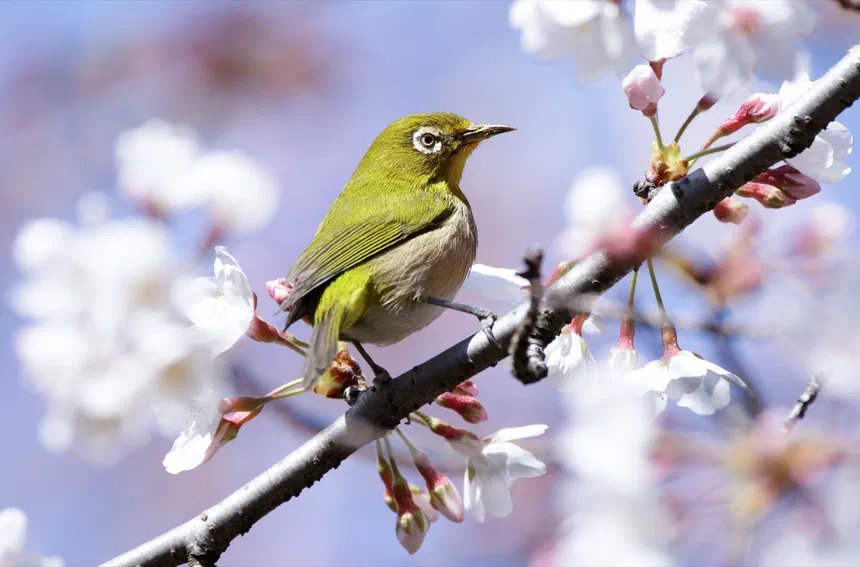
Image: Laitche — CC BY-SA 4.0 · source
What Is a Japanese White-eye?
The Japanese white-eye (Zosterops japonicus), also called the warbling white-eye or mejiro, is a small, lively songbird native to much of East Asia. It belongs to the white-eye family (Zosteropidae), a group named for the conspicuous ring of tiny white feathers that encircles each eye. Adaptable and gregarious, it has become one of the most familiar birds across its range and beyond.
Appearance and Identification
This is a petite bird, generally 10 to 12 centimeters (about 4 to 4.7 inches) in length and weighing only around 9 to 13 grams. Its upperparts are a soft olive-green, blending toward yellow on the throat and undertail, while the breast and belly are pale grayish-white. The most distinctive feature is the bold white eye-ring that gives the family its name. The bill is slender, slightly curved, and well suited to probing flowers, and the legs are dark. Males and females look nearly identical, making them difficult to tell apart in the field.
Habitat and Range
The Japanese white-eye is native to Japan, the Korean Peninsula, eastern China, Taiwan, and parts of the Philippines and Vietnam. It occupies a wide variety of wooded environments, including broadleaf and mixed forests, forest edges, scrubland, orchards, gardens, and urban parks. Its comfort around people has allowed it to thrive in suburban and city settings. The species was introduced to the Hawaiian Islands in the early 20th century, where it has since become one of the most abundant land birds and, in places, a concern for native flora and fauna.
Diet
Omnivorous and opportunistic, the Japanese white-eye feeds on nectar, small fruits and berries, and a range of insects and spiders. Its brush-tipped tongue is adapted for lapping nectar, and the bird is an important pollinator of many flowering plants within its range. During the breeding season it takes more insects, which supply the protein growing chicks require. In gardens it readily visits flowering trees, fruit, and feeders offering sugar water or cut oranges.
Behavior
These birds are social and highly active, often moving through the canopy in restless flocks outside the breeding season, sometimes joining mixed groups with other small species. They keep in contact with soft, high-pitched calls, and males produce a pleasant warbling song, a quality that historically made them popular cage birds in parts of Asia. Agile and acrobatic, they hang upside down and flit rapidly among branches while foraging. Flocks may travel considerable distances daily in search of blooming or fruiting trees.
Life Cycle and Reproduction
Breeding generally takes place in spring and summer. The pair builds a small, neat cup-shaped nest woven from grasses, plant fibers, moss, and spider silk, typically suspended in the fork of a branch. The female usually lays around two to four pale bluish eggs. Both parents share incubation, which lasts roughly 11 to 12 days, and both feed the nestlings. Young birds fledge about 10 to 12 days after hatching. A successful pair may raise more than one brood in a single season when conditions are favorable.
Conservation Status
The Japanese white-eye is listed as Least Concern by the IUCN, reflecting its large population, broad distribution, and tolerance of human-altered landscapes. It faces no significant threats across most of its native range. Where it has been introduced, however, notably in Hawaii, its success carries ecological costs: it competes with native birds, may spread the seeds of invasive plants, and can help transmit avian diseases, so it is regarded there as an invasive species rather than one in need of protection.
Frequently Asked Questions
Why is it called a white-eye? The name comes from the ring of small white feathers surrounding each eye, a trait shared by all members of the family Zosteropidae.
Is the Japanese white-eye a threat anywhere? In its native East Asian range it is a harmless and welcome bird, but as an introduced species in Hawaii it is considered invasive because it competes with native wildlife and spreads non-native plants.
What does it eat? It is an omnivore, feeding on flower nectar, soft fruits and berries, and small insects and spiders, with insects becoming especially important when feeding chicks.