Birds Guide
Japanese Grosbeak
What Is a Japanese Grosbeak? The Japanese grosbeak (Eophona personata) is a large, stocky finch native to East Asia. It belongs to the finch family Fringillidae and is best known for its enormous conical yellow bill, …
At a glance
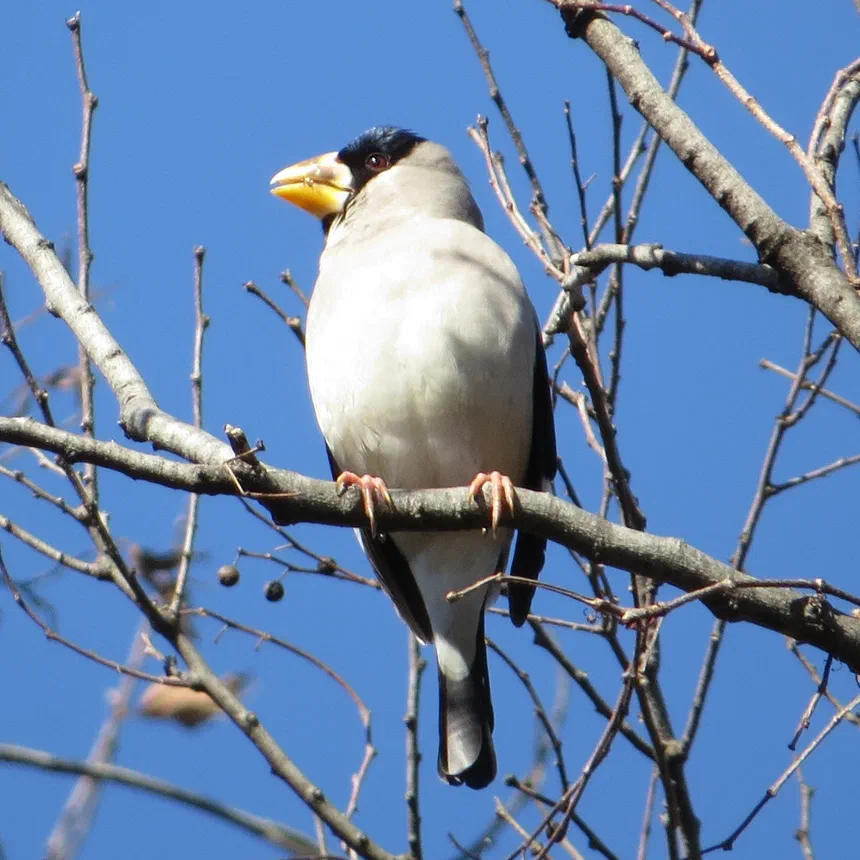
Image: Alpsdake — CC BY-SA 4.0 · source
What Is a Japanese Grosbeak?
The Japanese grosbeak (Eophona personata) is a large, stocky finch native to East Asia. It belongs to the finch family Fringillidae and is best known for its enormous conical yellow bill, which it uses to crack open tough seeds. Despite its name, the species ranges well beyond Japan.
Appearance and Identification
This is one of the biggest finches in its range, measuring roughly 18 to 23 centimeters in length. Its plumage is largely soft gray on the body, paler below and darker on the back, with a sharply contrasting glossy black hood covering the crown, face, and chin. The wings and tail are black, and in flight the birds flash bold white patches near the wingtips. The most striking feature is the massive, deep, bright yellow bill, disproportionately large for the head. Males and females look broadly similar, though males tend to show slightly more extensive and glossier black on the head. Juveniles are duller and browner, with less defined head markings.
Habitat and Range
The Japanese grosbeak occupies deciduous and mixed woodlands, forest edges, wooded valleys, and increasingly suburban parks and gardens with mature trees. Its breeding range spans the Russian Far East, northeastern China, the Korean Peninsula, and Japan. Northern populations are migratory or partially migratory, moving south in autumn to escape harsh winters, while birds in milder areas such as much of Japan are largely resident. During the colder months they often descend to lower elevations and gather where food is reliable.
Diet
Primarily a seed-eater, the Japanese grosbeak relies on its powerful bill to handle hard seeds and stones of fruit that smaller finches cannot manage. Its diet includes tree seeds, buds, berries, and the kernels of various woody plants. During the breeding season it supplements this plant material with insects and other small invertebrates, which provide the extra protein needed by rapidly growing nestlings. Birds will readily exploit seasonal abundances, moving between food sources as different trees fruit and set seed through the year.
Behavior
Outside the breeding season these grosbeaks are social, forming small flocks that forage together in the treetops and occasionally on the ground. They are generally unobtrusive and can be easy to overlook despite their size, often detected first by their calls: a hard, metallic “tik” and a short, fluty whistled song. Strong, direct fliers, they undulate between perches and favor the upper and middle levels of trees. Their heavy bill allows them to feed methodically, wedging and cracking seeds with precise, deliberate movements.
Life Cycle and Reproduction
Breeding takes place in spring and early summer. Pairs build a cup-shaped nest of twigs, rootlets, and plant fibers, usually placed in a tree or tall shrub. The female typically lays a clutch of around three to five eggs, which are incubated for roughly two weeks. Both parents help feed the chicks, delivering insects and softened plant food. The young fledge a couple of weeks after hatching but may continue to depend on the adults for a short period as they learn to forage. In the wild, individuals commonly live around five to eight years.
Conservation Status
The Japanese grosbeak is listed as Least Concern by the IUCN. It has a wide distribution across East Asia and a population that appears stable, and it tolerates a range of wooded habitats, including modified landscapes near people. As with many woodland birds, it can be affected locally by habitat loss and forest fragmentation, but no major range-wide threats are currently recognized.
Frequently Asked Questions
Is the Japanese grosbeak found only in Japan? No. While it is common in Japan, the species also breeds and winters across Korea, eastern China, and the Russian Far East.
Why is its bill so large? The oversized conical bill is a specialized tool for cracking hard seeds and fruit stones, giving the bird access to foods that smaller-billed finches cannot open.
Is it a threatened species? Not at present. It is classified as Least Concern, with a broad range and a population considered stable.