Birds Guide
Jandaya Parakeet
What Is a Jandaya Parakeet? The Jandaya parakeet (Aratinga jandaya) is a small, brightly colored parrot native to the tropical woodlands of northeastern Brazil. A member of the conure group, it is closely related to the …
At a glance
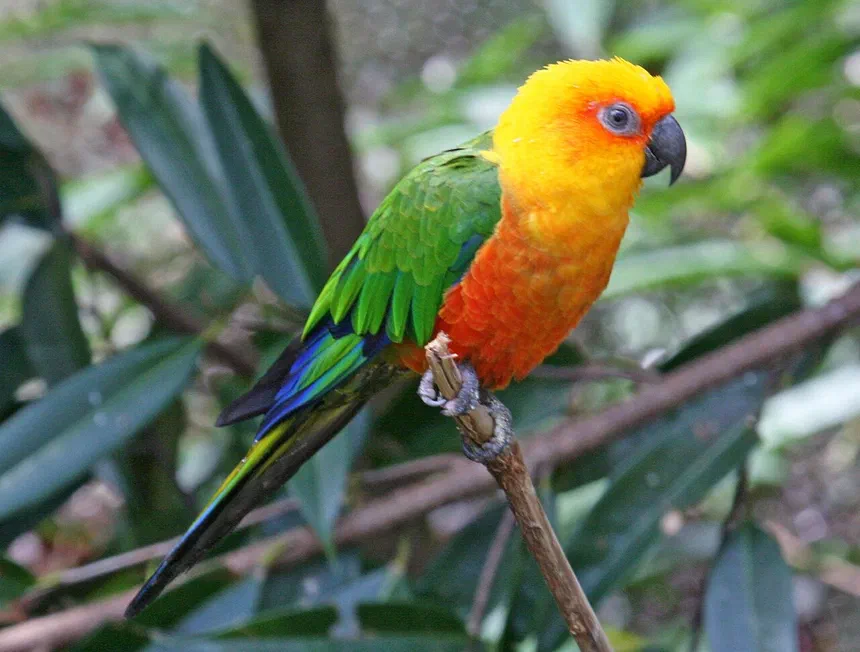
Image: Dick Daniels (https://theworldbirds.org/) — CC BY-SA 3.0 · source
What Is a Jandaya Parakeet?
The Jandaya parakeet (Aratinga jandaya) is a small, brightly colored parrot native to the tropical woodlands of northeastern Brazil. A member of the conure group, it is closely related to the sun parakeet and is instantly recognizable by its blazing yellow head and fiery orange underparts.
Appearance and Identification
This is a striking bird that seems painted in the warm colors of a sunset. Adults have a rich yellow head and neck that blends into orange across the breast and belly, while the back, wings, and long tapering tail are mostly green, often with a bluish wash on the flight feathers and tail tip. The bill is dark gray to black, and a bare ring of pale skin surrounds each eye. Males and females look alike, which makes visual sexing unreliable. Young birds are duller overall, showing more green on the head and a paler, less saturated body until they molt into adult plumage over their first year or two. At roughly 12 inches in length, much of which is tail, the Jandaya is a slender, agile flier.
Habitat and Range
The species is endemic to northeastern Brazil, occupying a band of country across states such as Maranhao, Piaui, Ceara, and neighboring areas. It favors semi-open landscapes rather than dense, closed forest, thriving along woodland edges, in stands of buriti and other palms, in gallery forest near watercourses, and in agricultural areas dotted with trees. This tolerance for altered, partly cultivated habitats has helped the Jandaya remain relatively common across its range.
Diet
Jandaya parakeets are primarily plant eaters. Their diet centers on a range of fruits, seeds, nuts, berries, and flowers, and they will also feed on buds and blossoms. Flocks forage in the treetops and can descend to cultivated crops, where they sometimes take maize and fruit, occasionally bringing them into conflict with farmers. Their strong, hooked bills let them crack hard seeds and pry into fruit, and a nimble foot is used to hold and manipulate food while feeding.
Behavior
These are social, vocal birds usually encountered in pairs or small flocks. Like most conures, they are noisy, keeping in touch with sharp, screeching calls as they fly and forage. In flight the flock moves in tight, fast-wheeling groups, the green wings flashing against the sky. They spend much of the day feeding and preening, and they are highly active and inquisitive. Their intelligence, playfulness, and strong pair bonds are part of why the species has long been kept as a companion bird, where it becomes affectionate and capable of learning simple tricks and sounds.
Life Cycle and Reproduction
Jandaya parakeets are cavity nesters, typically choosing a hollow in a tree, sometimes a former woodpecker hole or a natural cavity in a palm. The female generally lays a clutch of around three to five white eggs and incubates them for roughly three and a half to four weeks. The male helps by feeding the female and, later, the chicks. Nestlings hatch blind and helpless and are brooded and fed by both parents, fledging at approximately seven to eight weeks of age. Young birds may remain with their parents for a period after leaving the nest before joining the wider flock.
Conservation Status
The Jandaya parakeet is currently listed as Least Concern by the IUCN. It remains fairly widespread within its range and adapts well to human-modified habitats, which helps buffer it against some threats. That said, the species faces pressure from habitat loss and from trapping for the pet trade, and international commercial trade is regulated under CITES. Continued protection of native woodland and enforcement against illegal capture help keep wild populations stable.
Frequently Asked Questions
Is the Jandaya parakeet the same as a conure? Yes. “Conure” is a common name for a group of small to medium New World parrots, and the Jandaya is one of them, belonging to the genus Aratinga.
Where do Jandaya parakeets live in the wild? They are found only in northeastern Brazil, where they inhabit woodland edges, palm groves, and partly cultivated country.
How long do Jandaya parakeets live? In the wild they typically live around 15 to 20 years, and well-cared-for birds in captivity can live longer.
References
The conservation status and key facts in this profile are supported by these sources:
- Animal Diversity Web — Aratinga jandaya (Jandaya parakeet) (accessed 2026-07-29)
- GBIF — Aratinga jandaya (Gmelin, 1788) (accessed 2026-07-29)
Found an error, source problem, or image concern? Report this page.