Birds Guide
Jackson's Widowbird
What Is a Jackson’s Widowbird? Jackson’s widowbird (Euplectes jacksoni) is a small, seed-eating songbird in the weaver family (Ploceidae), native to the high grasslands of East Africa. It is best known for the breeding …
At a glance
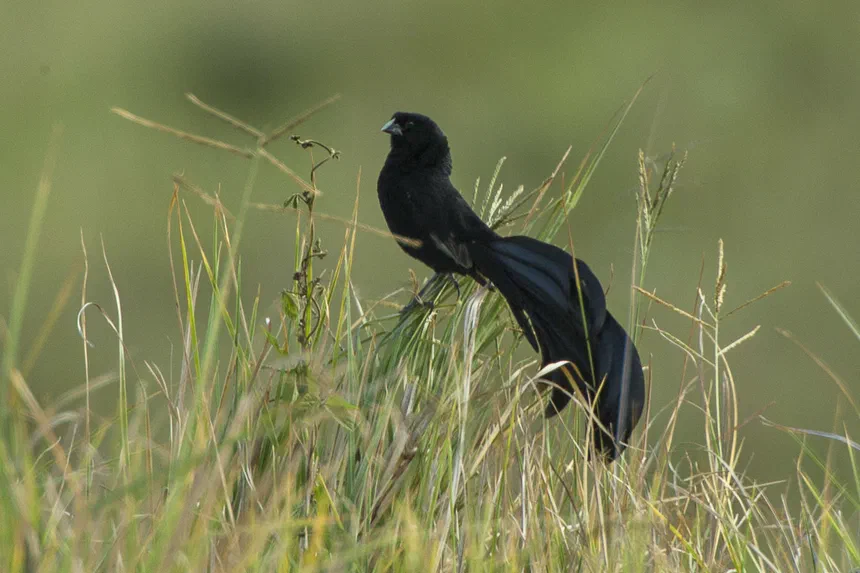
Image: Francesco Veronesi from Italy — CC BY-SA 2.0 · source
What Is a Jackson’s Widowbird?
Jackson’s widowbird (Euplectes jacksoni) is a small, seed-eating songbird in the weaver family (Ploceidae), native to the high grasslands of East Africa. It is best known for the breeding male’s glossy black plumage and long, arching tail, which he shows off in an energetic jumping courtship display. The species is named for the British ornithologist Frederick John Jackson.
Appearance and Identification
The breeding male is unmistakable: a compact, mostly black bird with warm brown to buff shoulders and wings, and a long, decurved tail that sweeps downward and to the side. This ornamental tail is grown only for the breeding season. Females, immatures, and non-breeding males are far plainer, wearing streaky brown and buff plumage that blends into dry grass, much like a female sparrow or weaver. Both sexes have a stout, conical, seed-cracking bill typical of weavers. Overall body length is around 12 to 14 cm, though a displaying male looks much longer because of his tail.
Habitat and Range
The species is restricted to open, high-altitude grasslands in the highlands of central Kenya and northern Tanzania, generally at elevations well above 1,500 meters. It favors moist, tussocky grassland and the grassy margins of cultivated country, avoiding dense forest and heavily built-up areas. Because it depends on this fairly narrow band of montane grassland, its distribution is patchy and localized.
Diet
Jackson’s widowbird is primarily granivorous, feeding mainly on the seeds of grasses and small herbaceous plants. It forages on or near the ground, often in loose flocks outside the breeding season. Insects and other small invertebrates supplement the diet, particularly when adults are feeding growing chicks that need extra protein.
Behavior
Outside of breeding, these birds are social and gather in flocks, sometimes mixing with other seed-eaters as they move through grassland in search of food. The species is best known for its remarkable lek-style courtship. Males clear a small circular “arena” in the grass, leaving a central tuft, and then repeatedly leap straight up above the surrounding vegetation, flicking the long tail, to attract watching females. Several males may display in the same area, and females visit these arenas to compare suitors before choosing a mate.
Life Cycle and Reproduction
Breeding is tied to the rains, when grass growth provides both cover and abundant seed. The mating system is polygynous: a successful male may attract and mate with several females, while contributing little to nesting duties. The female builds a domed or partly domed nest low in dense grass and takes on incubation and much of the chick-rearing. Clutches are small, typically a few eggs, and the young are fed insects and seeds until they fledge. After the breeding season the male molts out of his ornamental plumage and long tail, coming to resemble the drab female until the next season.
Conservation Status
Jackson’s widowbird is currently assessed by the IUCN as Near Threatened. Its reliance on a limited area of montane grassland makes it vulnerable to habitat loss, chiefly through the conversion of grassland to agriculture, overgrazing, and other land-use changes. While it can persist in lightly farmed landscapes, ongoing loss and degradation of its specialized grassland habitat are the main long-term concerns for the species.
Frequently Asked Questions
Why does the male have such a long tail? The long, curved tail is a sexual ornament used in courtship. Males show it off during their jumping displays, and females appear to favor males that perform vigorously, so the trait is maintained through mate choice.
Where can Jackson’s widowbird be seen? It is found in the montane grasslands of central Kenya and northern Tanzania, typically at higher elevations where open, tussocky grassland remains.
Is Jackson’s widowbird endangered? It is not classified as endangered, but the IUCN lists it as Near Threatened because its grassland habitat is limited and under pressure from agriculture and grazing.