Birds Guide
Jackdaw
What Is a Jackdaw? The jackdaw (Coloeus monedula) is a small, sociable member of the crow family, Corvidae. It is one of the smallest of the true crows and is easily told apart from its larger relatives by its compact …
At a glance
What Is a Jackdaw?
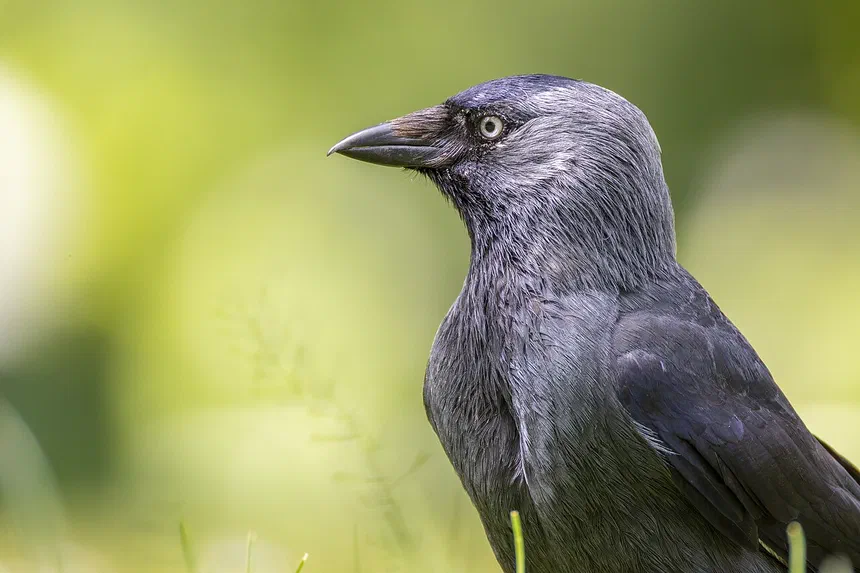
The jackdaw (Coloeus monedula) is a small, sociable member of the crow family, Corvidae. It is one of the smallest of the true crows and is easily told apart from its larger relatives by its compact build, silvery-gray nape, and strikingly pale eyes. Widespread and adaptable, it thrives everywhere from remote sea cliffs to busy city centers.
Appearance and Identification
Jackdaws are noticeably smaller and more lightly built than carrion crows or rooks. The plumage is mostly black, but with a soft slate-gray to silvery wash across the back of the head and neck that gives the bird a hooded look. The most distinctive feature is the eye, which in adults is a pale, almost white gray-blue that stands out clearly against the darker face. The bill is short and stout compared with the longer bills of rooks. Males and females look alike, and juveniles are duller, with browner tones and darker eyes that lighten as they mature. In flight, jackdaws show quick, pigeon-like wingbeats and often travel in tight, chattering flocks.
Habitat and Range
This species ranges across most of Europe, extending into North Africa and eastward through western and central Asia. It is one of the more flexible corvids when it comes to habitat, occupying open woodland, farmland with scattered trees, coastal and inland cliffs, quarries, and increasingly, human settlements. Jackdaws favor areas that combine open ground for feeding with vertical structures, such as old trees, rock faces, ruins, or buildings, that provide cavities for nesting and roosting. Many populations are resident year-round, while birds in the colder northern and eastern parts of the range may move south or to milder areas in winter.
Diet
Jackdaws are opportunistic omnivores with a broad and flexible diet. They take insects and their larvae, spiders, earthworms, snails, and other invertebrates, along with seeds, grain, fruit, and berries. Around people they readily scavenge scraps, food waste, and items left at feeders. They will also eat small vertebrates and occasionally the eggs or nestlings of other birds. Much of their foraging happens on the ground, where they walk and probe among grass and soil, but they are quick to exploit whatever seasonal or local food source is most abundant.
Behavior
Jackdaws are highly social and intelligent birds. They gather in flocks throughout the year and often mix with rooks and other corvids while feeding and roosting. Their calls include a sharp, metallic “tchack,” from which the name jackdaw is thought to derive. Communal roosts can hold large numbers, and flocks perform coordinated aerial movements at dawn and dusk. Like other members of the crow family, jackdaws show notable problem-solving ability and good memory, and studies have highlighted their sensitivity to the gaze and attention of other individuals. They form strong, lasting pair bonds and maintain a clear social order within their groups.
Life Cycle and Reproduction
Jackdaws are monogamous and typically pair for life, with partners staying together across breeding seasons. They nest in cavities, including tree holes, cliff crevices, chimneys, and gaps in buildings, often in loose colonies. The nest is a bulky base of sticks lined with softer materials such as wool, hair, and grass. Females usually lay around four to six eggs, which are pale blue-green with darker speckling. The female does most of the incubation, lasting roughly two and a half weeks, while the male helps provision her. Both parents feed the chicks, which fledge about a month after hatching. Young birds may remain near their parents for a time after leaving the nest.
Conservation Status
The jackdaw is listed as Least Concern by the IUCN. It has a very large range and a sizable, generally stable or increasing population, aided by its adaptability and its comfort living alongside humans. It faces no major threats at the species level, though local numbers can be affected by changes in farming practices and the availability of nesting cavities. Overall, it remains one of the most familiar and successful corvids across its range.
Frequently Asked Questions
How can I tell a jackdaw from a crow? Jackdaws are smaller, with a gray hood on the back of the head and pale, whitish eyes, while carrion crows are larger, uniformly black, and have dark eyes.
Are jackdaws intelligent? Yes. As members of the crow family they are considered highly intelligent, with strong memories, problem-solving skills, and a notable sensitivity to the attention of other individuals.
Do jackdaws mate for life? They generally do. Jackdaws form strong, lasting pair bonds and typically remain with the same partner across breeding seasons.