Birds Guide
Jabiru
What Is a Jabiru? The jabiru (Jabiru mycteria) is a towering stork found across the wetlands of the American tropics. It is one of the tallest flying birds in the Americas and the only living member of its genus, …
At a glance
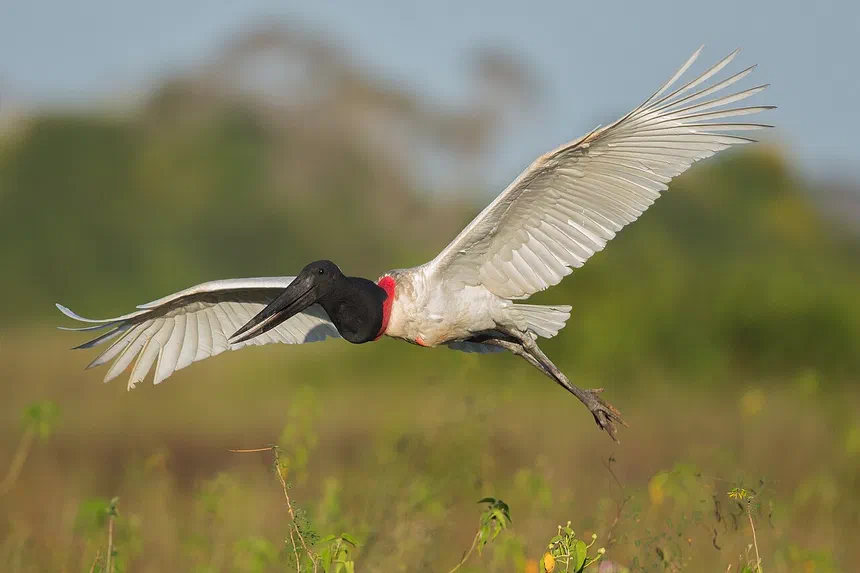
Image: Andreas Trepte — CC BY-SA 4.0 · source
What Is a Jabiru?
The jabiru (Jabiru mycteria) is a towering stork found across the wetlands of the American tropics. It is one of the tallest flying birds in the Americas and the only living member of its genus, instantly recognizable by its bare black head and the vivid red band of skin at the base of its neck.
Appearance and Identification
Adult jabiru are strikingly bold in pattern. The plumage is almost entirely white, contrasting sharply with a featherless black head and upper neck. A stretchy pouch of red skin encircles the lower neck, becoming brighter during the breeding season and when the bird is excited. The massive, slightly upturned bill is dark and can measure nearly a foot long, giving the bird a formidable profile. Standing between roughly 1.2 and 1.4 meters tall, with a wingspan that can approach 2.8 meters, the jabiru is unmistakable in flight, holding its neck extended rather than tucked. Males and females look alike, though males tend to be noticeably larger. Juveniles are duller, with grayish-brown feathering that whitens as they mature.
Habitat and Range
Jabiru favor open freshwater wetlands, including seasonally flooded grasslands, marshes, lagoons, and the margins of slow-moving rivers. They are strongly associated with regions such as the Pantanal of Brazil and the Llanos of Venezuela and Colombia, where vast wetlands support abundant prey. The species ranges from southern Mexico through Central America and across much of tropical South America to northern Argentina. Populations shift with the seasons, concentrating around shrinking water bodies during the dry months when fish and other aquatic animals become easy to catch in receding pools.
Diet
This stork is a carnivore and an opportunistic hunter of the shallows. Its diet centers on fish, but it readily takes amphibians, snakes, small reptiles, mollusks, crustaceans, and aquatic insects. During droughts, jabiru will also consume carrion and scavenge dead or dying fish stranded by falling water levels, playing a useful role in keeping wetlands clean. They typically forage by wading slowly through shallow water with the bill held partly open, snapping shut the moment prey brushes against it, a tactile method that works well in murky water.
Behavior
Jabiru are often seen alone or in loose groups, though they gather in larger numbers where food is plentiful. They are strong, soaring fliers, using thermals to travel between feeding sites with slow, deliberate wingbeats. Largely silent birds, they lack a true voice and instead communicate through bill-clattering displays, particularly at the nest. Much of the day is spent methodically stalking prey, and individuals may defend productive feeding spots from other large waterbirds.
Life Cycle and Reproduction
Breeding usually coincides with the dry season, when concentrated prey makes it easier to feed growing chicks. Pairs build enormous stick nests high in tall trees, often reusing and enlarging the same structure year after year until it becomes a bulky platform. A typical clutch contains two to four eggs, which both parents incubate for roughly a month. The young are cared for by both adults and remain dependent for an extended period, fledging after about three months but often continuing to be fed for weeks afterward. Jabiru are long-lived, with wild birds thought to reach around 30 years or more.
Conservation Status
The IUCN lists the jabiru as Least Concern, reflecting its wide distribution and generally stable numbers across much of its range. Even so, the species depends on healthy wetlands, and local declines occur where marshes are drained for agriculture, water flows are altered, or nesting trees are cleared. Because jabiru require large, undisturbed feeding areas, they serve as a useful indicator of wetland health, and protecting strongholds such as the Pantanal benefits many other species alongside them.
Frequently Asked Questions
How big is a jabiru? It is among the largest storks in the Americas, standing over a meter tall with a wingspan that can near 2.8 meters, making it one of the tallest flying birds on the continent.
What does a jabiru eat? It is a carnivore that feeds mainly on fish, along with frogs, snakes, reptiles, and aquatic invertebrates, and it will scavenge carrion during dry spells.
Where do jabiru live? They inhabit freshwater wetlands from southern Mexico through Central America and into tropical South America, with famous populations in Brazil’s Pantanal and the Llanos of Venezuela and Colombia.