Birds Guide
Ivory-Billed Woodpecker
What Is a Ivory-Billed Woodpecker? The ivory-billed woodpecker (Campephilus principalis) is one of the largest woodpeckers ever recorded, a striking black-and-white bird of the southern swamp forests. Once found across …
At a glance
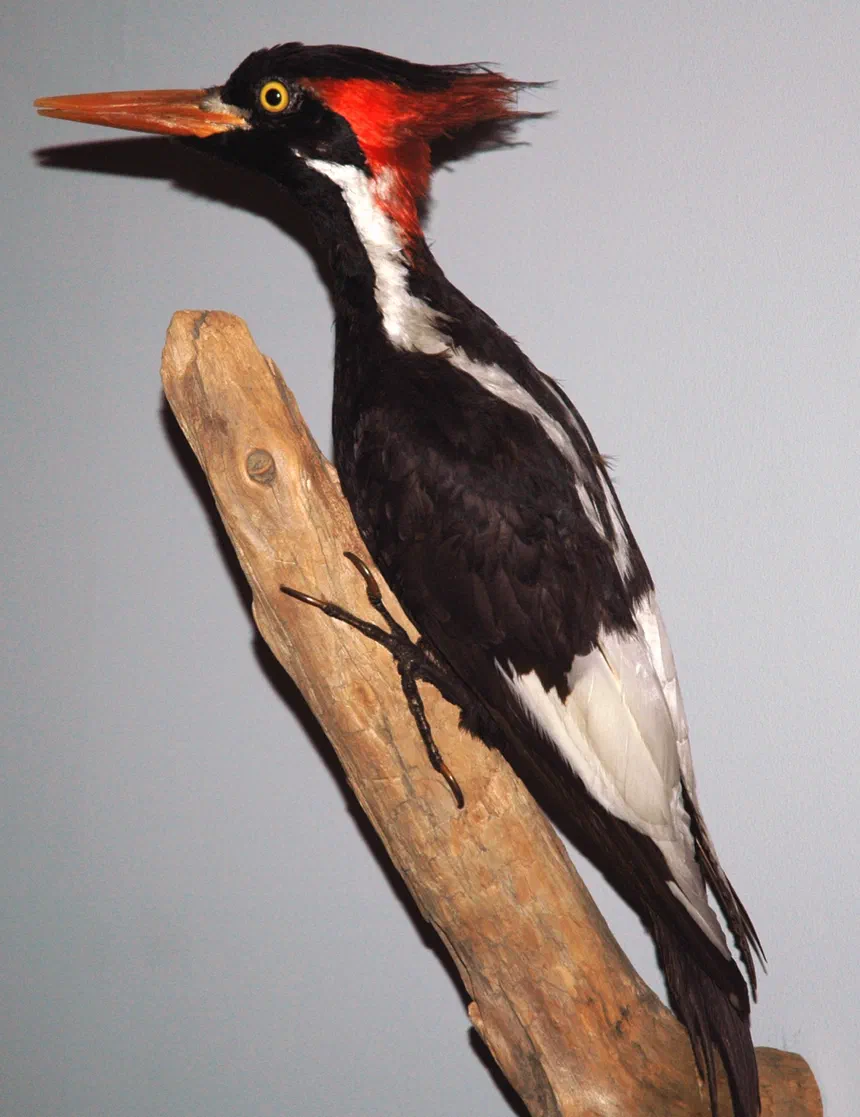
What Is a Ivory-Billed Woodpecker?
The ivory-billed woodpecker (Campephilus principalis) is one of the largest woodpeckers ever recorded, a striking black-and-white bird of the southern swamp forests. Once found across the southeastern United States and Cuba, it became a symbol of vanishing old-growth wilderness. Today it is feared extinct, though occasional unconfirmed reports keep hope faintly alive.
Appearance and Identification
This is an unmistakably large woodpecker, measuring roughly 48-51 centimeters (19-20 inches) in length with a wingspan approaching 76 centimeters (30 inches). Its plumage is a glossy blue-black, offset by broad white stripes running down the neck and prominent white panels on the trailing edge of the wings that are conspicuous in flight. Males carry a pointed, bright red crest, while females have a black crest. The heavy, chisel-shaped bill is pale ivory-white, giving the bird its name, and the eyes are a pale yellow. It is often confused with the smaller pileated woodpecker, but the ivory-bill’s white wing patches and bill color help distinguish it.
Habitat and Range
The ivory-billed woodpecker was a specialist of mature, undisturbed forest. It favored extensive bottomland hardwood forests and cypress swamps in the southeastern United States, ranging historically from the Gulf Coast and lower Mississippi Valley up into parts of the Carolinas and Florida. A separate subspecies inhabited the old-growth pine and hardwood forests of Cuba. These birds required large tracts of mature timber with abundant dead and dying trees, and their dependence on such habitat left them acutely vulnerable to logging.
Diet
The species was primarily insectivorous, feeding heavily on the larvae of wood-boring beetles that infest recently dead trees. Using its powerful bill, the bird would strip away loose bark in large sheets to expose the tunnels of grubs beneath, a foraging style that set it apart from woodpeckers that drill deep holes. Seasonal fruits, nuts, and seeds supplemented the diet when available. A single foraging pair reportedly needed a large area of freshly dead timber to sustain itself.
Behavior
Ivory-billed woodpeckers were shy, wary birds that ranged widely through their forest home. They were known for a distinctive nasal call often likened to a toy tin trumpet, and for a characteristic double-rap drumming on tree trunks. Pairs are thought to have maintained large territories and stayed together through the year. Their strong flight was direct and duck-like, carrying them between scattered stands of suitable feeding trees.
Life Cycle and Reproduction
Breeding pairs excavated nest cavities in large trees, typically well above the ground. Clutches generally numbered a few eggs, and both parents shared incubation and the feeding of young. The nestling period was relatively long, and fledglings depended on their parents for some time after leaving the cavity. Because the birds bred slowly and required extensive mature forest, populations recovered poorly once reduced.
Conservation Status
The ivory-billed woodpecker is listed by the IUCN as Critically Endangered and is widely regarded as possibly extinct. Extensive logging of old-growth southern forests through the late nineteenth and early twentieth centuries destroyed the habitat it depended upon, and hunting added further pressure. The last widely accepted sightings in the United States date to the mid-twentieth century, with the Cuban population persisting slightly longer. Reported rediscoveries in the 2000s generated intense interest but were never conclusively confirmed, and the bird remains one of the most sought-after and debated species in North American ornithology.
Frequently Asked Questions
Is the ivory-billed woodpecker extinct? It is officially classified as Critically Endangered and possibly extinct. No sighting since the mid-twentieth century has been definitively confirmed, though searches continue.
Why did the ivory-billed woodpecker decline? The main cause was large-scale logging of the old-growth bottomland and swamp forests it required, compounded by hunting and collecting.
How was it different from the pileated woodpecker? The ivory-bill was larger, had a pale ivory bill, and showed extensive white on the rear of its wings, whereas the similar pileated woodpecker has a dark bill and mostly dark wings.