Birds Guide
Island Scrub Jay
What Is a Island Scrub Jay? The Island Scrub Jay (Aphelocoma insularis) is a striking blue songbird found on only a single place on Earth: Santa Cruz Island, one of the Channel Islands off the coast of Southern …
At a glance
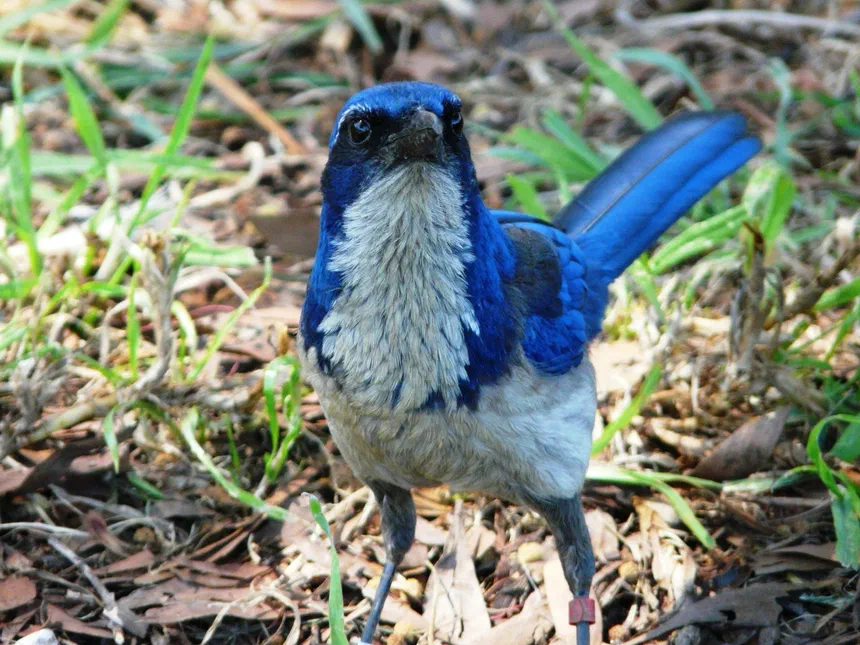
Image: Pacific Southwest Region USFWS — Public domain · source
What Is a Island Scrub Jay?
The Island Scrub Jay (Aphelocoma insularis) is a striking blue songbird found on only a single place on Earth: Santa Cruz Island, one of the Channel Islands off the coast of Southern California. It is the only bird species restricted entirely to a single island in the continental United States, making it one of North America’s most geographically limited birds.
Appearance and Identification
The Island Scrub Jay is a robust, crestless jay with rich azure-blue wings, tail, and head contrasting with a grayish-brown back and pale, whitish-gray underparts. A blue “necklace” band often breaks across the upper chest, and a whitish throat and eyebrow stripe add contrast to the face. It closely resembles its mainland relative, the California Scrub Jay, but is noticeably larger, deeper blue, and heavier-billed. Adults measure around 31 centimeters (12 inches) in length. The sexes look alike, though males average slightly larger. Juveniles are duller, with grayer plumage that brightens as they mature.
Habitat and Range
This species is a true island endemic, occurring nowhere but Santa Cruz Island, which covers roughly 250 square kilometers (about 96 square miles). Within that small world it favors stands of oak woodland, especially island scrub oak, along with chaparral, pine groves, and canyon vegetation. Because the entire global population lives in one location, the birds are unusually vulnerable to any island-wide event, from wildfire to disease. Densities are highest where oak cover is dense and acorns are plentiful.
Diet
The Island Scrub Jay is an opportunistic omnivore. Acorns form a cornerstone of its diet, particularly outside the breeding season, and the birds cache large numbers of them in the soil for later use. This caching behavior makes them important seed dispersers, effectively planting oaks across the island. They also eat insects and other invertebrates, spiders, seeds, berries, and occasionally small vertebrates such as lizards, along with the eggs and nestlings of other birds when the opportunity arises. Their diet shifts seasonally, with more animal prey taken in spring and summer.
Behavior
Island Scrub Jays are bold, curious, and vocal, giving harsh scolding calls and a range of rasping notes. Unlike some of their western relatives, they are not cooperative breeders; pairs defend territories on their own rather than relying on family helpers. They are strongly territorial year-round, and established pairs may hold the same ground for many seasons. Intelligent and inquisitive, they readily investigate novel objects and remember the locations of their many buried acorn caches. They are generally sedentary, rarely moving far from their home range.
Life Cycle and Reproduction
Breeding typically begins in early spring. A pair builds a bulky cup nest of twigs lined with finer material, usually well hidden in a shrub or low tree. The female lays a clutch of around three to four eggs, which she incubates for roughly 18 to 20 days while the male brings food. Chicks are altricial, hatching helpless and blind, and both parents feed them until they fledge about three weeks after hatching. Young birds may remain near their parents’ territory for a time before dispersing. Island Scrub Jays are relatively long-lived for a songbird, with individuals often reaching eight to twelve years and some surviving longer.
Conservation Status
Because its entire range is a single island, the Island Scrub Jay is classified as Vulnerable by the IUCN. The total population is small, generally estimated in the low thousands of birds, and confined to one location. Historical threats included habitat degradation from introduced grazing animals, since removed as part of island restoration. Ongoing concerns include the risk of catastrophic wildfire, drought, and the potential arrival of West Nile virus, to which the species could be highly susceptible. Conservation efforts focus on habitat recovery, disease monitoring, and contingency planning such as possible vaccination during an outbreak.
Frequently Asked Questions
Where do Island Scrub Jays live? They live only on Santa Cruz Island off Southern California and are found nowhere else in the world.
How is the Island Scrub Jay different from the California Scrub Jay? It is larger, deeper blue, and heavier-billed, and it is completely isolated on its island home rather than ranging across the mainland.
Why is the species considered at risk? Its entire population lives in one small area, so a single wildfire, drought, or disease outbreak could threaten the whole species at once.