Birds Guide
Indigo Bunting
What Is a Indigo Bunting? The indigo bunting (Passerina cyanea) is a small, seed-eating songbird in the cardinal family, Cardinalidae. It is best known for the dazzling blue plumage of breeding males, which flock to …
At a glance
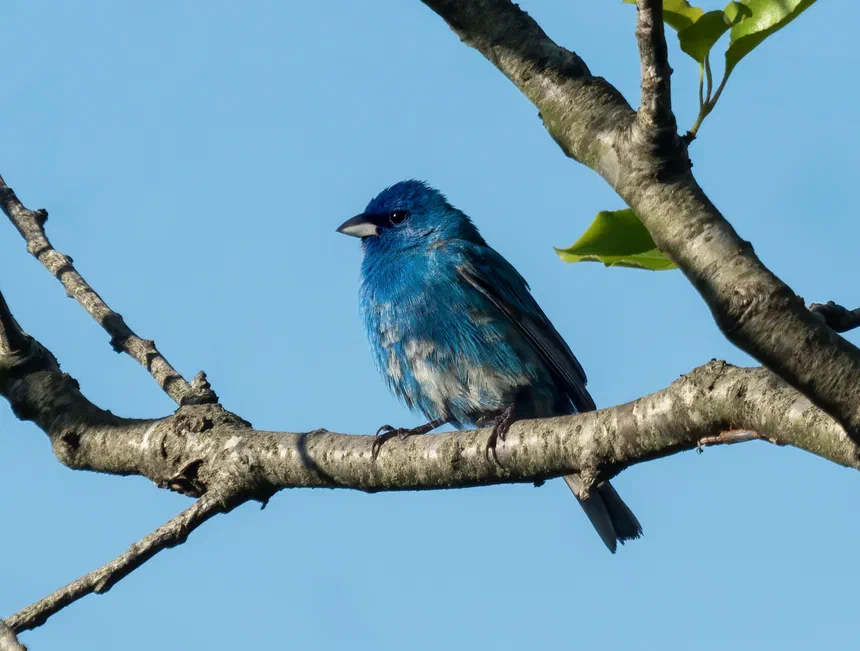
Image: Rhododendrites — CC BY-SA 4.0 · source
What Is a Indigo Bunting?
The indigo bunting (Passerina cyanea) is a small, seed-eating songbird in the cardinal family, Cardinalidae. It is best known for the dazzling blue plumage of breeding males, which flock to brushy fields and woodland edges across eastern North America each summer. Despite its tropical-looking color, it is one of the most familiar and widespread songbirds of the continent’s warmer months.
Appearance and Identification
The indigo bunting is a compact finch-like bird, roughly 4.5 to 5.1 inches (11.5 to 13 cm) long with a short, conical, silvery bill built for cracking seeds. Breeding males are an eye-catching, saturated blue over the entire body, often appearing brighter on the head. This blue is not a true pigment but a structural color: microscopic feather structures scatter light, so a male can look nearly black in shadow and vivid turquoise in direct sun. Females and immature birds are a plain warm brown, usually paler on the underparts with faint streaking and, at times, a hint of blue in the wings or tail. In winter, males molt into a brown, female-like plumage flecked with patches of blue. The species weighs only about 0.4 to 0.6 ounces (12 to 18 grams).
Habitat and Range
Indigo buntings favor open and semi-open country: overgrown fields, forest clearings, brushy roadsides, power-line cuts, hedgerows, and the shrubby edges where woodland meets meadow. They have adapted well to human-altered landscapes and are often seen singing from wires or the tops of small trees. Their breeding range covers much of eastern and central North America, from southern Canada south through the eastern and central United States. They are long-distance migrants, spending the winter in Mexico, Central America, the Caribbean, and occasionally northern South America.
Diet
The indigo bunting is an omnivore whose diet shifts with the seasons. In spring and summer, when raising young, it eats large numbers of insects and other small invertebrates, including caterpillars, beetles, grasshoppers, and spiders. During cooler months and migration, it relies more heavily on seeds from grasses, weeds, and small grains, as well as berries and buds. Birds forage on the ground and in low vegetation, and they readily visit feeders offering small seeds such as nyjer and millet.
Behavior
Male indigo buntings are persistent singers, delivering a bright, paired-note song from exposed perches through the heat of summer. Young males learn their songs from neighboring males rather than their fathers, which produces local “song neighborhoods” where nearby birds share similar phrases. The species is largely diurnal but migrates at night, and researchers have shown that it uses the pattern of stars around the North Star to orient during nocturnal flights. Outside the breeding season, indigo buntings often gather in loose flocks, sometimes mixing with other seed-eating songbirds.
Life Cycle and Reproduction
Breeding takes place in late spring and summer. The female builds a cup-shaped nest of grasses, leaves, and stems low in dense shrubs or tall weeds, and she does most of the incubation. A typical clutch contains about three to four pale, unmarked eggs, which hatch after roughly 12 to 13 days. The chicks are altricial, hatching naked and helpless, and they fledge about 9 to 12 days later. In the southern parts of the range, a pair may raise two broods in a single season. Like many open-nesting songbirds, indigo buntings are frequent hosts to brown-headed cowbirds, which lay their eggs in bunting nests.
Conservation Status
The indigo bunting is listed as Least Concern by the IUCN. It remains abundant and widespread, and its use of disturbed, shrubby habitats has helped it thrive alongside human land use such as farming and forestry clearings. Overall populations are considered stable, though like many migratory songbirds it can be affected by habitat loss on wintering grounds and collisions during migration.
Frequently Asked Questions
Are female indigo buntings blue? No. Females are a plain warm brown and lack the vivid blue of breeding males, which can make them tricky to identify.
Why does a male indigo bunting sometimes look black? The blue comes from light scattering in the feather structure rather than pigment, so in poor light or shade a male can appear dark gray or black.
Where do indigo buntings go in winter? They migrate south to Mexico, Central America, and the Caribbean, traveling at night and returning north to breed the following spring.