Birds Guide
Indian Vulture
What Is a Indian Vulture? The Indian vulture (Gyps indicus) is a large Old World vulture native to the Indian subcontinent. It belongs to the genus Gyps, a group of gregarious griffon-type scavengers built for soaring …
At a glance
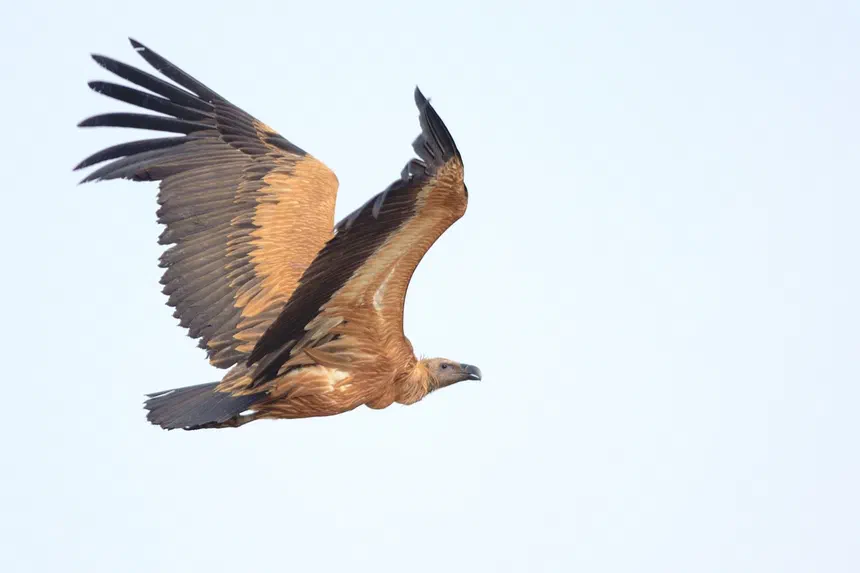
Image: Deepak sankat — CC BY-SA 3.0 · source
What Is a Indian Vulture?
The Indian vulture (Gyps indicus) is a large Old World vulture native to the Indian subcontinent. It belongs to the genus Gyps, a group of gregarious griffon-type scavengers built for soaring flight and communal feeding on carrion. Once abundant, it is now one of the most threatened birds in Asia.
Appearance and Identification
The Indian vulture is a heavy-bodied raptor with a pale sandy-brown to buff body and contrasting darker flight feathers that appear almost black against the wings’ undersides. The head and neck are largely bare, showing dusky, wrinkled skin, an adaptation that keeps feathers clean when the bird feeds inside a carcass. A ruff of short, pale down encircles the base of the neck. The bill is stout and pale, and the eyes are dark. In flight, the broad wings and short, wedge-shaped tail create the characteristic griffon silhouette. It closely resembles the slender-billed vulture (Gyps tenuirostris), with which it was once lumped as a single species, but the Indian vulture is bulkier with a heavier bill.
Habitat and Range
This species favors open and semi-open country, including dry plains, agricultural land, scrubby hills, and rocky river gorges. It ranges across peninsular India and extends into parts of Pakistan and Nepal. Unlike some relatives that nest primarily in trees, the Indian vulture typically nests on cliff ledges and in crags, often in loose colonies. It frequently occurs near villages, towns, and slaughter sites, where livestock carcasses provide a reliable food supply. Birds may travel long distances each day, riding thermal updrafts to cover wide areas in search of food.
Diet
The Indian vulture is an obligate scavenger, feeding almost entirely on the carcasses of dead animals, particularly domestic livestock such as cattle and buffalo. It has no role as a predator and lacks the powerful feet needed to kill prey. Using keen eyesight, it locates carcasses from great heights and descends in numbers, often alongside other vulture species. Its bare head and long neck let it reach deep into a carcass, and its strong bill tears through hide and soft tissue. By quickly consuming carrion, large flocks help remove animal remains from the landscape and limit the spread of disease.
Behavior
Highly social, Indian vultures roost, nest, and feed in groups. They spend much of the day soaring on rising columns of warm air, expending little energy while scanning the ground below. At a carcass, a strict but competitive feeding order forms, with birds jostling for access. They are largely silent but produce hisses, grunts, and cackles when squabbling over food or at the nest. Away from feeding sites, they gather at communal roosts on cliffs or tall structures, sunning themselves with wings spread in the morning before the air warms enough for soaring.
Life Cycle and Reproduction
Indian vultures are slow breeders, which makes population recovery difficult. Pairs are generally monogamous and nest on cliff ledges or rocky outcrops, building a platform of sticks. The female usually lays a single egg per breeding season. Both parents share incubation, which lasts roughly seven to eight weeks, and both feed the chick by regurgitation. The young bird remains dependent for several months and is slow to fledge. Birds do not reach breeding maturity until around four to five years of age, and a pair may raise only one chick per year, so losses to a population are replaced very slowly.
Conservation Status
The Indian vulture is listed as Critically Endangered by the IUCN. Beginning in the 1990s, its numbers collapsed catastrophically, falling by well over 90 percent across the region. The primary cause was diclofenac, a veterinary anti-inflammatory drug given to livestock; vultures that fed on carcasses of treated animals suffered fatal kidney failure. India, Pakistan, and Nepal have since banned veterinary diclofenac, and conservation programs now include captive breeding, “vulture safe zones,” and supplementary feeding at protected sites. Recovery remains slow because of the species’ low reproductive rate and continued exposure to other harmful drugs.
Frequently Asked Questions
Why did Indian vulture populations crash so quickly? The veterinary drug diclofenac, used to treat livestock, is highly toxic to Gyps vultures. Birds feeding on carcasses of treated animals died of kidney failure, causing one of the fastest declines ever recorded in a bird.
Are Indian vultures dangerous to people or livestock? No. They are pure scavengers that eat only dead animals and cannot kill prey. By clearing carcasses, they actually benefit human communities.
How is the Indian vulture different from other Gyps vultures? It is a bulky, cliff-nesting griffon most easily confused with the slender-billed vulture, from which it differs in its heavier build and stouter bill.