Birds Guide
Indian Roller
What Is a Indian Roller? The Indian roller (Coracias benghalensis) is a stocky, medium-sized bird in the roller family (Coraciidae), celebrated across South Asia for its dazzling blue plumage. It is a familiar sight …
At a glance
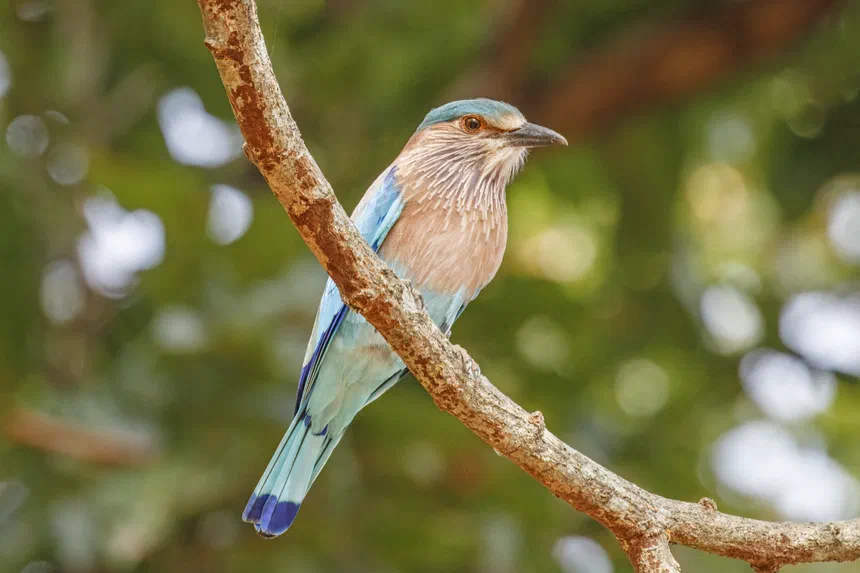
Image: Charles J. Sharp — CC BY-SA 4.0 · source
What Is a Indian Roller?
The Indian roller (Coracias benghalensis) is a stocky, medium-sized bird in the roller family (Coraciidae), celebrated across South Asia for its dazzling blue plumage. It is a familiar sight perched on roadside wires and bare branches, where it scans open ground for prey. The species takes its name from the tumbling, rolling aerial displays that males perform during the breeding season.
Appearance and Identification
At rest the Indian roller can look rather plain, showing a warm pinkish-brown breast and a dull bluish crown. In flight, however, it transforms into one of the most striking birds of the region: the wings and tail flash bands of deep purple-blue and bright turquoise. Adults measure roughly 30 to 34 centimeters in length, with a wingspan of about 65 to 74 centimeters, and weigh somewhere between 80 and 120 grams. The bill is strong, dark, and slightly hooked, well suited to seizing hard-bodied insects. Males and females look broadly similar, and juveniles appear duller with less vivid coloring than adults.
Habitat and Range
This roller favors open and semi-open country. It thrives in cultivated farmland, grassland, dry scrub, thin woodland, and the edges of villages and towns, generally avoiding dense forest and true desert. Its range extends across much of the Indian subcontinent, reaching west into parts of the Middle East and the Arabian Peninsula and east toward Southeast Asia. The Indian roller is largely resident and sedentary across most of this range, though some populations make short local movements in response to seasonal conditions. It is quick to exploit human-altered landscapes, and freshly plowed fields often attract several birds hunting the exposed prey.
Diet
The Indian roller is a carnivore that feeds mainly on large insects such as grasshoppers, crickets, beetles, and winged termites. It also takes spiders, small lizards, frogs, and occasionally small snakes and rodents. A typical hunting strategy is the “perch and pounce”: the bird waits on an elevated lookout, then drops swiftly to the ground to grab prey before returning to its perch. Hard or dangerous items are often beaten against a branch before being swallowed. Rollers gather readily around grass fires and around grazing livestock, snapping up the insects that are flushed into the open.
Behavior
Outside the breeding season the Indian roller is usually seen alone or in loose pairs, spending long periods sitting motionless on a prominent perch. It is most active in the cooler hours of morning and late afternoon. The bird’s common name comes from its spectacular courtship flight, in which the male climbs, then dives and twists while rocking from side to side, flashing its blue wings and giving harsh, croaking calls. These displays advertise territory and help attract or reaffirm a mate. Away from breeding, the species is fairly quiet, but it can be aggressive toward intruders near a nest.
Life Cycle and Reproduction
Breeding generally takes place in the warmer months, timed so that chicks hatch when insect prey is abundant. The Indian roller is a cavity nester, using natural tree holes, old woodpecker or barbet holes, cavities in buildings, and similar sheltered sites; the nest itself is sparsely lined. A clutch usually contains around three to five glossy white eggs. Both parents share incubation, which lasts roughly two and a half to three weeks, and both feed the young. The chicks are altricial, hatching blind and helpless, and remain in the nest for several weeks before fledging. Wild birds may live around eight to ten years.
Conservation Status
The Indian roller is classified as Least Concern by the IUCN. It has a very wide range and a large, generally stable population, and it adapts well to farmland and other human-modified habitats. Localized declines have been noted in some areas, linked mainly to heavy pesticide use, which reduces insect prey, and to the loss of large nesting trees. Even so, the species remains common and conspicuous across most of its range. It holds cultural significance in parts of India, where it has been chosen as a state bird and is regarded as auspicious.
Frequently Asked Questions
Why is it called a “roller”? The name refers to the male’s dramatic courtship flight, in which he rolls, tumbles, and twists in the air while showing off his brilliant blue wing feathers.
Are Indian rollers really blue? At rest they look mostly brown with a bluish wash, but their wings and tail reveal vivid bands of turquoise and deep blue whenever they take flight.
What do Indian rollers eat? They are insect-focused hunters, taking grasshoppers, beetles, and termites along with small lizards, frogs, and other small prey caught on the ground.