Birds Guide
Indian Robin
What Is a Indian Robin? The Indian robin (Copsychus fulicatus) is a small, sprightly songbird native to the open landscapes of the Indian subcontinent. A member of the Old World flycatcher family (Muscicapidae), it is …
At a glance
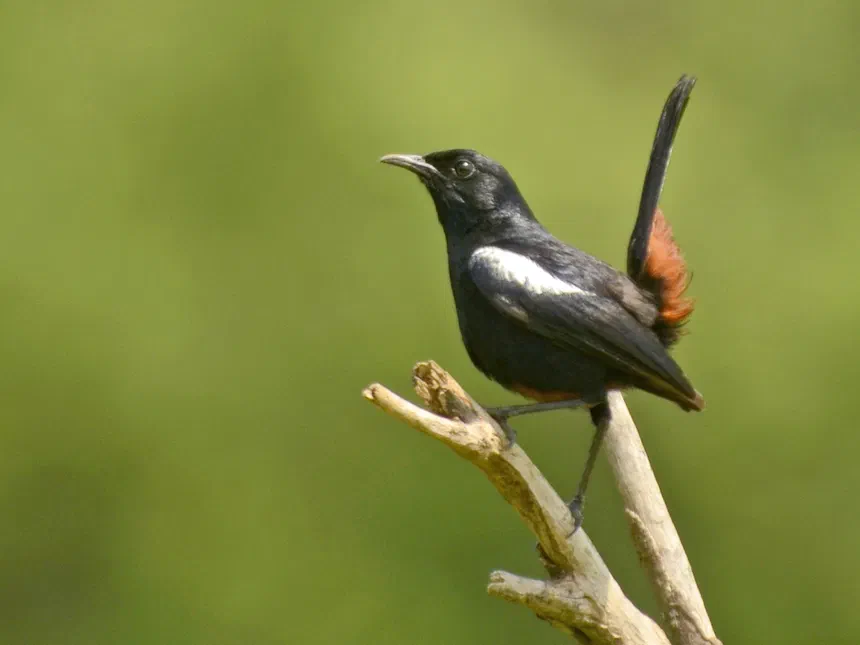
Image: PJeganathan, cropped & flipped left-right for taxobox use by MPF — CC BY-SA 4.0 · source
What Is a Indian Robin?
The Indian robin (Copsychus fulicatus) is a small, sprightly songbird native to the open landscapes of the Indian subcontinent. A member of the Old World flycatcher family (Muscicapidae), it is best known for its habit of cocking its tail high over its back to reveal a flash of rust-colored feathers underneath. Despite its name, it is not closely related to the familiar European or American robins.
Appearance and Identification
The Indian robin shows clear differences between the sexes. Males are largely glossy black, often with a bluish sheen, and display a conspicuous white patch on the shoulder or wing coverts. The undertail and vent are a warm chestnut or rufous, which becomes striking when the tail is raised. Females and juveniles are far plainer, dressed in soft grey-brown tones with paler underparts, though they share the same rusty vent.
Regional populations vary: birds in the north tend to have brown backs, while those farther south are more uniformly black. The species measures roughly 16 to 18 centimeters in length, with a slim body, long legs suited to a ground-foraging life, and a thin, pointed bill typical of insect-eaters. Adults weigh only about 15 to 25 grams.
Habitat and Range
This adaptable bird favors dry, open habitats. It thrives in scrubland, stony hillsides, fallow fields, village edges, and gardens, and it is often seen hopping across bare ground or perching on low rocks, walls, and fence posts. It generally avoids dense forest and heavy rainfall zones, preferring semi-arid and lightly cultivated country.
The Indian robin is widespread across the Indian subcontinent, occurring throughout much of India, as well as parts of Pakistan, Nepal, Bangladesh, and Sri Lanka. It is largely a resident, non-migratory species, staying within its home range year-round.
Diet
The Indian robin is primarily insectivorous. It feeds on a broad range of small invertebrates, including beetles, ants, termites, grasshoppers, caterpillars, and spiders. It typically hunts on or near the ground, making short dashes to snatch prey or picking insects from low vegetation and soil. On occasion it will also take small amounts of plant material such as berries. Its ground-foraging style, punctuated by frequent pauses and tail-flicking, is characteristic and helps distinguish it in the field.
Behavior
Active and confident around people, the Indian robin is a common sight in rural and suburban settings. It moves in quick hops and short flights, frequently flicking its wings and raising its tail to expose the chestnut underside, a display used in both social signaling and courtship. Males are territorial and sing a pleasant, warbling series of whistled notes, often from an exposed perch, especially during the breeding season. The species is generally seen singly or in pairs rather than in flocks.
Life Cycle and Reproduction
Breeding usually coincides with the warmer and monsoon months, though timing varies across the bird’s wide range. The nest is a simple cup of grasses, rootlets, and fine material, often tucked into a crevice among rocks, a hole in a wall, or the base of a shrub. The female typically lays two to four eggs, which are pale with darker speckling.
Incubation lasts roughly two weeks, and the chicks are altricial, hatching helpless and dependent on their parents. Both adults help feed the young, which fledge within about two weeks of hatching. Pairs may raise more than one brood in a favorable season. In the wild, Indian robins are thought to live around five to eight years.
Conservation Status
The Indian robin is classified as Least Concern by the IUCN. It has a large range and a stable, widespread population, and it tolerates human-modified landscapes well. Because it readily uses farmland, village margins, and gardens, it has not suffered the declines seen in more habitat-specialized birds. No major threats are currently recognized, though local pressures such as pesticide use can affect insect prey.
Frequently Asked Questions
Is the Indian robin related to the American or European robin? No. Despite the shared name, it belongs to the Old World flycatcher family and is not closely related to those thrushes; the name reflects a superficial resemblance and perky behavior.
Why does the Indian robin raise its tail? Raising the tail displays the bright chestnut feathers beneath and serves as a signal in courtship and territorial interactions, as well as a general expression of alertness.
Where can I see an Indian robin? It is common across the Indian subcontinent in dry, open country, scrubland, farmland edges, and gardens, often perched on rocks, walls, or low bushes.