Birds Guide
Indian Paradise Flycatcher
What Is a Indian Paradise Flycatcher? The Indian paradise flycatcher (Terpsiphone paradisi) is a medium-sized passerine bird known for the extravagantly long tail streamers of adult males. A member of the monarch …
At a glance
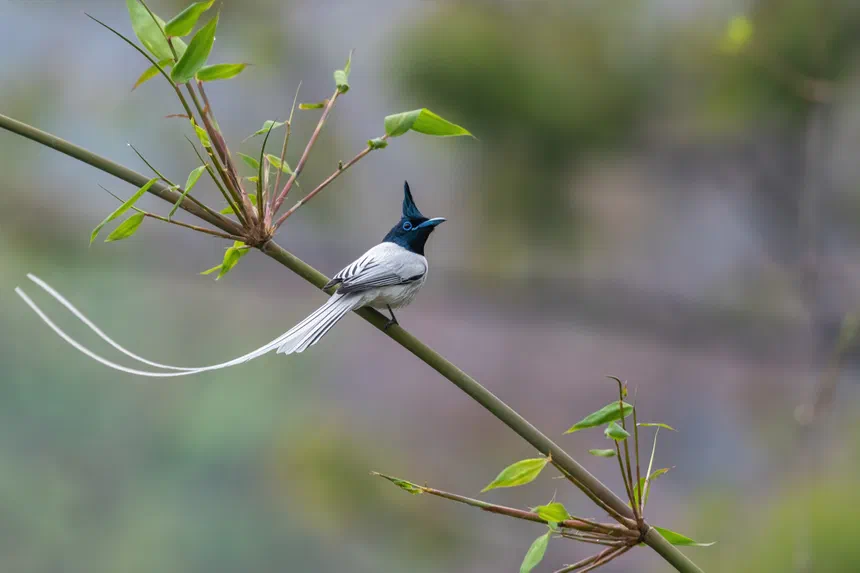
Image: Mildeep — CC BY-SA 4.0 · source
What Is a Indian Paradise Flycatcher?
The Indian paradise flycatcher (Terpsiphone paradisi) is a medium-sized passerine bird known for the extravagantly long tail streamers of adult males. A member of the monarch flycatcher family (Monarchidae), it is a familiar sight in the woodlands and gardens of South and Southeast Asia, where its bold coloring and fluttering flight make it hard to miss.
Appearance and Identification
Both sexes have a glossy black head, a black throat, and a prominent crest, set off by a ring of blue skin around the eye and a stout blue-based bill. The body length is roughly 19 to 22 centimeters, but adult males carry two greatly elongated central tail feathers that can trail 24 centimeters or more behind them. Males occur in two color forms: a rufous (chestnut) morph and a striking white morph in which the back, wings, and streamers turn pure white with fine black shaft lines. Females and young males are rufous above with grayish underparts and lack the long streamers. The species weighs only about 12 to 23 grams.
Habitat and Range
This flycatcher favors shaded, moist forest and secondary woodland, but it also settles readily in bamboo, mango groves, garden trees, and the leafy edges of cultivated land. It ranges widely across the Indian subcontinent and into parts of Central and Southeast Asia. Populations in the cooler north are migratory, moving south to peninsular India, Sri Lanka, and neighboring regions for the non-breeding season, while birds in warmer areas may be resident year-round. It is generally a lowland and hill-country species, ranging from sea level up into moderate elevations.
Diet
The Indian paradise flycatcher is almost entirely insectivorous. It hunts by “hawking,” launching from an exposed perch to snatch flying insects in mid-air before returning to a branch, and it also gleans prey from foliage. Its diet includes flies, moths, small beetles, wasps, and other winged insects. The active, darting foraging style keeps the bird constantly on the move through the middle and lower levels of the canopy.
Behavior
Restless and agile, this bird flits through shaded foliage with quick sallies, the male’s streamers rippling behind it like ribbons. It is often detected first by voice, giving sharp, scolding calls and a pleasant, warbling song during the breeding season. Outside of nesting it tends to be solitary or found in loose association with mixed-species foraging flocks. It is territorial when breeding, and pairs will actively drive off intruders and potential nest predators.
Life Cycle and Reproduction
Breeding generally coincides with the warmer and wetter months across much of the range. The pair builds a small, neat cup nest of fine plant fibers, grass, and cobwebs, usually placed in the fork of a slender branch and often over or near water. A typical clutch is three to four eggs. Both parents share incubation, which lasts roughly two weeks, and both feed the nestlings, which fledge a couple of weeks after hatching. Young males take a few years to acquire their full adult plumage and the long tail streamers, so first-year breeding males may look much like females.
Conservation Status
The Indian paradise flycatcher is listed as Least Concern by the IUCN. It has a large range and remains fairly common in suitable habitat, and it adapts well to gardens and lightly disturbed woodland. Localized threats include the loss of mature trees and shaded forest, but no widespread decline is currently recognized.
Frequently Asked Questions
Why do only some males have long tails? The dramatic tail streamers develop as males mature; young males resemble females and gradually grow the streamers over their first few years.
What is the difference between the white and rufous males? Both are the same species in different color morphs. Rufous males are chestnut-backed, while white-morph males have pure white plumage with fine black feather lines.
Where does the bird go in winter? Northern breeding populations migrate south to peninsular India, Sri Lanka, and Southeast Asia, while birds in warmer regions may stay in place year-round.