Birds Guide
Indian Cormorant
What Is a Indian Cormorant? The Indian cormorant (Phalacrocorax fuscicollis) is a medium-sized, fish-eating waterbird found across much of South and Southeast Asia. A member of the cormorant family (Phalacrocoracidae), …
At a glance
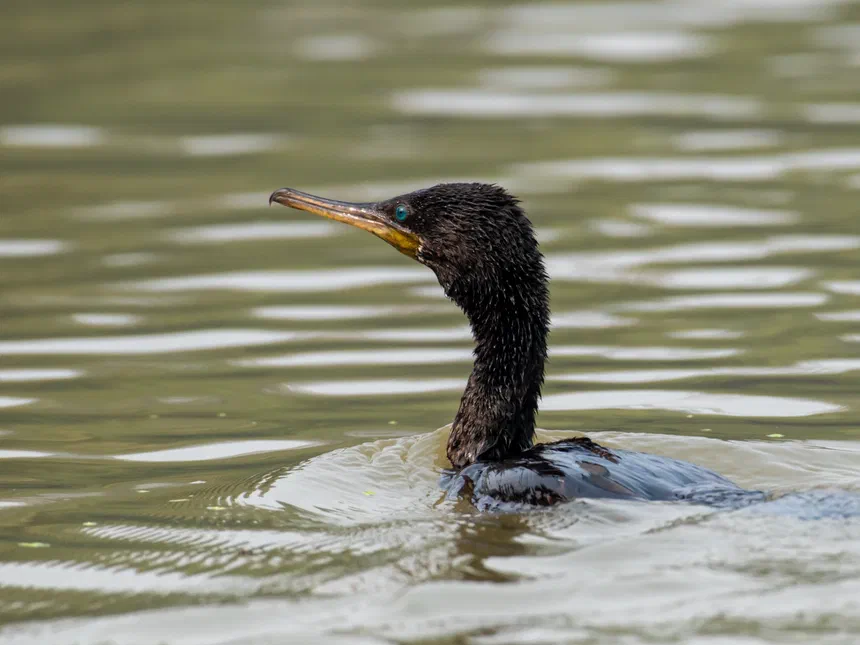
Image: Rohit Sharma — CC BY-SA 4.0 · source
What Is a Indian Cormorant?
The Indian cormorant (Phalacrocorax fuscicollis) is a medium-sized, fish-eating waterbird found across much of South and Southeast Asia. A member of the cormorant family (Phalacrocoracidae), it is a strong underwater swimmer that pursues prey by diving beneath the surface. It is often seen in large, sociable flocks on inland wetlands and along sheltered coasts.
Appearance and Identification
Adults are almost entirely glossy black with a faint bronze or coppery sheen across the back and wings, where dark-edged feathers create a scaled pattern. The species is slim and slightly built, with a long neck, a fairly long, narrow bill that hooks at the tip, and striking blue-green or turquoise eyes. In breeding condition, adults develop a small white patch or short white plumes near the ear and a slightly more prominent forehead. Juveniles are duller and browner, often paler on the underparts. The Indian cormorant is easily confused with the smaller little cormorant, but it is longer-necked, has a more slender bill, and shows the distinctive bright eye. Overall length is about 60 to 65 centimeters (24 to 26 inches).
Habitat and Range
This cormorant favors freshwater habitats, including lakes, ponds, rivers, canals, flooded fields, and large reservoirs, though it also frequents estuaries, tidal creeks, and sheltered coastal waters. It is widespread across the Indian subcontinent, including India, Pakistan, Nepal, Bangladesh, and Sri Lanka, and extends eastward into parts of mainland Southeast Asia such as Myanmar, Thailand, Cambodia, and Vietnam. The species is largely resident but makes local movements in response to water levels, rainfall, and the availability of fish, sometimes gathering in enormous numbers where prey is abundant.
Diet
The Indian cormorant is a carnivore that feeds almost entirely on fish. It hunts by diving from the surface and propelling itself underwater with its webbed feet, seizing prey in its hooked bill. It commonly forages in cooperative flocks, with many birds diving together and driving fish into tight, easily caught shoals. Small to medium fish make up the bulk of the diet, but it will also take aquatic invertebrates, amphibians, and crustaceans when available. Like other cormorants, its plumage is not fully waterproof, so birds are frequently seen perched with wings spread to dry after feeding.
Behavior
Highly gregarious, Indian cormorants roost, breed, and often feed in groups that can number from a few birds to many thousands. They are strong, direct fliers and typically travel in loose lines or V-formations between roosts and feeding grounds. When not fishing, they rest on rocks, sandbars, posts, dead trees, and overhead wires, often in the company of other waterbirds such as darters, egrets, and herons. The wing-spreading posture, common to cormorants, helps them dry their feathers and regulate body temperature. They are generally quiet away from colonies but become vocal at breeding sites, producing low grunts and croaks.
Life Cycle and Reproduction
Breeding is often tied to the rainy season and periods of high water, when food is plentiful. Indian cormorants nest colonially, frequently alongside other waterbirds in mixed heronries built in trees standing in or near water. The nest is a fairly untidy platform of sticks and vegetation, usually placed over water. A typical clutch contains around three to five pale, chalky bluish eggs. Both parents share incubation and later feed the chicks, which hatch naked and helpless and are brooded closely in their early days. The young are fed regurgitated fish and remain dependent on the adults for several weeks before fledging and gradually becoming independent.
Conservation Status
The Indian cormorant is listed as Least Concern by the IUCN. It has a very large range and a sizeable, generally stable population, and it adapts well to human-modified wetlands such as reservoirs, fish ponds, and irrigation systems. Localized threats include wetland drainage, pollution, disturbance at nesting colonies, and, in some areas, persecution by fisheries that view the birds as competitors. On the whole, however, the species remains common and widespread across its range.
Frequently Asked Questions
How is the Indian cormorant different from the little cormorant? The Indian cormorant is larger and more slender, with a longer neck, a narrower bill, and bright blue-green eyes, while the little cormorant is smaller, stockier, and shorter-billed.
What does the Indian cormorant eat? It eats mainly fish, which it catches by diving and swimming underwater, often hunting cooperatively in flocks.
Why do cormorants stand with their wings spread out? Their feathers are not fully waterproof, so they spread their wings to dry after diving and to help regulate their body temperature.