Birds Guide
Inca Tern
What Is a Inca Tern? The Inca tern (Larosterna inca) is a striking seabird found along the cool, productive waters of the Humboldt Current off western South America. Instantly recognizable by its dark plumage and curling …
At a glance
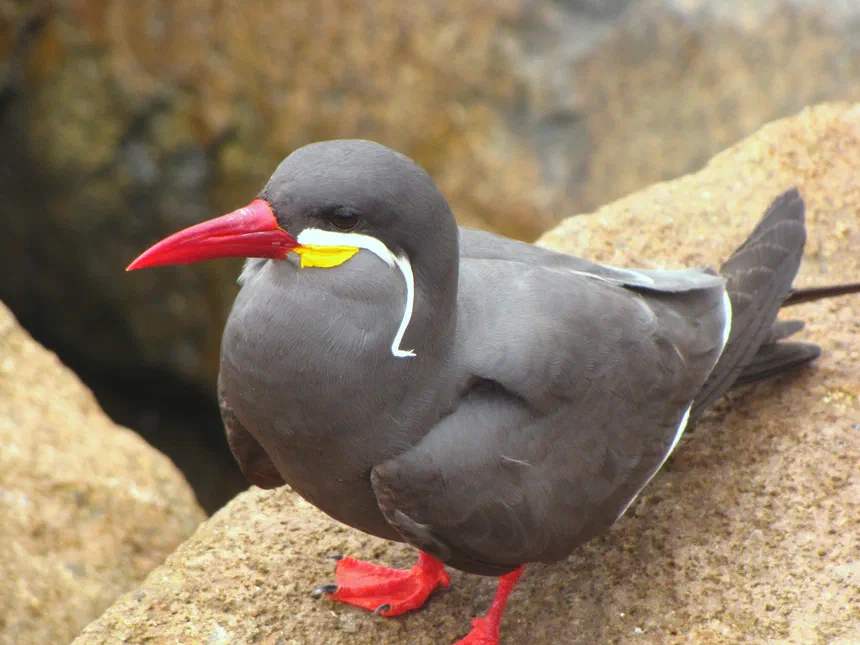
What Is a Inca Tern?
The Inca tern (Larosterna inca) is a striking seabird found along the cool, productive waters of the Humboldt Current off western South America. Instantly recognizable by its dark plumage and curling white “mustache,” it is one of the most distinctive terns in the world and the only member of its genus.
Appearance and Identification
Adult Inca terns are cloaked in dark slate-gray plumage that can appear almost charcoal in strong light. The most memorable feature is a pair of long, curling white feather plumes that trail back from the base of the bill on each side of the face, resembling an elaborate mustache. The bill and legs are a vivid deep red, and there is a small patch of yellow, fleshy skin (wattle) at the corner of the mouth. The trailing edge of the wing shows a narrow white margin, and the tail is forked in typical tern fashion. Males and females look alike. Juveniles are duller, browner, and lack the developed white plumes, gaining full adult coloration over time.
Habitat and Range
This species is closely tied to the Humboldt Current ecosystem, ranging along the Pacific coast from northern Peru south to central Chile, with occasional wanderers turning up beyond this core range. Inca terns favor rocky coastlines, sea cliffs, offshore islands, and guano-covered stacks where they can roost and nest in relative safety. They forage over near-shore waters and are often seen resting on piers, rocks, and boats near fishing activity.
Diet
Inca terns are carnivores that feed mainly on small schooling fish such as anchovies, which are abundant in the nutrient-rich upwelling zones of the Humboldt Current. They also take small crustaceans and offal. Foraging birds hunt by plunge-diving and surface-dipping, and they readily follow fishing vessels, sea lions, whales, and other marine predators to snatch prey driven toward the surface. Large, noisy flocks may gather where prey is concentrated.
Behavior
Highly social, Inca terns roost, forage, and nest in colonies that can number in the thousands. They are agile, buoyant fliers and communicate with a range of calls, including a distinctive mewing note. Birds often loaf together on rocks and ledges between feeding bouts. Their close association with marine mammals and fishing operations reflects an opportunistic feeding strategy shaped by the boom-and-bust productivity of their upwelling habitat.
Life Cycle and Reproduction
Inca terns nest colonially on cliffs, in rock crevices, in burrows, and sometimes in cavities left by other seabirds, which offers shelter from sun and predators. A typical clutch contains one to two eggs, incubated by both parents for roughly four weeks. Chicks are cared for and fed by both adults, remaining dependent for several weeks before fledging. Breeding success is strongly influenced by food availability, which fluctuates with ocean conditions such as El Nino events that can suppress fish stocks.
Conservation Status
The Inca tern is listed as Near Threatened by the IUCN. Its population is concentrated in a relatively narrow coastal band and is sensitive to changes in prey abundance. Key threats include overfishing of anchovies and other forage fish, disturbance and habitat loss at nesting colonies, guano harvesting, predation by introduced animals, and the periodic food shortages caused by El Nino. Protecting nesting islands and managing fisheries sustainably are important for the species’ long-term security.
Frequently Asked Questions
Why does the Inca tern have a white “mustache”? The curling white facial plumes are a natural ornament present in adults of both sexes. Research suggests longer, fuller plumes signal better condition and may play a role in mate choice.
Where can I see Inca terns? They are best seen along the Pacific coasts of Peru and Chile, often near rocky shores, seabird islands, harbors, and active fishing areas.
What do Inca terns eat? They feed mostly on small fish like anchovies, along with crustaceans and scraps, often foraging alongside sea lions, whales, and fishing boats.