Birds Guide
Eastern Imperial Eagle
What Is a Eastern Imperial Eagle? The Eastern imperial eagle (Aquila heliaca) is a large bird of prey belonging to the booted eagle group, closely related to the golden eagle. It is a majestic raptor of the open lowlands …
At a glance
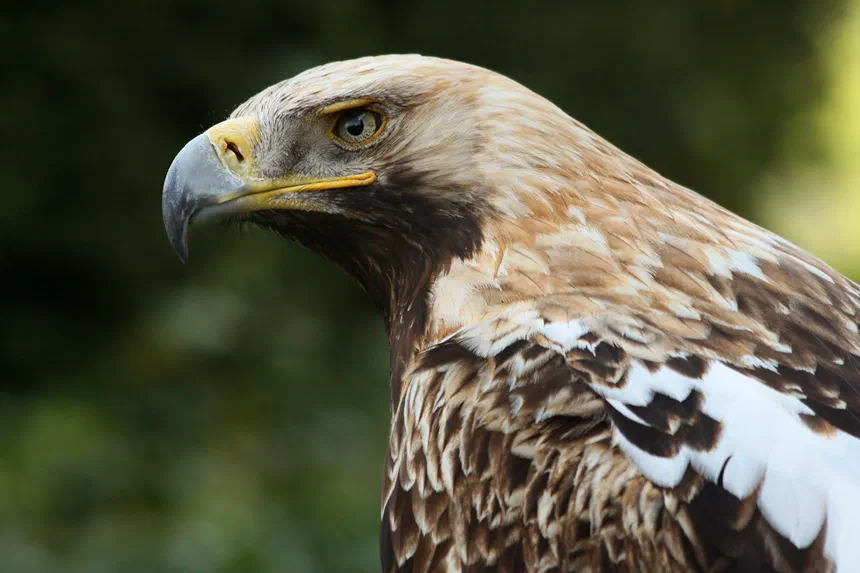
Image: user:AngMoKio — CC BY-SA 2.5 · source
What Is a Eastern Imperial Eagle?
The Eastern imperial eagle (Aquila heliaca) is a large bird of prey belonging to the booted eagle group, closely related to the golden eagle. It is a majestic raptor of the open lowlands and wooded steppe, ranging from central Europe eastward across Asia, and it holds cultural significance as a symbol of power in several nations along its range.
Appearance and Identification
Adults are dark brown to nearly blackish over most of the body, offset by a distinctly pale, golden-buff crown and nape that catches the light. The most reliable field marks are small white patches, or “braces,” on the leading edge of each shoulder, which are visible in flight and at rest. The wings are long and broad with parallel edges, and the tail is fairly long and gray-brown with darker barring and a broad terminal band. Juveniles look completely different, appearing pale sandy-brown with heavy streaking, and they take five to six years to acquire full adult plumage. In flight the species holds its wings nearly flat, unlike some other soaring raptors.
Habitat and Range
The Eastern imperial eagle favors open and semi-open country rather than dense forest. It nests in tall trees standing in or near steppe, agricultural land, river valleys, and grassy plains, often choosing an isolated tree with a commanding view of surrounding hunting grounds. Its breeding range stretches from central and southeastern Europe, including Hungary, Slovakia, and the Balkans, eastward through Russia, Ukraine, and the countries of Central Asia. Northern populations are migratory, wintering in the Middle East, northeastern Africa, the Arabian Peninsula, the Indian subcontinent, and southern China, while some southern birds remain year-round residents.
Diet
This eagle is a versatile carnivore that relies heavily on medium-sized ground mammals. Across much of its range, ground squirrels (susliks), hamsters, voles, and hares form the core of its diet. It also takes birds such as pheasants, partridges, crows, and waterfowl, along with the occasional reptile. Eastern imperial eagles readily feed on carrion, especially in winter when live prey is scarce, and they will sometimes pirate food from other raptors. They typically hunt from a perch or by quartering low over open ground, dropping onto prey in a swift stoop.
Behavior
Eastern imperial eagles are generally solitary or found in pairs, and established adults defend large territories throughout the breeding season. They are powerful, soaring fliers that use thermals to survey their range, and they can spend long periods perched watchfully on trees, pylons, or the ground. Pairs perform undulating display flights over their territory in spring, and they are known for strong, long-term pair bonds. Away from the breeding grounds, wintering birds can be more tolerant of one another and may gather where food is abundant.
Life Cycle and Reproduction
Pairs build a large stick nest high in a tree, reusing and adding to it over successive years until it becomes a bulky structure. The female usually lays two to three eggs, and incubation, carried out mainly by the female, lasts roughly six weeks. Although several chicks may hatch, sibling rivalry and food shortages often mean that not all survive to fledging. The young leave the nest at around two months of age but remain dependent on their parents for some weeks afterward. Eastern imperial eagles do not reach breeding maturity until they are four to six years old.
Conservation Status
The Eastern imperial eagle is classified as Vulnerable by the IUCN, with a global population estimated in the low thousands of breeding pairs and declining in many areas. The main threats include electrocution and collision on power lines, illegal shooting and poisoning, habitat loss from agricultural intensification, and disturbance at nest sites. Targeted conservation work, including insulating dangerous power poles, protecting nesting trees, and anti-poisoning campaigns, has helped stabilize or even increase some European populations, showing that focused effort can make a real difference.
Frequently Asked Questions
How is the Eastern imperial eagle different from the golden eagle? The two are close relatives, but imperial eagles are darker overall with a pale golden nape and small white shoulder patches, and they prefer lowland steppe rather than the golden eagle’s mountainous terrain.
Where do Eastern imperial eagles live? They breed across central and eastern Europe and Central Asia, favoring open wooded steppe and farmland, and northern birds migrate south to the Middle East, Africa, and southern Asia for winter.
Are Eastern imperial eagles endangered? They are listed as Vulnerable, meaning they face a real risk of extinction if threats such as power-line deaths and poisoning are not managed, though conservation efforts have improved the outlook in parts of Europe.