Birds Guide
Iiwi
What Is a Iiwi? The iiwi (Drepanis coccinea) is a striking scarlet songbird endemic to the Hawaiian Islands and one of the most recognizable of the Hawaiian honeycreepers. Famous for its vivid vermilion plumage and long, …
At a glance
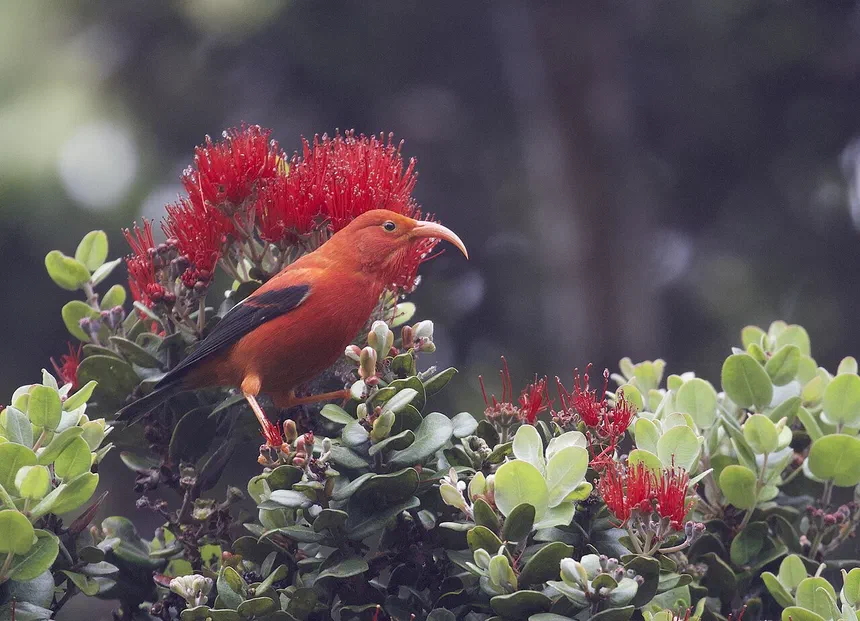
Image: Gregory "Slobirdr" Smith — CC BY-SA 2.0 · source
What Is a Iiwi?
The iiwi (Drepanis coccinea) is a striking scarlet songbird endemic to the Hawaiian Islands and one of the most recognizable of the Hawaiian honeycreepers. Famous for its vivid vermilion plumage and long, curved salmon-colored bill, it has become a living emblem of Hawaii’s native forests and their ongoing conservation struggles.
Appearance and Identification
Adult iiwi are unmistakable. Their bodies are a brilliant vermilion-red, set against jet-black wings and tail, while a long, deeply curved bill glows salmon-pink to orange. This decurved bill evolved to probe the tubular flowers of native plants such as the ohia lehua. Adults measure roughly 12 to 15 centimeters in length and weigh only about 16 to 20 grams. Juveniles look very different, with dull golden-yellow to olive plumage flecked with dark spots and a paler bill, gradually molting into the adult’s fiery red over their first year. In flight, iiwi produce a distinctive whirring of the wings, and their varied calls include creaky, rusty-hinge notes and clear whistles.
Habitat and Range
The iiwi is found only in Hawaii. It once ranged widely across the main islands, but today the largest populations persist on Hawaii Island (the Big Island), Maui, and Kauai, with only remnants or near-absence elsewhere. The birds favor wet and mesic native forests dominated by ohia and koa trees. Crucially, iiwi have retreated to higher elevations, generally above roughly 1,200 to 1,500 meters, where cooler temperatures limit the mosquitoes that transmit deadly avian malaria. This dependence on high-elevation refuges makes the species especially sensitive to a warming climate.
Diet
Iiwi are primarily nectarivores. They feed on nectar drawn from the flowers of native trees and shrubs, historically favoring lobelioids with long curved blossoms that matched their bill shape, and now relying heavily on ohia lehua. As they feed, they act as important pollinators, transferring pollen between flowers. Iiwi also glean small insects and spiders from foliage, which provide protein, particularly valuable during breeding. Highly mobile, they may travel considerable distances or move up and down mountain slopes in pursuit of flowering trees.
Behavior
These are active, energetic birds, often seen darting among the canopy and defending flowering trees or clumps of blossoms from rivals. Iiwi are known for their strong seasonal movements, tracking the bloom of ohia across the landscape, which can concentrate large numbers in flowering areas. Their vocal repertoire is remarkably diverse, mixing whistles, squeaks, and mechanical-sounding notes; early Hawaiians noted their creaking calls. The whirring flight sound produced by their wings is another useful identifying trait in the forest.
Life Cycle and Reproduction
Breeding is closely tied to the flowering of ohia, typically peaking in the cooler, wetter months from roughly late winter into spring. Iiwi build small cup-shaped nests of twigs, rootlets, and fibers placed high in the branches of native trees. Clutches usually contain two to three eggs, incubated mainly by the female for about two weeks. Both parents help feed the nestlings, which fledge within a couple of weeks of hatching. Young birds retain their mottled juvenile plumage for several months before acquiring adult coloration. In the wild, iiwi may live for several years, with typical lifespans in the range of about five to ten years.
Conservation Status
The iiwi is classified as Vulnerable by the IUCN and is protected under the U.S. Endangered Species Act as threatened. Although still numbering in the hundreds of thousands overall, its populations are highly uneven, with Hawaii Island holding the great majority and other islands severely depleted. The species faces serious threats from introduced mosquitoes carrying avian malaria and pox, to which iiwi are extremely susceptible, as well as habitat loss, invasive predators, and non-native plants. As climate change pushes disease-bearing mosquitoes into higher elevations, the cool refuges the iiwi depends on are shrinking, making conservation of high-elevation forests and mosquito control central to the bird’s future.
Frequently Asked Questions
Why is the iiwi red? Its brilliant vermilion plumage likely functions in social signaling and mate recognition. The color makes adults conspicuous in the green forest canopy, while dull juveniles are far more camouflaged.
What does the iiwi eat? It feeds mainly on flower nectar, especially from ohia lehua, and supplements this with small insects and spiders for protein.
Why does the iiwi live only at high elevations? Higher, cooler forests limit the mosquitoes that spread avian malaria, a disease the iiwi tolerates poorly, so these zones serve as vital disease refuges.