Birds Guide
Hyacinth Macaw
What Is a Hyacinth Macaw? The hyacinth macaw (Anodorhynchus hyacinthinus) is the largest flying parrot in the world and one of the most instantly recognizable birds of South America. Cloaked in vivid cobalt-blue plumage …
At a glance
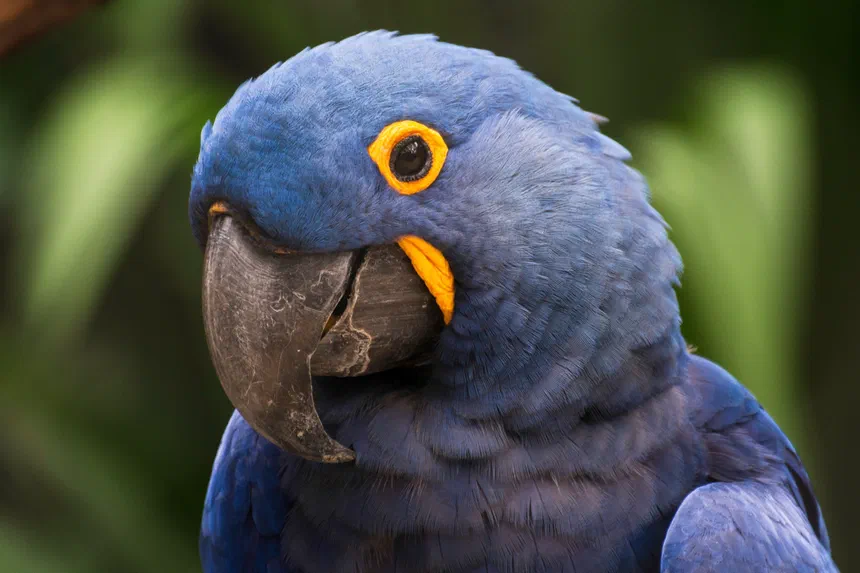
Image: Leonardo Ramos — CC BY-SA 4.0 · source
What Is a Hyacinth Macaw?
The hyacinth macaw (Anodorhynchus hyacinthinus) is the largest flying parrot in the world and one of the most instantly recognizable birds of South America. Cloaked in vivid cobalt-blue plumage and marked with bright yellow skin around the eyes and bill, it is a powerful, long-tailed macaw of the continent’s interior wetlands and palm savannas.
Appearance and Identification
Hyacinth macaws are almost entirely deep blue, with the plumage often described as cobalt or violet-blue and appearing darker on the wings. The most striking identifying features are patches of bare yellow skin: a ring encircling each eye and a crescent of yellow along the lower edge of the massive black bill. That bill is heavy and strongly hooked, built for cracking extremely hard nuts. Adults measure roughly a meter in length, much of it accounted for by the long, tapering tail, and typically weigh between about 1.2 and 1.7 kilograms. Males and females look alike, and juveniles resemble adults but have shorter tails and paler yellow facial skin. The species is easily distinguished from the smaller, similarly colored Lear’s macaw by its greater size and range.
Habitat and Range
The hyacinth macaw occupies three main regions of central South America. The largest population lives in the Pantanal, the vast seasonal wetland of southwestern Brazil, extending into eastern Bolivia and northern Paraguay. Other populations occur in the cerrado grasslands of central Brazil and in the palm-dotted savannas and gallery forests farther north and east. Across these areas the bird favors open and semi-open landscapes with scattered palms and stands of trees, rather than dense, unbroken rainforest. Access to large trees and palms for nesting and to nut-bearing palms for food shapes where it can live.
Diet
This macaw is a specialist herbivore whose diet centers on the nuts of a handful of palm species, including acuri and bocaiuva palms. Its enormously strong bill can crush the woody shells that defeat most other animals, giving it access to a rich, fatty food source. In the Pantanal it often feeds on palm nuts that have passed through the guts of cattle, which softens the outer husk. Hyacinth macaws also eat other seeds and fruits, and they may visit exposed riverbanks to consume mineral-rich clay. They typically forage in pairs or small groups, sometimes on the ground.
Behavior
Hyacinth macaws are social, intelligent, and noisy, communicating with loud, guttural squawks and screeches that carry across open country. They are usually seen in pairs or small family flocks and are most active in the cooler hours of morning and late afternoon. Strong, direct fliers, they travel considerable distances between roosting, feeding, and nesting sites. Like other large parrots they are curious and manipulative, using the bill almost like a third foot when climbing and handling food. Pairs form lasting bonds and are often seen perched close together, preening one another.
Life Cycle and Reproduction
Hyacinth macaws nest mainly in natural tree cavities, with a strong preference for hollows in large manduvi trees in the Pantanal; they may also use cliff hollows in some regions. A female usually lays one or two eggs, and while she incubates them the male brings food. Incubation lasts roughly a month, and the chicks remain in the nest for several months before fledging. Even after leaving the nest, young birds stay dependent on their parents for an extended period, so pairs generally raise young only every year or two. This slow reproductive rate makes populations slow to recover from losses. Hyacinth macaws are long-lived, commonly reaching several decades of age.
Conservation Status
The hyacinth macaw is classified as Vulnerable by the IUCN. Populations were heavily reduced in the twentieth century by trapping for the illegal pet trade and by habitat loss as savannas were converted to agriculture and pasture. The birds’ dependence on specific palms for food and on large old trees for nesting makes them sensitive to land-use change and to the loss of nesting cavities. Sustained conservation efforts, including nest-box programs, landowner cooperation in the Pantanal, and reduced trapping, have helped some populations stabilize or grow, though ongoing threats keep the species at risk.
Frequently Asked Questions
How big is a hyacinth macaw? It is the largest flying parrot, reaching about a meter in length and weighing roughly 1.2 to 1.7 kilograms, with much of its length made up of the long tail.
What do hyacinth macaws eat? Their diet is dominated by hard palm nuts, which their powerful bills crack open, along with other seeds and fruits.
Why are hyacinth macaws endangered? They have declined mainly because of past capture for the pet trade and loss of the palm savannas and large nesting trees they depend on, though targeted conservation has helped some populations recover.