Birds Guide
House Wren
What Is a House Wren? The house wren (Troglodytes aedon) is a small, energetic songbird in the wren family, Troglodytidae. It is one of the most widely distributed songbirds in the Western Hemisphere, ranging from Canada …
At a glance
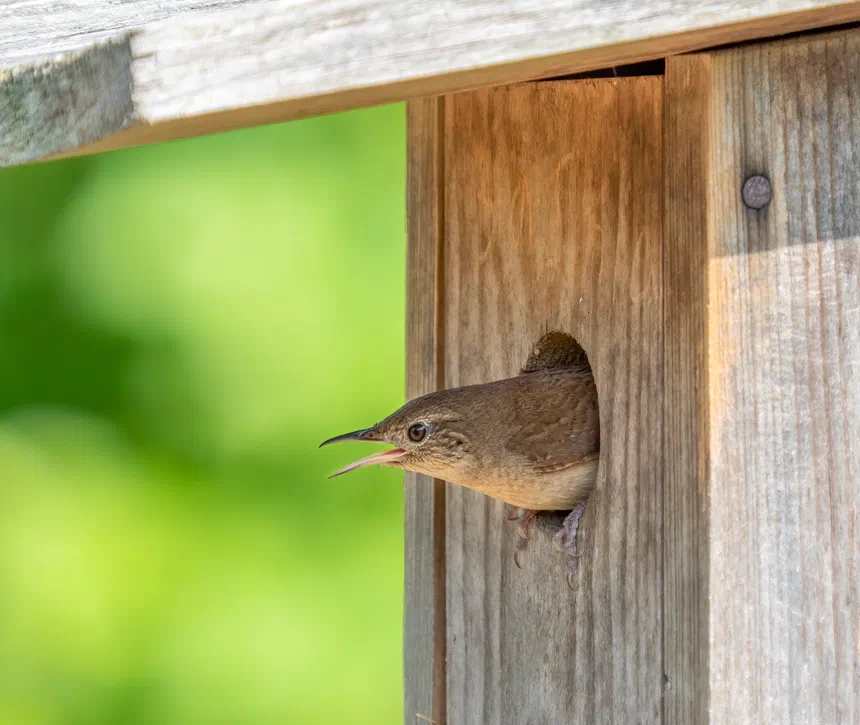
Image: Rhododendrites — CC BY-SA 4.0 · source
What Is a House Wren?
The house wren (Troglodytes aedon) is a small, energetic songbird in the wren family, Troglodytidae. It is one of the most widely distributed songbirds in the Western Hemisphere, ranging from Canada through much of South America. Familiar and adaptable, it readily nests near people, which is how it earned its common name.
Appearance and Identification
The house wren is a compact bird with a rather plain, unassuming plumage. Its upperparts are a warm grayish-brown, marked with fine, dark barring on the wings and tail, while the underparts are paler and often washed with buff. The bill is thin and slightly downcurved, well suited to probing for small prey. Both sexes look alike, and the bird frequently holds its short tail cocked upward at a jaunty angle, a classic wren posture. At roughly 11 to 13 centimeters long and weighing only about 10 to 12 grams, it is easy to overlook by sight but hard to miss by ear, thanks to its loud, bubbling song.
Habitat and Range
House wrens occupy a remarkable variety of habitats, including woodland edges, brushy thickets, hedgerows, shrubby fields, parks, and suburban gardens. They favor semi-open areas with abundant cover and plenty of nooks for nesting. The species breeds across much of North America and, in resident and migratory forms, occurs south through Central America and into large parts of South America. Northern populations are migratory, wintering in the southern United States and Mexico, while many tropical populations remain year-round in the same area.
Diet
This wren is almost entirely insectivorous. It hunts a wide range of small invertebrates, including beetles, caterpillars, grasshoppers, flies, spiders, and other creeping arthropods. Foraging usually takes place low in vegetation, along the ground, and among tangled branches, where the bird gleans prey from leaves, bark, and soil. Its varied insect diet makes it a helpful presence in gardens, where it consumes many species considered pests.
Behavior
House wrens are restless and inquisitive, constantly flitting through dense cover in search of food. Males are especially vocal during the breeding season, delivering a rapid, cascading song to defend territory and attract mates. Despite their small size, they can be surprisingly assertive and are known to compete aggressively for nest sites, sometimes removing the eggs of other cavity-nesting birds. Outside of breeding, they tend to be more solitary and secretive, keeping to thickets and undergrowth.
Life Cycle and Reproduction
House wrens are cavity nesters, using natural tree hollows, old woodpecker holes, crevices, and readily accepting nest boxes. The male typically begins several “dummy” nests within his territory, and the female selects one to line and complete. A clutch usually contains around five to eight small, speckled eggs. The female incubates for roughly two weeks, and both parents feed the nestlings, which fledge about two weeks after hatching. Pairs often raise two broods in a single season. In the wild, most house wrens live only a few years, though some individuals survive considerably longer.
Conservation Status
The house wren is listed as Least Concern by the IUCN. Its broad range, large population, and comfort with human-altered landscapes have helped it remain abundant. The widespread use of backyard nest boxes has likely benefited local populations in many areas. While no major threats currently endanger the species as a whole, individual populations can be affected by habitat loss and pesticide use that reduces insect prey.
Frequently Asked Questions
Are house wrens good for gardens? Yes. Because they eat large numbers of insects and spiders, house wrens can help keep garden pest populations in check, and they nest readily in boxes.
Why do house wrens sing so often? Males sing frequently and loudly during the breeding season to establish territory and attract a mate. Their bubbling, energetic song is one of the most recognizable sounds of summer.
Do house wrens migrate? Northern populations migrate south for winter, often to the southern United States and Mexico, while many populations in tropical regions stay in the same area year-round.