Birds Guide
House Finch
What Is a House Finch? The House Finch (Haemorhous mexicanus) is a small, sociable songbird in the finch family Fringillidae, native to western North America and now widespread across the continent. It is one of the most …
At a glance
What Is a House Finch?
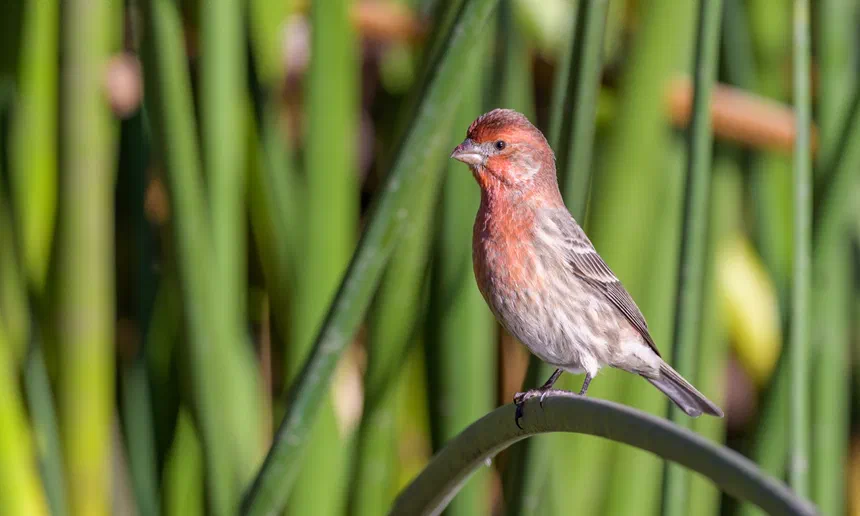
The House Finch (Haemorhous mexicanus) is a small, sociable songbird in the finch family Fringillidae, native to western North America and now widespread across the continent. It is one of the most familiar birds at backyard feeders, known for the male’s rosy-red coloring and its cheerful, warbling song.
Appearance and Identification
House Finches are compact birds about 5 to 6 inches (13 to 15 cm) long, with a wingspan of roughly 8 to 10 inches (20 to 25 cm). They have a fairly large, seed-cracking beak with a curved upper edge, a flat head, and a relatively long, shallowly notched tail. Both sexes are heavily streaked in brown and gray across the back, wings, and underparts. Adult males show varying amounts of rosy red on the head, throat, upper breast, and rump, though this color can range from pale yellow to deep orange-red depending on diet, since the red pigments come from carotenoids in the foods they eat. Females and juveniles lack the bright coloring and are plainer, streaky brown throughout, which can make them easy to confuse with other small finches and sparrows.
Habitat and Range
Originally a bird of the arid West, the House Finch was native to Mexico and the southwestern United States, where it inhabited desert scrub, open woodlands, canyons, and grasslands. In the 1940s, birds released or escaped from the cage-bird trade became established in the eastern United States, and the species has since spread dramatically to cover most of the continent, including southern Canada. Today House Finches thrive in human-altered landscapes, favoring cities, suburbs, parks, farms, and backyards, where buildings and ornamental plantings offer nesting sites and food. They readily nest on ledges, in hanging planters, and in dense shrubs and conifers.
Diet
House Finches are almost entirely vegetarian, an unusual trait among North American songbirds. Their diet is dominated by seeds, buds, flower parts, and small fruits. At feeders they show a strong preference for sunflower and nyjer (thistle) seed. Unlike many birds that switch to insects while raising young, House Finches feed their nestlings a diet of regurgitated plant matter rather than insect prey. The carotenoid pigments in the fruits and plants they consume directly influence the redness of a male’s plumage, so a well-fed male in a berry-rich area may be noticeably brighter than one on a poorer diet.
Behavior
These finches are highly social and are usually found in flocks outside of the breeding season, often gathering in noisy groups at feeders and around water. Their flight is bouncy and undulating, and they perch readily on wires, rooftops, and treetops. Males sing a long, lively series of warbling notes, frequently ending in a buzzy or downslurred phrase, and they may sing throughout much of the year. House Finches are generally tolerant of people and have adapted comfortably to urban life. They are not territorial in the strict sense; instead, they defend the immediate area around a mate and nest while otherwise foraging communally.
Life Cycle and Reproduction
House Finches form monogamous pairs during the breeding season, and a pair may raise multiple broods in a single year. The female builds a cup-shaped nest of grasses, twigs, and other fine materials, often in a sheltered spot on a building, in a hanging basket, or in a dense shrub. She typically lays 2 to 6 pale bluish eggs, which she incubates for about 13 to 14 days while the male brings her food. The young are altricial, hatching helpless and blind, and they fledge roughly 12 to 19 days after hatching. Both parents help feed the chicks. Most House Finches live only a few years in the wild, though some individuals survive considerably longer.
Conservation Status
The House Finch is listed as Least Concern by the IUCN, with a very large and widespread population. It has benefited greatly from human development and bird feeding, expanding its range across the continent over the past century. One notable challenge is a bacterial eye disease, house finch conjunctivitis, which emerged in the 1990s and can cause swollen, crusted eyes; it periodically reduces local populations but has not threatened the species overall. Keeping backyard feeders clean helps limit its spread.
Frequently Asked Questions
Why are some male House Finches yellow or orange instead of red? The red coloring comes from carotenoid pigments in the male’s diet. Birds that eat fewer carotenoid-rich foods develop paler yellow or orange plumage rather than deep red.
How can I tell a House Finch from a Purple Finch? House Finches are streakier and browner overall, with red concentrated on the head and chest, while Purple Finches look more uniformly raspberry-washed. Female House Finches have a plainer face without the strong pale eyebrow of female Purple Finches.
Are House Finches native to the eastern United States? No. They are native to the West and Mexico. Eastern populations descend from cage birds released in the New York area in the 1940s, after which the species spread across the East.