Birds Guide
Horned Puffin
What Is a Horned Puffin? The horned puffin (Fratercula corniculata) is a stocky, brightly billed seabird of the auk family, closely related to the more familiar Atlantic puffin. It nests in colonies on rocky coasts and …
At a glance
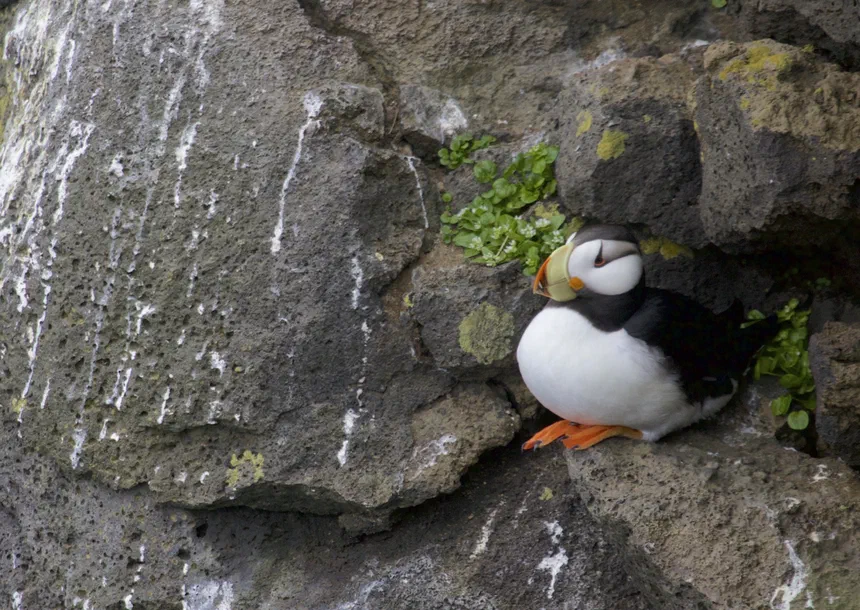
Image: Gregory "Slobirdr" Smith — CC BY-SA 2.0 · source
What Is a Horned Puffin?
The horned puffin (Fratercula corniculata) is a stocky, brightly billed seabird of the auk family, closely related to the more familiar Atlantic puffin. It nests in colonies on rocky coasts and islands across the northern Pacific and spends most of the year at sea. Its name comes from the small, fleshy dark “horn” that projects above each eye during the breeding season.
Appearance and Identification
Adults in breeding plumage are boldly patterned: glossy black on the back, wings, and collar, with a clean white face and underparts. The large, laterally flattened bill is yellow at the base and bright orange-red toward the tip, and a fleshy rosette sits at the corner of the mouth. A thin, dark fleshy spike, or “horn,” rises above each eye. The legs and webbed feet are orange. After breeding, the bill sheds its colorful outer plates and becomes smaller and duller, and the face darkens to a grayish tone. Both sexes look alike, though males average slightly larger. Juveniles resemble non-breeding adults but have smaller, darker bills.
Habitat and Range
Horned puffins breed along the coasts and islands of the North Pacific and Bering Sea, from Alaska and the Aleutian Islands westward to eastern Siberia, and locally south to British Columbia. Nesting sites are typically rocky cliffs, boulder fields, and steep island slopes where crevices offer protected nest sites. Outside the breeding season the birds disperse widely across the open North Pacific, often ranging far from land and only returning to shore to breed.
Diet
This puffin is a carnivore that feeds mainly on small fish such as sand lance, capelin, herring, and juvenile pollock, supplemented by squid and other marine invertebrates. It forages by diving from the surface and “flying” underwater with its wings, chasing prey at depth. Like other puffins, it can hold several small fish crosswise in its bill at once, using backward-pointing spines on the tongue and palate to keep the catch in place while continuing to hunt.
Behavior
Horned puffins are social at their breeding colonies, where many pairs nest close together. They are strong but effortful fliers, beating their short wings rapidly to stay aloft, and they are far more graceful underwater than in the air. On land they stand upright and walk with a waddling gait. Away from the colony they are generally quiet, but at the nest they produce low growling and moaning calls. Birds spend the non-breeding months solitary or in loose groups scattered over the open ocean.
Life Cycle and Reproduction
Horned puffins are believed to form long-term pair bonds and often return to the same nest site in successive years. The nest is placed in a rock crevice or cavity, sometimes in a shallow burrow, where the female lays a single egg. Both parents share incubation, which lasts roughly six weeks, and both feed the chick after it hatches. The nestling remains hidden in its crevice for around five to six weeks, fed a steady supply of small fish, before departing for the sea largely on its own. Young birds take several years to reach breeding age.
Conservation Status
The horned puffin is currently listed as Least Concern by the IUCN, with a large population spread across a wide northern range. Even so, it faces threats common to seabirds, including oil spills, entanglement in fishing gear, introduced predators such as rats and foxes on nesting islands, and shifts in prey availability driven by changing ocean conditions. Protecting colony islands from invasive predators and maintaining healthy fish stocks are key to its long-term security.
Frequently Asked Questions
Why is it called a “horned” puffin? During the breeding season each bird grows a small dark fleshy spike above the eye that looks like a tiny horn. These structures are shed after breeding.
How is it different from the Atlantic puffin? The two are close relatives and look similar, but the horned puffin lives in the North Pacific rather than the Atlantic and has the distinctive eye “horns” and a slightly different bill pattern.
How many eggs do they lay? A pair raises just one egg per breeding season, and both parents share incubation and chick-rearing duties.