Birds Guide
Horned Lark
What Is a Horned Lark? The Horned Lark (Eremophila alpestris) is a small, ground-dwelling songbird named for the pair of tiny black feather tufts that males can raise on the crown like little horns. It is the only true …
At a glance
What Is a Horned Lark?
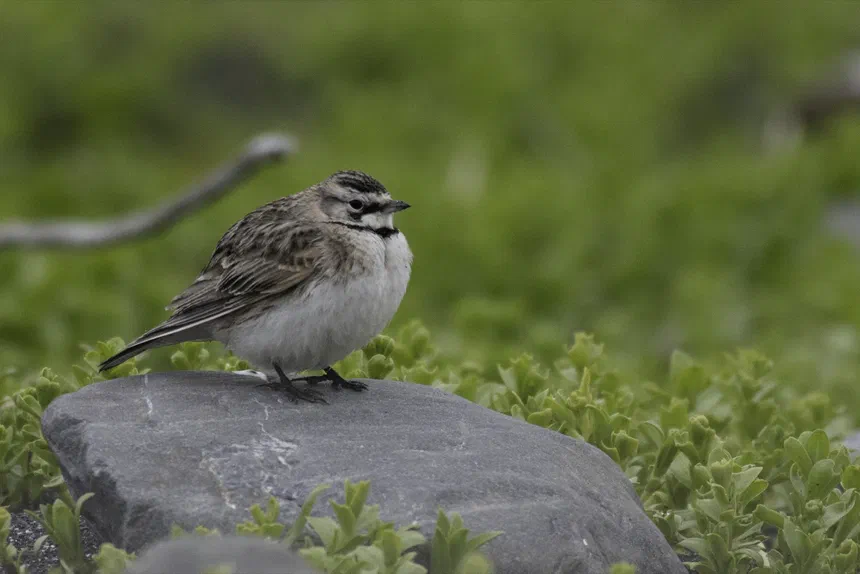
The Horned Lark (Eremophila alpestris) is a small, ground-dwelling songbird named for the pair of tiny black feather tufts that males can raise on the crown like little horns. It is the only true lark native to the Americas and also ranges widely across Eurasia and North Africa, making it one of the most broadly distributed songbirds in the Northern Hemisphere.
Appearance and Identification
Horned Larks are slim, sparrow-sized birds with a length of roughly 6.3 to 7.9 inches and a wingspan near 12 to 13 inches. The upperparts are sandy brown, providing excellent camouflage against bare soil, while the underparts are pale. The most distinctive markings are on the face: a black mask running from the bill through the eye, a black band across the breast, and a yellow to white throat and forehead. Males display these bold patterns most strongly, along with the small erectile “horns” that give the species its name. Females and juveniles are duller and often lack obvious horns. In flight the bird shows a black tail with white outer feathers.
Habitat and Range
This species is a bird of wide-open, sparsely vegetated country. It favors short-grass prairie, plowed and stubble fields, deserts, alpine meadows, shorelines, and arctic and alpine tundra. Horned Larks generally avoid tall grass, dense brush, and forest, preferring ground where they can see approaching predators and forage on exposed soil. Their range spans much of North America from the Arctic to Mexico, across Europe and Asia, and into the mountains of North Africa and the Middle East. Northern populations migrate south for winter, while many populations in temperate and southern areas remain year-round.
Diet
Horned Larks are omnivorous, with a diet that shifts seasonally. For much of the year they feed heavily on seeds of grasses, weeds, and waste grain gleaned from the ground. During the breeding season, and especially when feeding nestlings, they take large numbers of insects and other small invertebrates such as beetles, grasshoppers, caterpillars, and spiders. They forage by walking and running along the ground rather than hopping, picking food from the soil surface and low plants.
Behavior
On the ground, Horned Larks walk and run with a distinctive crouching gait. Outside the breeding season they often gather in flocks, sometimes large ones, and may mix with longspurs, buntings, and pipits in winter fields. In the breeding season males become territorial and perform a striking flight display, climbing high into the air, sometimes hundreds of feet, before singing and then diving back toward the ground. Their song is a high, tinkling series of thin notes. When threatened, their cryptic coloring lets them freeze and blend into bare ground rather than flush.
Life Cycle and Reproduction
Horned Larks nest on the ground, often beginning to breed very early in the season, sometimes while snow still lingers. The female builds a cup-shaped nest in a shallow depression, frequently sheltered beside a clump of grass, a stone, or a dirt clod, and lines it with fine grasses and other soft material. A clutch usually contains 2 to 5 grayish, speckled eggs. The female incubates them for roughly 10 to 12 days. Chicks hatch helpless and leave the nest after about 8 to 12 days, often before they can fly well. Pairs commonly raise two or more broods per year, taking advantage of the long breeding window that open habitats allow.
Conservation Status
The Horned Lark is listed as Least Concern by the IUCN because of its enormous range and large overall population. Despite this, many regional populations, particularly in North America, have declined significantly in recent decades. Losses are linked to changes in agriculture, loss of open grassland and prairie habitat, pesticide use that reduces insect prey, and the conversion of bare-ground habitats. Some distinct subspecies with small ranges are of greater conservation concern.
Frequently Asked Questions
Do Horned Larks really have horns? No, the “horns” are not true horns but small tufts of black feathers on the head that males can raise and lower. They are used in display and are often hard to see when flattened.
Where are Horned Larks most likely to be seen? Look for them in wide-open, bare or short-grass places such as plowed fields, prairies, airports, beaches, and tundra, where they forage by walking along the ground.
Are Horned Larks migratory? It depends on the population. Birds breeding in the far north migrate south for winter, while many in milder regions stay in the same area year-round.