Birds Guide
Hoopoe
What Is a Hoopoe? The hoopoe (Upupa epops) is a striking, medium-sized bird best known for its sweeping crown of erectile feathers and its soft, far-carrying “oop-oop-oop” call. It belongs to the family Upupidae and …
At a glance
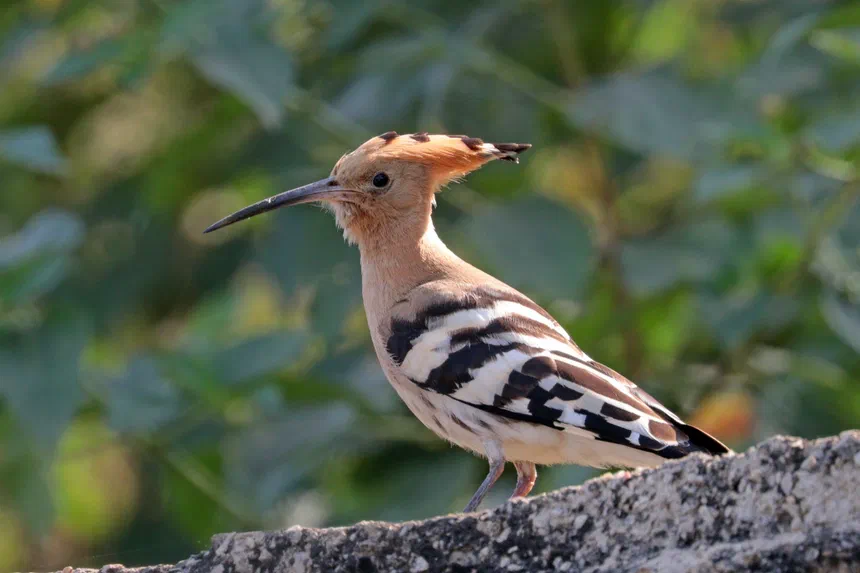
Image: Charles J. Sharp — CC BY-SA 4.0 · source
What Is a Hoopoe?
The hoopoe (Upupa epops) is a striking, medium-sized bird best known for its sweeping crown of erectile feathers and its soft, far-carrying “oop-oop-oop” call. It belongs to the family Upupidae and ranges widely across Europe, Asia, and Africa, where it favors warm, open country. Its unmistakable appearance and distinctive voice have made it a familiar and celebrated bird across many cultures.
Appearance and Identification
The hoopoe is instantly recognizable. Its head, neck, and breast are a warm pinkish-brown, while the wings and tail are boldly patterned with black and white bars, creating a flashing, butterfly-like effect in flight. The bird’s most famous feature is its crest, a fan of feathers tipped in black that it can raise dramatically when excited or alarmed and lower flat against the head at rest. The long, slender, gently down-curved bill is well suited to probing soil for prey. Males and females look broadly similar, though females tend to be slightly duller. Adults typically measure about 25 to 32 centimeters in length, with a wingspan near 44 to 48 centimeters, and weigh roughly 45 to 90 grams.
Habitat and Range
Hoopoes thrive in warm, open landscapes with short vegetation or bare ground where they can forage, combined with trees, walls, or banks that provide nesting cavities. Typical habitats include farmland, pastures, orchards, vineyards, savanna, and lightly wooded areas. The species has an enormous range spanning much of Europe, Asia, and Africa. Northern populations are migratory, wintering in sub-Saharan Africa and southern Asia, while birds in warmer regions are often resident year-round.
Diet
The hoopoe is primarily an insectivore. It walks along the ground, probing the soil and leaf litter with its long bill to extract insects, larvae, and pupae. Beetles, crickets, grasshoppers, ant lions, and the larvae of moths are common prey, and it is especially fond of large, soil-dwelling grubs. It may also take spiders, small reptiles, and occasionally seeds or berries. Large or hard-bodied prey is often beaten against the ground or a hard surface to remove indigestible parts before being swallowed.
Behavior
Hoopoes are usually seen singly or in pairs, foraging quietly on open ground. Their flight is undulating and floppy, recalling a large butterfly as the barred wings open and close. On the ground they walk and run rather than hop. The species is best known for the male’s rhythmic, hollow call, which gives the bird both its common and scientific names. When threatened, a hoopoe may spread its wings and tail flat against the ground and point its bill skyward, an unusual sunbathing-like posture. Nestlings and brooding females have a notable defense: a gland that produces a foul-smelling secretion, and young birds can also direct droppings at intruders, both of which help deter predators.
Life Cycle and Reproduction
Hoopoes are generally monogamous during a breeding season, and males defend territories, sometimes engaging in fierce bill-to-bill disputes with rivals. Nests are placed in cavities, such as holes in trees, walls, cliffs, or nest boxes. The female typically lays a clutch of around 5 to 8 eggs, though clutch size varies with region, and she alone incubates them for roughly 15 to 18 days while the male brings her food. The chicks hatch helpless and are fed by both parents. Young hoopoes usually fledge about three to four weeks after hatching. The nest cavity often becomes soiled and pungent during the breeding period, which is thought to help repel predators and parasites.
Conservation Status
The hoopoe is currently listed as Least Concern by the IUCN, reflecting its very large range and sizable global population. Nevertheless, some regional populations, particularly in parts of northern and western Europe, have declined due to agricultural intensification, loss of nesting sites, and reduced availability of large insect prey. Maintaining traditional low-intensity farmland, hedgerows, old trees, and undisturbed foraging areas benefits the species, and nest boxes can help support populations where natural cavities are scarce.
Frequently Asked Questions
Why is the hoopoe named the way it is? Both its common name “hoopoe” and its scientific name Upupa epops echo the bird’s distinctive “oop-oop-oop” call, an example of onomatopoeia across languages.
Does the hoopoe really smell bad? During breeding, nestlings and brooding females produce a foul-smelling secretion, and the nest cavity often becomes soiled. This odor is believed to deter predators and reduce parasites.
Where can you see a hoopoe? Hoopoes are found across Europe, Asia, and Africa in open, warm habitats such as farmland, orchards, and grassland. Many northern birds migrate south to spend the winter in Africa or southern Asia.