Birds Guide
Hoatzin
What Is a Hoatzin? The hoatzin (Opisthocomus hoazin) is an unusual, pheasant-sized bird of tropical South America, famous for its shaggy crest, blue facial skin, and leaf-based diet. It is the only living member of its …
At a glance
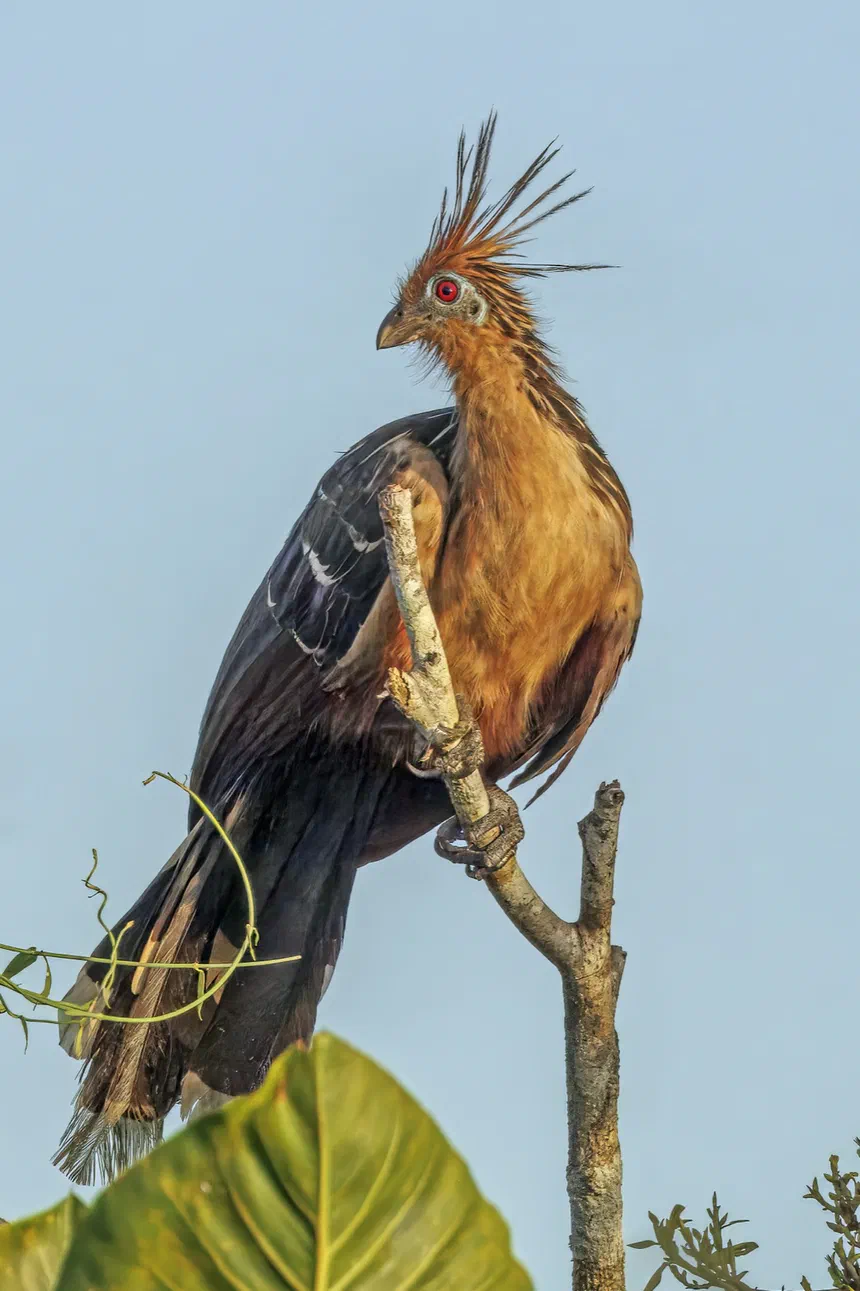
Image: Charles J. Sharp — CC BY-SA 4.0 · source
What Is a Hoatzin?
The hoatzin (Opisthocomus hoazin) is an unusual, pheasant-sized bird of tropical South America, famous for its shaggy crest, blue facial skin, and leaf-based diet. It is the only living member of its family and order, making it one of the most evolutionarily distinctive birds alive today. Local names such as “stinkbird” refer to the manure-like odor produced by its unique digestion.
Appearance and Identification
The hoatzin is a large but slender bird, roughly the size of a small chicken, measuring about 24 to 28 inches (60 to 70 cm) in length. Adults have loose, rufous-and-olive plumage streaked with buff on the neck and wings, a long tail tipped with pale buff, and a spiky, disheveled crest of stiff feathers. The bare facial skin is bright blue, and the eyes are a striking maroon-red. The body is heavy relative to the small head, and the flight muscles are surprisingly weak, so the bird is a clumsy, short-distance flier. Males and females look alike.
Habitat and Range
Hoatzins live in the Amazon and Orinoco river basins across countries including Brazil, Colombia, Venezuela, Ecuador, Peru, Guyana, and Bolivia. They are strongly tied to water, favoring the dense, tangled vegetation along the margins of slow rivers, oxbow lakes, swamps, and seasonally flooded forest. They spend most of their time perched in shrubs and low trees overhanging the water, rarely straying far from these riparian thickets.
Diet
The hoatzin is one of the very few birds that feed almost entirely on leaves. Its diet is dominated by the foliage of riverside plants, supplemented by buds, flowers, and some fruit. To process this tough, fibrous material, the hoatzin relies on foregut fermentation, using bacteria in an enlarged, muscular crop and lower esophagus to break down plant matter. This system works much like a cow’s rumen and is unique among birds. The fermentation gives the bird its characteristic musty smell and also makes it slow and top-heavy, since the bulky crop displaces much of the flight musculature.
Behavior
Hoatzins are social, noisy, and largely sedentary birds that live in small groups. They are poor fliers and often clamber awkwardly through branches using their wings and feet. Groups communicate with a range of hoarse calls, hisses, grunts, and wheezing sounds, especially when disturbed. Because they digest slowly, hoatzins spend long periods resting and sunning while fermentation proceeds, often perched with the breast leaning against a branch to support their weight. They are not hunted much for food, partly because of their unpleasant taste and odor.
Life Cycle and Reproduction
Breeding is often timed to the rainy season, when riverside vegetation is lush. Hoatzins are cooperative breeders: nesting pairs are frequently assisted by helpers, usually offspring from previous broods. They build loose stick nests on branches overhanging water and typically lay two or three eggs. The most remarkable feature appears in the chicks, which hatch with two functional claws on each wing. These claws let young birds clamber through branches and, if threatened, drop into the water, swim, and later climb back to the nest using their wing claws, beak, and feet. The claws are lost as the birds mature. This trait has long fueled comparisons to ancient birds such as Archaeopteryx, though it is considered an independent adaptation.
Conservation Status
The hoatzin is classified as Least Concern by the IUCN. It has a wide range across the Amazon and Orinoco basins and remains locally common in suitable riverside habitat. Because it is unpalatable, it faces little pressure from hunting. The main long-term threats are habitat loss and disturbance from deforestation, wetland drainage, and development along waterways, but at present populations are considered stable.
Frequently Asked Questions
Why is the hoatzin called the “stinkbird”? Its leaf-fermenting digestion produces a strong, manure-like odor, which discourages predators and hunters and gives the bird its unflattering nickname.
Why do hoatzin chicks have claws on their wings? The clawed wings help chicks climb through branches and return to the nest after dropping into the water to escape predators. The claws disappear as the birds grow up.
Can hoatzins fly well? Not really. Their enlarged fermentation crop crowds out flight muscles, so they are heavy, weak fliers that mostly make short, labored flights between perches.