Birds Guide
Harpy Eagle
What Is a Harpy Eagle? The harpy eagle (Harpia harpyja) is one of the largest and most powerful birds of prey in the world, native to the tropical rainforests of Central and South America. Named after the harpies of …
At a glance
What Is a Harpy Eagle?
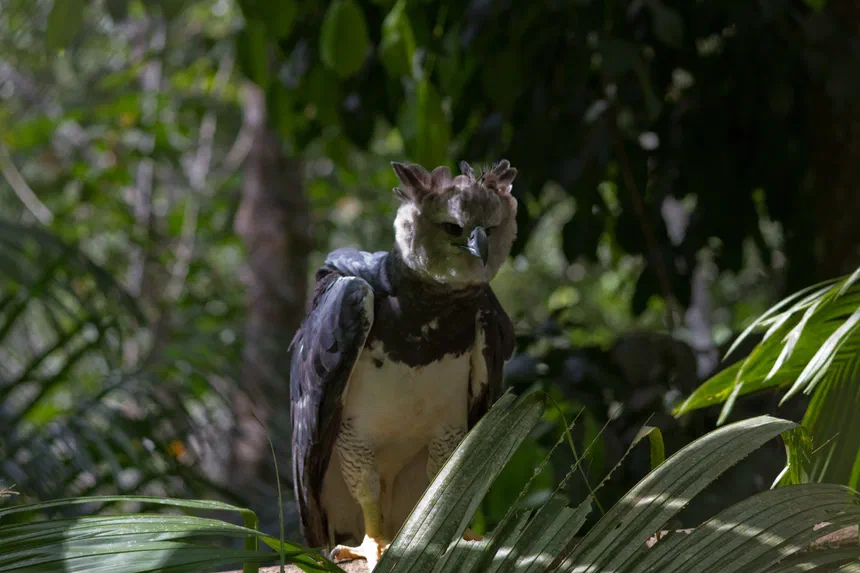
The harpy eagle (Harpia harpyja) is one of the largest and most powerful birds of prey in the world, native to the tropical rainforests of Central and South America. Named after the harpies of Greek mythology, this raptor is a top predator of the forest canopy, capable of seizing prey nearly its own weight. It is instantly recognizable by its imposing size, striking gray-and-white plumage, and a crown of feathers it can raise into a dramatic crest.
Appearance and Identification
Harpy eagles are among the heaviest eagles on Earth, and they show pronounced size difference between the sexes: females can weigh roughly twice as much as males, often reaching 15-20 pounds while males typically weigh 9-12 pounds. The upperparts are dark slate-gray, the belly and legs are white, and a broad black band crosses the upper chest. The head is pale gray and topped with a double crest of long feathers that fan out when the bird is alert. Perhaps most striking are the legs and feet: the tarsi can be as thick as a person’s wrist, and the rear talons may exceed 3 to 4 inches, longer than the claws of a grizzly bear. Compared with many soaring eagles, the harpy has relatively short, broad wings suited to maneuvering through dense forest rather than long-distance soaring.
Habitat and Range
This species inhabits undisturbed lowland tropical rainforest, generally below about 3,000 feet in elevation, where it hunts within and just below the upper canopy. Its historic range extends from southern Mexico through Central America and across much of tropical South America east of the Andes, reaching into northern Argentina, Paraguay, and southern Brazil. The largest surviving populations are concentrated in the Amazon Basin. Harpy eagles require large tracts of continuous forest, which makes them sensitive to habitat fragmentation.
Diet
Harpy eagles are carnivores specializing in tree-dwelling mammals. Sloths and monkeys make up a large share of their diet in many areas, and they also take opossums, porcupines, coatis, and other medium-sized mammals, along with large birds and occasionally reptiles such as iguanas. A hunting harpy typically perches quietly and watches, then launches a fast, powerful strike through the canopy, using its enormous talons to grip and kill prey. Its strength allows it to lift animals weighing several pounds and carry them back to a perch or nest.
Behavior
Despite their power, harpy eagles are secretive and can be difficult to observe. They spend long periods perched motionless while scanning for movement, relying on stealth and short, explosive flights rather than the sustained soaring seen in open-country eagles. They are not strongly migratory and generally remain within a home range year-round. Individuals and breeding pairs are territorial, and their large size means they have few natural enemies as adults.
Life Cycle and Reproduction
Harpy eagles form long-term pair bonds and build massive stick nests, often placed high in the crown of an emergent tree such as a kapok. A female usually lays two eggs, but typically only one chick is raised; once the first egg hatches, the second is generally neglected. Incubation lasts around 55 days. The single chick develops slowly and depends on its parents for many months after fledging, sometimes staying near the nest well into its second year. Because of this extended parental care, a pair generally breeds only once every two to three years. Young birds take several years to reach full adult plumage and maturity.
Conservation Status
The harpy eagle is classified as Vulnerable by the IUCN, with populations declining across much of its range. The main threats are deforestation and habitat fragmentation, which reduce both nesting sites and prey, along with direct persecution by shooting. Its slow reproductive rate makes recovery difficult once numbers fall. Conservation efforts include habitat protection, nest monitoring, captive breeding, and community education programs, particularly in Panama, where the harpy eagle is the national bird.
Frequently Asked Questions
How strong is a harpy eagle’s grip? Harpy eagles have exceptionally powerful feet and can exert enough force to crush bone, allowing them to kill and carry prey weighing several pounds.
Are harpy eagles dangerous to people? They generally avoid humans, but they can be defensive near their nests. Attacks on people are extremely rare.
Why are harpy eagles endangered? Their populations are declining mainly because of rainforest loss and hunting, compounded by a naturally slow breeding rate that makes it hard to recover from losses.