Birds Guide
Hairy Woodpecker
What Is a Hairy Woodpecker? The hairy woodpecker (Leuconotopicus villosus) is a medium-sized woodpecker found across much of North America and into Central America. It is best known for its crisp black-and-white plumage …
At a glance
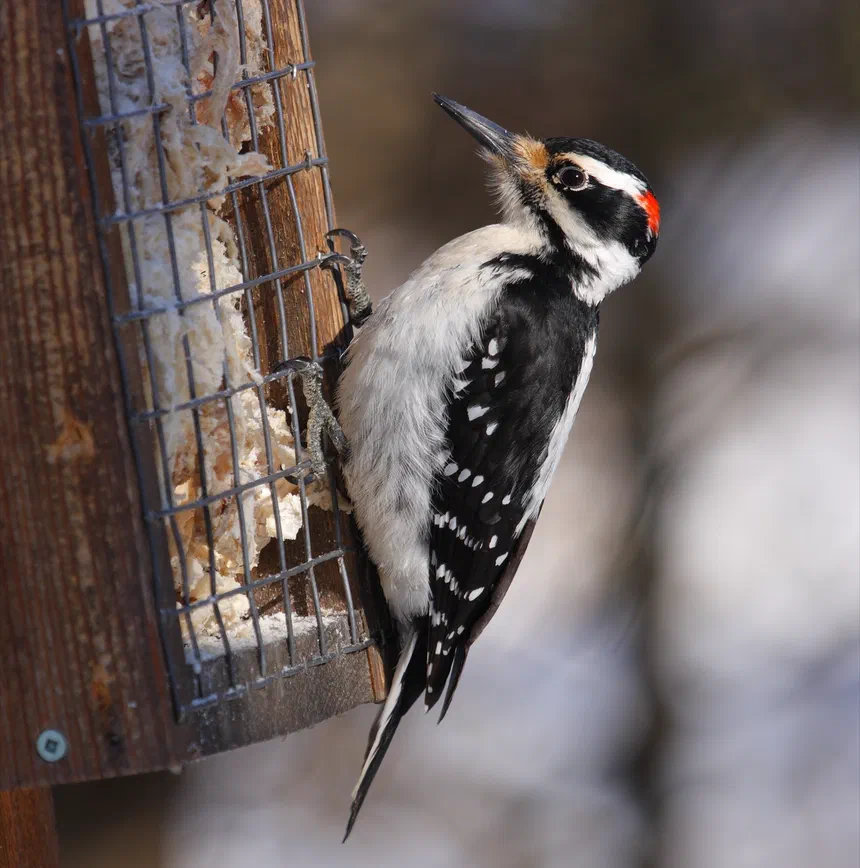
Image: Cephas — CC BY-SA 3.0 · source
What Is a Hairy Woodpecker?
The hairy woodpecker (Leuconotopicus villosus) is a medium-sized woodpecker found across much of North America and into Central America. It is best known for its crisp black-and-white plumage and its habit of hammering into tree trunks and branches in search of hidden insects. The species takes its name from the long, hair-like white feathers running down the center of its back.
Appearance and Identification
Hairy woodpeckers have a striking black-and-white pattern. The back carries a broad white stripe, the wings are checkered with white spots, and the outer tail feathers are typically plain white. The head is boldly marked with black-and-white stripes, and adult males display a small red patch on the back of the head that females lack. A stout, chisel-shaped bill roughly as long as the head is one of the best field marks. This bird is very often confused with the smaller downy woodpecker, but the hairy is noticeably larger, has a longer bill, and usually shows unmarked white outer tail feathers.
Habitat and Range
This adaptable woodpecker occupies a wide variety of wooded habitats, from mature deciduous and coniferous forests to woodlots, orchards, parks, and leafy suburbs. Its range stretches from Alaska and across Canada southward through the United States and into Mexico and Central America. Because it favors larger trees with sturdy trunks, it is most common where mature timber and standing dead wood remain available. Populations across this broad range vary in size and plumage tone, with birds in some regions running noticeably smaller or darker than others.
Diet
The hairy woodpecker is primarily insectivorous. It feeds heavily on the larvae and adults of wood-boring beetles, along with ants, caterpillars, and other insects that it extracts from bark and decaying wood. It locates prey by tapping and probing, then uses its long, barbed tongue to pull insects from tunnels. The diet is rounded out with seeds, nuts, and berries, especially in colder months, and these birds readily visit backyard feeders for suet and sunflower seeds.
Behavior
Hairy woodpeckers are active, agile foragers that hitch up and around tree trunks and larger limbs, bracing themselves with stiff tail feathers. They communicate with sharp, distinctive calls and by drumming rapid bursts against resonant wood, a sound used to defend territory and attract mates. For the most part they are nonmigratory, holding a home territory year-round, though birds in the far north may move short distances in harsh winters. Outside the breeding season they are often solitary but may join mixed-species foraging flocks.
Life Cycle and Reproduction
Pairs form in late winter or early spring and typically excavate a fresh nest cavity each year, usually in a dead tree or a dead limb of a living tree. The female generally lays around 3 to 6 white eggs. Both parents share incubation, which lasts roughly two weeks, and both feed the nestlings. Young woodpeckers grow quickly and leave the cavity about a month after hatching, though they may follow their parents for a time while learning to forage. Most pairs raise a single brood per year.
Conservation Status
The hairy woodpecker is listed as Least Concern by the IUCN, reflecting its broad range and generally stable numbers. It benefits from its ability to use many kinds of forested and semi-forested habitats, including human-altered landscapes. The main long-term concerns for the species involve the loss of mature forest and the removal of dead and dying trees, which provide both feeding sites and nesting cavities. Retaining standing deadwood is one of the most effective ways to support local populations.
Frequently Asked Questions
How do you tell a hairy woodpecker from a downy woodpecker? The hairy is larger and has a longer, heavier bill about as long as its head, while the downy is smaller with a short, stubby bill. Hairy woodpeckers also usually show clean white outer tail feathers.
Do only male hairy woodpeckers have red on the head? Yes. Adult males have a small red patch on the back of the head, while females lack it entirely. Juveniles may show variable reddish coloring on the crown.
Are hairy woodpeckers common at backyard feeders? They can be regular feeder visitors, especially where suet and sunflower seeds are offered near wooded areas, though they are often less abundant than the similar downy woodpecker.