Birds Guide
Grey Crowned Crane
What Is a Grey Crowned Crane? The grey crowned crane (Balearica regulorum) is a striking, long-legged wading bird best known for the golden spray of stiff feathers that crowns its head. It belongs to the crane family, …
At a glance
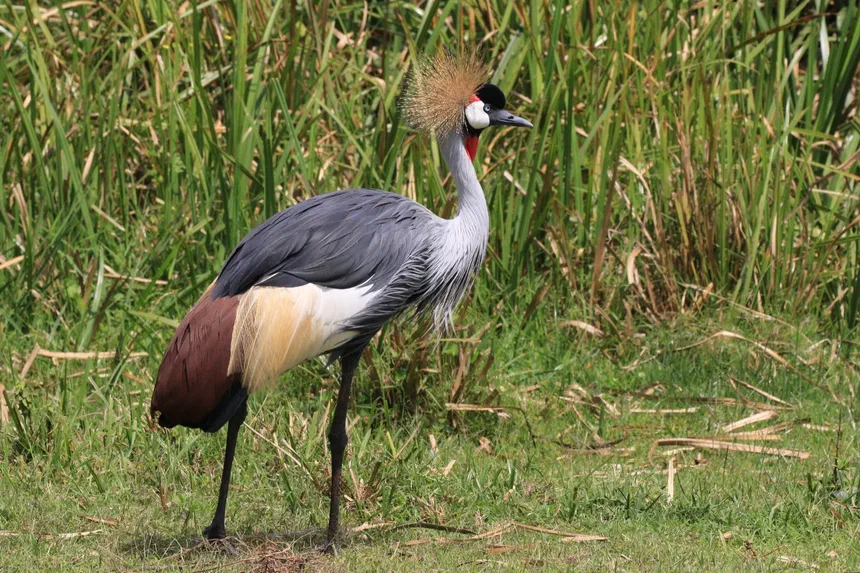
Image: Charles J. Sharp — CC BY-SA 4.0 · source
What Is a Grey Crowned Crane?
The grey crowned crane (Balearica regulorum) is a striking, long-legged wading bird best known for the golden spray of stiff feathers that crowns its head. It belongs to the crane family, Gruidae, and is one of only two crane species that can roost in trees, thanks to a flexible hind toe that lets it grip branches.
Appearance and Identification
This crane is instantly recognizable. The body is a soft slate grey, the wings show broad patches of white, and the flight feathers include chestnut and gold tones. The head carries a distinctive fan of golden bristle-like plumes, a black-and-white patterned face, and bare white cheek patches often flushed with a red spot above. A small red gular sac hangs beneath the chin, and the legs and bill are dark. Adults typically stand around 3.3 feet (1 meter) tall with a wingspan close to 6.5 feet (2 meters). Males and females look alike, though males average slightly larger.
Habitat and Range
The grey crowned crane lives in eastern and southern Africa, from Kenya and Uganda south through Tanzania, Zambia, and into parts of South Africa and Zimbabwe. It favors open wetlands, marshes, wet grasslands, and the margins of lakes and rivers, but it also forages readily in pastures and cultivated farmland. This adaptability to human-altered landscapes keeps it visible across much of its range, yet it still depends on healthy wetlands for breeding.
Diet
As an omnivore, the grey crowned crane takes a wide variety of foods. It eats grass seeds, grain, the tips of green plants, and a range of small animals including insects, worms, snails, frogs, and small reptiles. A common feeding tactic is to stamp the ground with its feet, flushing insects and other prey that it then snaps up. Flocks frequently follow grazing livestock or wild herbivores, catching creatures stirred up by the moving animals.
Behavior
Grey crowned cranes are social birds and gather in flocks outside the breeding season, sometimes numbering in the dozens or more. They are famous for their elaborate dancing, which involves bowing, jumping, wing-flapping, and short running steps. Dancing occurs year-round and among birds of all ages, serving both courtship and social bonding. Their loud, honking calls carry far across open country, produced with the help of an inflatable throat sac. Unlike most cranes, they can perch and roost in trees.
Life Cycle and Reproduction
Breeding pairs are monogamous and defend a wetland territory. Both partners build a large nest of grasses and sedges, usually hidden in tall wetland vegetation. The female typically lays two to four eggs, and both parents share incubation over roughly a month. The chicks are precocial, able to leave the nest and follow their parents within a day of hatching. They fledge at around two to three months but remain with their parents for a time afterward, learning to forage before joining larger flocks.
Conservation Status
The IUCN lists the grey crowned crane as Endangered. Its numbers have fallen sharply in recent decades due to the loss and degradation of wetlands, conversion of grasslands to agriculture, pesticide exposure, and the illegal capture of birds and eggs for the pet trade and captivity. Conservation efforts focus on protecting key wetlands, reducing illegal trade, and working with farming communities to keep breeding sites intact.
Frequently Asked Questions
Why is it called a crowned crane? The name comes from the showy fan of stiff golden feathers on top of its head, which resembles a crown.
Can grey crowned cranes fly well? Yes. Despite spending much of their time on the ground, they are strong fliers and cover long distances between feeding and roosting sites.
Are grey crowned cranes endangered? Yes. The species is classified as Endangered by the IUCN, mainly because of wetland loss and illegal capture of wild birds.