Birds Guide
Greater Roadrunner
What Is a Greater Roadrunner? The greater roadrunner (Geococcyx californianus) is a large, ground-dwelling member of the cuckoo family famous for sprinting across desert landscapes rather than flying. Instantly …
At a glance
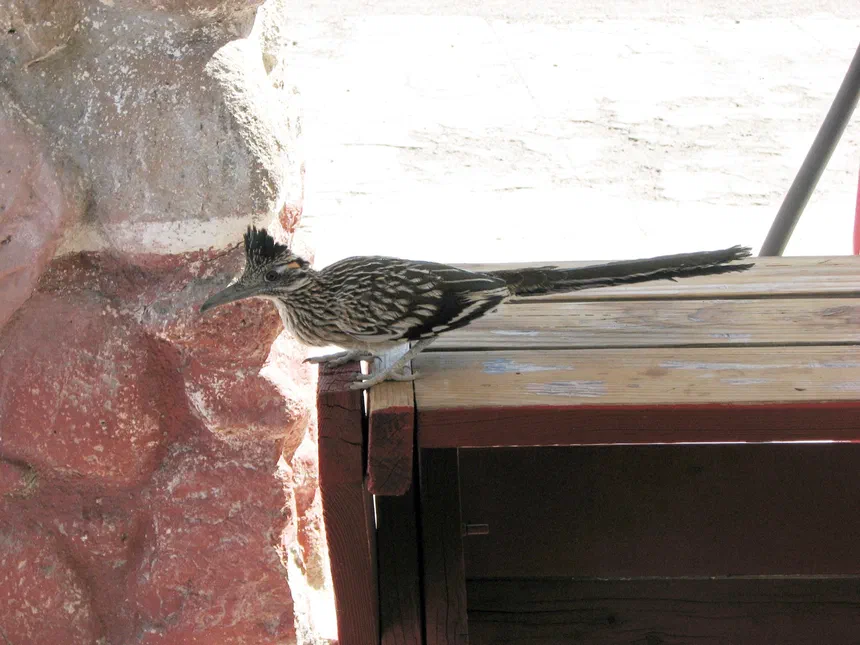
Image: Bob DuHamel — CC BY-SA 3.0 · source
What Is a Greater Roadrunner?
The greater roadrunner (Geococcyx californianus) is a large, ground-dwelling member of the cuckoo family famous for sprinting across desert landscapes rather than flying. Instantly recognizable by its long tail, shaggy crest, and rapid dashing gait, it is an iconic bird of the American Southwest and northern Mexico.
Appearance and Identification
The greater roadrunner is a slender, long-legged bird measuring roughly 20 to 24 inches (52 to 62 cm) from bill tip to tail tip, with much of that length made up by its long, expressive tail. Its plumage is heavily streaked in brown, black, and white, providing excellent camouflage against dry desert ground. A shaggy, erectile crest tops the head, and a patch of bare skin behind each eye shows a distinctive band of blue and orange-red. The bird has a stout, slightly downcurved bill and strong feet with a zygodactyl toe arrangement (two toes pointing forward and two back), leaving a characteristic X-shaped track. Though capable of short bursts of flight, roadrunners spend most of their time on the ground and can run at speeds around 15 to 20 miles per hour.
Habitat and Range
This species thrives in arid and semi-arid environments, including deserts, chaparral, scrublands, and open grasslands scattered with brush. Its range covers much of the southwestern United States, from California and Nevada east to Texas and parts of Oklahoma and Kansas, extending south throughout much of Mexico. Roadrunners favor open terrain broken by low vegetation that offers both hunting grounds and cover, and they have adapted well to human-altered landscapes such as ranchland, roadsides, and suburban edges.
Diet
The greater roadrunner is an opportunistic predator with a remarkably varied diet. It feeds heavily on insects, spiders, scorpions, lizards, and small snakes, and is well known for tackling venomous prey including rattlesnakes, often working in pairs to subdue larger snakes. It also eats small rodents, young birds, eggs, and, especially in colder months, seeds and fruit. Roadrunners hunt by walking and running, then striking swiftly with the bill, sometimes beating larger prey against rocks or the ground before swallowing it whole.
Behavior
Roadrunners are primarily solitary or found in pairs and are active during the day. As desert specialists, they have several adaptations for conserving water and managing temperature: they reabsorb water from their food and can excrete excess salt through a gland near the eyes. On cold desert mornings, a roadrunner will fluff its feathers and expose dark patches of skin on its back to soak up sunlight and warm itself, reducing the energy needed to stay warm. They are fast and agile on foot, using the long tail as a rudder and brake to make sharp turns while chasing prey.
Life Cycle and Reproduction
Greater roadrunners typically form monogamous pair bonds that may last for multiple seasons. Courtship involves displays, chases, and the male offering food to the female. The pair builds a shallow, cup-shaped nest of sticks lined with softer material, usually placed in a low tree, cactus, or dense shrub. The female generally lays about 2 to 6 eggs, and both parents share incubation, which lasts roughly 19 to 20 days. Chicks hatch mostly helpless and develop quickly, leaving the nest within about two to three weeks and becoming independent not long after.
Conservation Status
The greater roadrunner is listed as Least Concern by the IUCN, reflecting a broad range and a generally stable population. It has adapted reasonably well to human presence, though localized declines can occur where desert and scrub habitats are lost to development or agriculture. Maintaining open, brushy habitat and healthy prey populations remains important for its long-term security.
Frequently Asked Questions
Can greater roadrunners fly? Yes, but only weakly and for short distances. They are built for running and prefer to travel and hunt on the ground, using flight mainly to reach perches or escape danger.
Do roadrunners really eat rattlesnakes? They do. Roadrunners are skilled predators of snakes, including venomous rattlesnakes, and pairs sometimes cooperate to overpower larger ones.
How fast can a roadrunner run? A greater roadrunner can sprint at roughly 15 to 20 miles per hour, making it one of the fastest running birds capable of flight.