Birds Guide
Great Horned Owl
What Is a Great Horned Owl? The great horned owl (Bubo virginianus) is one of the most widespread and adaptable owls in the Americas. Named for the prominent feather tufts on its head, it is a large, powerful nocturnal …
At a glance
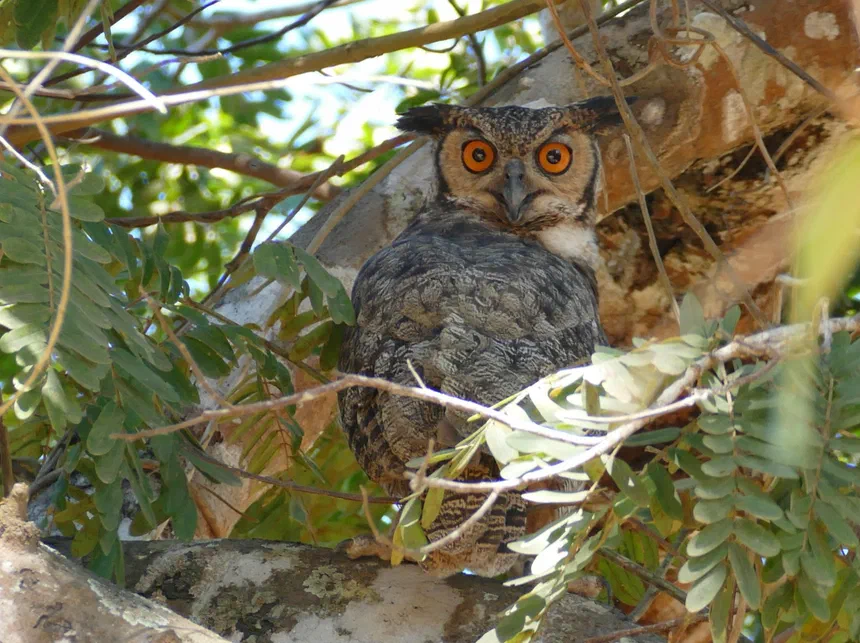
Image: Bernard DUPONT from FRANCE — CC BY-SA 2.0 · source
What Is a Great Horned Owl?
The great horned owl (Bubo virginianus) is one of the most widespread and adaptable owls in the Americas. Named for the prominent feather tufts on its head, it is a large, powerful nocturnal predator known for its deep hooting call and formidable grip.
Appearance and Identification
This is a bulky, barrel-chested owl with a large, rounded head and two conspicuous tufts of feathers, or “horns,” that are not ears at all but display feathers. Its plumage is a camouflaged blend of gray, brown, and black, with fine dark barring across the belly and a distinctive white patch on the throat. The facial disk is often rusty or grayish and rimmed in black, and the large, forward-facing eyes are a striking yellow. Females are noticeably larger than males, though males typically have deeper voices. The owl’s feathered legs and toes end in thick, curved talons capable of exerting a powerful crushing grip.
Habitat and Range
The great horned owl ranges from the Arctic tree line of North America south through Central America and into much of South America. Few birds match its ecological flexibility: it occupies deciduous and coniferous forests, deserts, mountain woodlands, swamps, prairies, and increasingly suburban parks and city edges. It does not build its own nest, instead taking over the abandoned stick nests of hawks, herons, or crows, or settling into tree cavities, cliff ledges, and other sheltered sites.
Diet
An opportunistic carnivore, the great horned owl has one of the broadest diets of any North American raptor. Mammals such as rabbits, hares, mice, voles, squirrels, and skunks form a large part of its diet, but it also takes birds up to the size of ducks, geese, and other owls, along with reptiles, amphibians, fish, and large insects. It hunts mainly at dusk and through the night, using exceptional hearing and low-light vision to locate prey, then dropping silently on nearly noiseless wings. It is one of the few predators that routinely preys on skunks, seemingly untroubled by their spray.
Behavior
Largely nocturnal, the great horned owl spends daylight hours roosting quietly in dense cover, where its cryptic plumage makes it hard to spot. It is fiercely territorial and will defend its nesting area against intruders, including humans and much larger birds. Its signature call is a series of low, resonant hoots, often rendered as “who’s awake, me too,” used to mark territory and communicate between mates. These owls are generally solitary outside of the breeding season and maintain territories year-round.
Life Cycle and Reproduction
Great horned owls are among the earliest nesting birds in North America, often laying eggs in late winter when snow is still on the ground. Pairs are monogamous and may remain together for several years. The female typically lays one to four eggs and incubates them for roughly a month while the male brings food. Both parents feed and defend the young, which leave the nest and clamber onto nearby branches at about six weeks, before they can fly. Fledglings depend on their parents for several months as they learn to hunt. Wild birds commonly live around 10 to 15 years, though individuals in captivity have lived considerably longer.
Conservation Status
The great horned owl is listed as Least Concern by the IUCN, reflecting its wide range, large population, and remarkable adaptability to human-altered landscapes. It faces threats from vehicle collisions, poisoning through rodenticides that accumulate in its prey, electrocution on power lines, and shooting, but none of these currently endanger the species as a whole.
Frequently Asked Questions
Are the “horns” actually ears? No. The tufts are simply feathers used for camouflage and display. The owl’s true ear openings are hidden on the sides of its head, positioned asymmetrically to help pinpoint sounds.
Are great horned owls dangerous to people? They generally avoid humans, but a nesting owl may aggressively defend its territory. Attacks on people are rare and usually occur only when someone approaches a nest too closely.
What is the easiest way to identify one? Look for a large owl with prominent ear tufts, a white throat patch, yellow eyes, and finely barred underparts, and listen for its deep, evenly spaced hoots at dusk.