Birds Guide
Great Egret
What Is a Great Egret? The Great Egret (Ardea alba) is a tall, elegant wading bird in the heron family, Ardeidae. Recognized by its snowy-white feathers and slow, deliberate movements along the water’s edge, it is one of …
At a glance
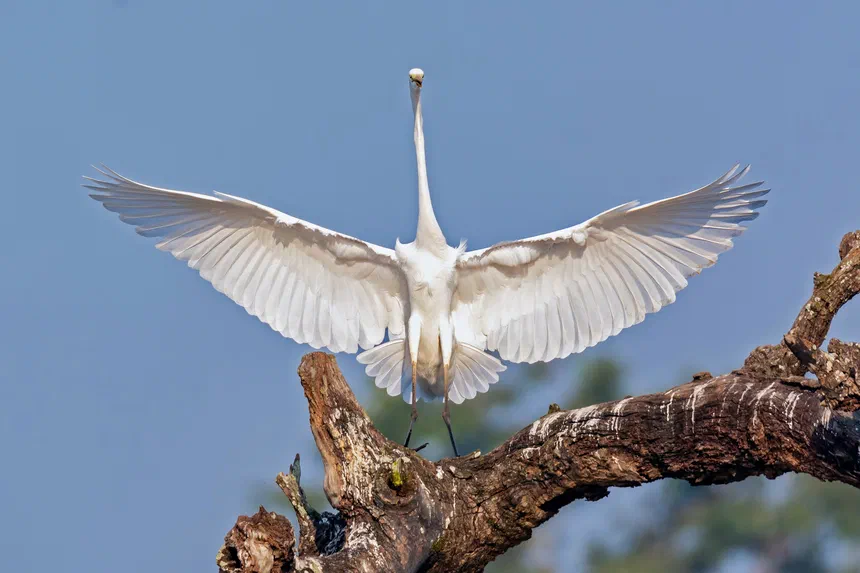
Image: Mildeep — CC BY-SA 4.0 · source
What Is a Great Egret?
The Great Egret (Ardea alba) is a tall, elegant wading bird in the heron family, Ardeidae. Recognized by its snowy-white feathers and slow, deliberate movements along the water’s edge, it is one of the most widespread herons on the planet. It is sometimes called the great white egret or common egret.
Appearance and Identification
The Great Egret is a large bird, standing roughly 80 to 105 centimeters tall with a wingspan that commonly reaches 130 to 170 centimeters. Its plumage is entirely white in all seasons. Key field marks are the long, dagger-like yellow bill and the black legs and feet, a combination that helps separate it from the smaller Snowy Egret, which has a dark bill and yellow feet. During the breeding season, adults grow long, wispy plumes called aigrettes on their backs, and the bare skin between the bill and eye can flush a bright green. In flight, the bird tucks its neck into an S-shape and trails its legs behind, a characteristic heron silhouette.
Habitat and Range
Great Egrets occupy a remarkable variety of wetland habitats, including freshwater and saltwater marshes, the margins of lakes and rivers, flooded fields, mangroves, and coastal estuaries. They are found on every continent except Antarctica, ranging across much of North and South America, Europe, Africa, Asia, and Australia. Northern populations are migratory, moving toward warmer southern regions in winter, while birds in milder climates may remain year-round. The species readily uses human-altered landscapes such as rice paddies and reservoirs when suitable prey is present.
Diet
The Great Egret is a patient, visual predator. Its diet is dominated by fish, but it also takes frogs, salamanders, aquatic insects, crayfish, small snakes, and occasionally small mammals or the young of other birds. The bird typically hunts by standing motionless or wading slowly through shallow water, then striking with a rapid thrust of its neck and spearing or seizing prey with its sharp bill. It hunts most actively in early morning and late afternoon.
Behavior
Outside of the breeding season, Great Egrets are often solitary foragers that defend feeding territories from other egrets. They are, however, highly social when nesting and resting, gathering in communal roosts and mixed-species colonies. Their flight is slow and steady, with deep, unhurried wingbeats. Vocalizations are limited, consisting mainly of low, hoarse croaks given at the colony or when disturbed.
Life Cycle and Reproduction
Great Egrets nest in colonies known as rookeries or heronries, frequently alongside other herons, egrets, and ibises, usually in trees or shrubs near water. During courtship the male displays his elaborate plumes and performs stretching and bowing rituals to attract a mate. The female typically lays about 3 to 4 pale blue-green eggs, which both parents incubate for roughly three to four weeks. Chicks are fed regurgitated food and grow quickly, often clambering out onto nearby branches before they can fly. Sibling rivalry can be intense, and smaller chicks sometimes do not survive. Young birds fledge at around six to seven weeks of age.
Conservation Status
The Great Egret is currently listed as Least Concern by the IUCN, reflecting its broad range and large, generally stable population. This status marks a dramatic recovery from the late 1800s and early 1900s, when the species was hunted heavily for its ornamental breeding plumes to supply the fashion trade. That slaughter helped galvanize early bird-protection movements, and the Great Egret became an enduring symbol of conservation. Today the main threats are the loss and degradation of wetlands, water pollution, and disturbance at nesting colonies.
Frequently Asked Questions
How can I tell a Great Egret from a Snowy Egret? Look at the bill and feet: the Great Egret has a yellow bill and black feet, while the smaller Snowy Egret has a black bill and bright yellow feet.
Are Great Egrets endangered? No. They are listed as Least Concern, though they were nearly wiped out a century ago by plume hunting before legal protections allowed them to recover.
What do Great Egrets eat? They are carnivores that feed mainly on fish, along with frogs, insects, crayfish, small reptiles, and other small aquatic animals caught in shallow water.