Birds Guide
Great Blue Heron
What Is a Great Blue Heron? The great blue heron (Ardea herodias) is the largest heron native to North America and one of the most familiar wading birds across the continent. A tall, long-legged hunter of shallow water, …
At a glance
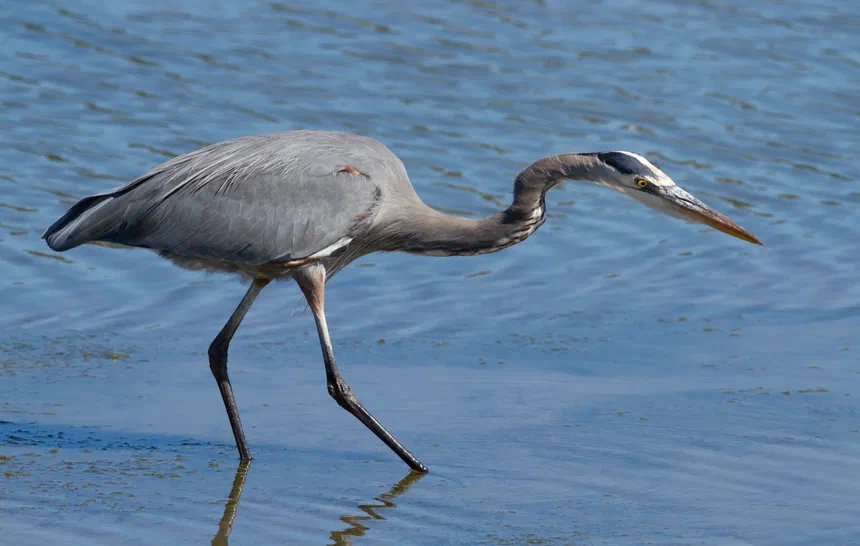
Image: Frank Schulenburg — CC BY-SA 3.0 · source
What Is a Great Blue Heron?
The great blue heron (Ardea herodias) is the largest heron native to North America and one of the most familiar wading birds across the continent. A tall, long-legged hunter of shallow water, it is easily recognized by its stately posture and deliberate, patient movements as it stalks prey.
Appearance and Identification
Standing roughly 3 to 4.5 feet tall, the great blue heron combines a slate blue-gray body with a mostly white face and a black stripe running back from the eye into a slender plume. The neck is long and often folded into an S-shape, the bill is long and dagger-like with a yellowish hue, and the legs are long and thin. In flight the wings appear broad and rounded, spanning up to about 6.5 feet, and the bird flies with its neck tucked and legs trailing behind. A distinctive all-white form, sometimes called the “great white heron,” occurs in southern Florida and the Caribbean. Males and females look alike, though males average slightly larger.
Habitat and Range
Great blue herons are highly adaptable and occur in a wide range of wetland habitats, including freshwater marshes, the edges of lakes and slow rivers, flooded meadows, mangroves, and coastal estuaries and shorelines. They range from southern Canada and Alaska south through the United States and Mexico into Central America, with populations also present in the Caribbean and the Galapagos Islands. Northern breeders migrate south for winter, while birds in milder regions may remain year-round wherever open water keeps their hunting grounds ice-free.
Diet
This heron is a carnivore and an opportunistic predator. Fish make up the bulk of its diet, but it also readily takes amphibians, crustaceans, aquatic insects, reptiles, small mammals such as voles, and occasionally other birds. It hunts mainly by standing motionless or wading slowly in shallow water, then striking with a rapid thrust of its bill to seize or spear prey. Prey is typically swallowed whole, sometimes after being maneuvered head-first.
Behavior
Great blue herons are usually solitary when feeding and can be territorial about prime fishing spots, but they gather in colonies to nest. They are patient, methodical hunters, often standing frozen for long stretches before striking. Largely active by day, they may also feed at dusk. Their calls are harsh, guttural squawks, most often heard when a bird is disturbed and takes flight. Despite their size, they are strong, graceful fliers capable of covering long distances during migration.
Life Cycle and Reproduction
Breeding pairs nest in colonies known as heronries, usually in tall trees near water but sometimes in shrubs, on the ground, or on artificial structures. The male typically gathers sticks that the female works into a large platform nest, which pairs often reuse and enlarge in successive years. The female lays about three to five pale blue eggs, and both parents share incubation over roughly four weeks. The chicks are fed regurgitated food and fledge at around two months of age. In the wild, many great blue herons live six to fifteen years, though survival through the first year is often the greatest challenge.
Conservation Status
The great blue heron is listed as Least Concern by the IUCN, reflecting a large, widespread, and generally stable population. It benefits from its flexibility in habitat and diet. Localized threats include wetland drainage, water pollution, disturbance of nesting colonies, and collisions with power lines, but none currently threaten the species as a whole.
Frequently Asked Questions
Are great blue herons dangerous to people? No. They are wary of humans and prefer to fly off rather than confront anyone, though a cornered bird can jab with its sharp bill.
Do great blue herons only eat fish? Fish are their main food, but they are flexible hunters that also take frogs, snakes, insects, and small mammals when available.
Where do great blue herons build their nests? They nest in colonies called heronries, usually high in trees near water, often reusing the same bulky stick nests year after year.