Birds Guide
Gouldian Finch
What Is a Gouldian Finch? The Gouldian finch (Chloebia gouldiae) is a small, brilliantly colored grassfinch native to the tropical savannas of northern Australia. Often called the rainbow finch or Lady Gouldian finch, it …
At a glance
What Is a Gouldian Finch?
The Gouldian finch (Chloebia gouldiae) is a small, brilliantly colored grassfinch native to the tropical savannas of northern Australia. Often called the rainbow finch or Lady Gouldian finch, it is widely regarded as one of the most vividly patterned songbirds in the world. Despite its fame in aviculture, wild populations have declined markedly over the past century.
Appearance and Identification
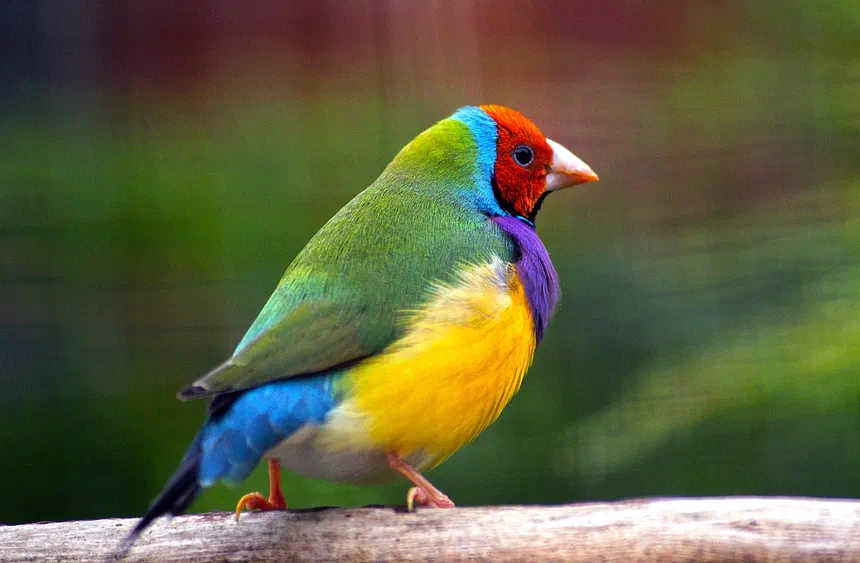
Few birds are as instantly recognizable as the Gouldian finch. Adults display a striking mosaic of colors: a grass-green back, a golden-yellow belly, a purple breast band, and a turquoise-blue collar. The head comes in three natural color forms, or morphs, distinguished by face color: black-headed birds are by far the most common, followed by red-headed birds, and rarely yellow- (orange-) headed individuals. Males tend to be more saturated in color than females, whose plumage is somewhat paler and whose breast band is a lighter mauve. Juveniles are drab by comparison, mostly gray and olive, and develop their adult brilliance after their first molt. Adults measure roughly 5 to 6 inches (13 to 15 cm) in length and weigh only around 12 to 16 grams.
Habitat and Range
The Gouldian finch is endemic to northern Australia, occurring across parts of the Kimberley region of Western Australia, the Top End of the Northern Territory, and pockets of northern Queensland. It favors tropical savanna woodland, particularly open grassy areas dotted with eucalypts and other trees, and it rarely strays far from water. Access to drinking water is important because the bird’s seed-heavy diet is dry. The species is somewhat nomadic, moving seasonally in response to the availability of ripe grass seed and surface water between the wet and dry seasons.
Diet
Gouldian finches are primarily seed eaters, specializing in the ripening and ripe seeds of native grasses such as sorghum and spinifex. They forage both by gleaning seed from standing grass stems and by feeding on fallen seed on the ground. During the breeding season, adults supplement their diet with flying insects, which supply the extra protein needed to raise chicks. Their dependence on a narrow window of seeding grasses makes them sensitive to changes in fire regimes and grazing, which alter the timing and abundance of their food.
Behavior
These are sociable, gregarious birds that gather in flocks, sometimes mixing with other grassfinch species at feeding and drinking sites. Their calls are soft and high-pitched, and the male’s song is a quiet, somewhat scratchy warble delivered during courtship. Gouldian finches are relatively quiet and unobtrusive for such flamboyant birds. They are strong, direct fliers and often travel considerable distances between food and water sources during the dry season.
Life Cycle and Reproduction
Breeding is timed to the early dry season, when grass seed becomes abundant. Unusually among grassfinches, Gouldian finches are hole nesters, typically nesting in tree hollows and spouts, most often in smooth-barked eucalypts. The female lays a clutch of around 4 to 8 white eggs, and both parents share incubation, which lasts roughly two weeks. The chicks hatch with distinctive luminous nodules at the corners of the mouth that help the parents locate their gaping mouths in the dark nest cavity. Young fledge at about three weeks of age and reach their full adult coloration within a year.
Conservation Status
The Gouldian finch is listed as Near Threatened on the IUCN Red List and is protected under Australian law, having suffered a dramatic decline through the twentieth century. Causes include changed fire regimes, cattle grazing that reduces native grass seed, and historically the trapping of wild birds for the pet trade. Conservation efforts focus on managing fire and grazing to maintain a reliable seed supply and protecting the tree hollows the birds need for nesting. Some populations have shown signs of local recovery where habitat is well managed.
Frequently Asked Questions
Why does the Gouldian finch have different colored heads? The species has three natural head-color morphs, black, red, and yellow, that occur within the same populations. Black is the most common, red less so, and yellow is rare.
Are Gouldian finches endangered? They are classified as Near Threatened. Wild numbers fell sharply in the twentieth century, though careful habitat management has helped some populations stabilize.
What do Gouldian finches eat? They feed mainly on the seeds of native grasses and add insects to their diet while breeding to meet the higher protein demands of raising young.